Panama 2010: island and rainstorm adventures

Note: This posts comes from an email I sent during a trip to Venezuela, Colombia, and Panama in June 2010.

Hello everyone, one last time…

This is my last night in South/Central America, and I have mixed feelings about heading home tomorrow evening. I’m gazing out the bay windows at the view of downtown Panama City and loving it, but I am also missing my view of the Capitol.

Our plans got changed a bit in the last couple of days. Although I ended my last email saying that I was about to go to the Canal, that didn’t end up happening… Greg and I both felt a little strange (I thought perhaps it was due to the fact that I’d been wearing several layers of heavy-DEET insect repellent for 20 hours, but Greg is not a mosquito magnet and felt similar), so we decided that instead of going to the Canal, we would choose to be lazy for the rest of the day. I picked up a new book, established myself in a hammock, and remained there until it was time to watch “Spaceballs” in the theater. After that, we ordered a pizza (Panama City is essentially the United States, so there is Dominos here) and spent the rest of the evening making new friends in the hostel. This place really is awesome… I could stay here a long, long time without getting tired of the shared showers and dorm room.

Yesterday we made pancakes and then started out on a journey to a nearby island. However, when we arrived at the docks, we learned that my guidebook (published in 2004…) was more than a little out of date and that boats to the island were in fact over for the morning. Thinking quickly, we ordered the cabbie to take us to the Canal instead, so Greg, Emily (our new friend from Montreal), and I spent the rest of the morning at the set of locks nearest to Panama City. We walked through a four-floor exhibit in the museum and then went to the observation deck to await the arrival of one of the many, many cargo ships we’d seen hanging out near the entrance to the canal. We did get to see a boat go through the locks, but it wasn’t a cargo ship… it was a small passenger boat (that tours the canal) and an even smaller sailboat. It was more than a little anticlimactic, but it was still very cool to see the process. It’s truly an amazing feat of engineering! I took some video and some pictures that you’ll need to check out on Facebook.

We returned to our area of the city for lunch and went to a cafe that provided us with a menu that said “just let us surprise you – you’re on vacation, right?” After choosing our meat course, we sipped our steaming (?) cold beers and awaited the delicious series of dishes that appeared on our table: salad with a very tasty dressing, a vegetable tortilla (quiche to most of you, but for anyone who’s been to Spain, this was tortilla, not quiche), and then typical Panamanian rice with our meat (fish for me). All of this, plus an apple crisp for dessert, cost us $9 – win.

Although I felt like a nap was in order following that meal, we grabbed another cab and went to Panama Viejo, which is the site of the very first Spanish settlement here. There is not much left at all – it is like walking around Roman ruins except that this stuff isn’t more than 500 years old. It was burned down by pirates (really!) and not replaced. We had a fun time climbing up the stairs of the cathedral’s bell tower, and I attempted to revive my French by talking to Emily… I did better than expected but proved that I have indeed lost most of my skill in that language.

Back at the hostel, Greg set about taking out his braids, which were starting to look a bit ragged. Given that our braids have been a major point of conversation for us, this was a pretty big deal, and a small crowd assembled to watch and/or help. It was around this time that we finally got to see why this is called the rainy season in Panama. Yes, it’s been cloudy the whole time we’ve been here (and most of the rest of the trip, too), and yes, we survived some flash flooding in Caracas… but it was POURING here last night for several hours straight. Because we didn’t want to be lame and order pizza TWO nights in a row (plus apparently you can’t order pizza when it’s raining… not that we checked…), we donned our rain jackets and headed out into the wet with three French speakers who all had different budgets and interests for dinner. We eventually settled on a place and enjoyed a meal that proved that I am not allergic to shellfish (unlike my dad and brother) – hooray! I polished off a great plate of shrimp, squid, mussels, and scallops.

This morning we got up early and headed to the smaller of Panama City’s two airports for our trip to Isla Contadora, one of the many islands in the Pearl Islands chain about 50 miles south of Panama City. We flew in a single-propeller plane and sat two seats behind the two pilots, which was definitely a new experience for me. The airstrip on the island runs the entire width of it – this island is about a mile long and maybe half a mile wide, if that. Oh, and did I mention that our boarding passes were plastic cards, not tickets? It reminded me of the bathroom pass I used in my classroom.

Anyway, we hopped off the plane and started walking around without any particular agenda. The island has a bunch of different beaches (separated really only by rocks or a bit of cliff), so you can essentially just pick a direction to walk and find one. We arrived first at Playa Larga (Long Beach), where there was not a soul on the quarter mile of sand. We found an abandoned ferry at the end of the beach and climbed around in that for a bit; it was like excavating a plane crash… I half expected to find a skeleton somewhere! Seats were strewn about, windows broken, walls ripped out…

…and this proved to be the case for many things on the island. What looked like it had once been a beautiful hotel lay in ruins behind us on this same beach, and as we continued exploring, we happened upon a few more abandoned buildings. We found the next one after it started pouring rain. Take a moment and picture this: I am wearing a white skirt with flip flops and carrying a bag that is by no means waterproof, my umbrella is conveniently under my bed up in the dorm, and it is raining like it’s time to build another arc. We spent the next 30 minutes literally standing under a broken piece of roof covering the remains of what might once have been a community center of some sort. I spent the next two hours walking around in my bathing suit with my soaked clothes inside my soaked bag. Apparently I’ve lost my ability to plan ahead for all weather contingencies.

We next encountered what is the only legal nude beach in all of Panama, but as it was still raining, we didn’t take advantage of that. (Plus, really… it’s only a nude beach if there are other people there who are nude. Otherwise, it’s just skinny dipping.) I quickly fell behind Greg, who was wearing athletic sandals that lent themselves to climbing over rocks and up embankments. When I caught up, I was covered in mud, leaves, and various scratches from tall plants that had given me a warm welcome to the island. We eventually found a road again and walked towards nothing in particular until we eventually ended up on the other side of the airstrip. It was still raining at this point, but we managed to find an accommodating hut on a beach in front of one of the island’s cute hotels and sat there until it finally cleared.

My guidebook, though outdated, provided us with a recommendation for a place called Gerald’s Restaurant, which boasted a host of international and local cuisine. A number of things had already happened up to that point that I hadn’t expected; I certainly had not planned on eating bratwurst on a small island, but that’s what I did… the German section was the most impressive part of the menu, so I took advantage and thoroughly enjoyed my taste of my other homeland’s cuisine.

The rain appeared to be over for the time being, so I headed back to the beach in front of the hotel, hung up my clothes to dry, and lay down on the sand. This beach was deserted, too… there are only 300 inhabitants of this island, and given the weather, what few tourists there were did not choose to come outside today. I think this is too bad for them, because I might have found my new favorite beach in the WORLD today. I have three components for the perfect beach, and so far, only one (La Pared in Puerto Rico) has had all three: clear water, sand, and waves. Isla Contadora has clear water and sand, but the waves are very small… I don’t know whether to count them as such or not. However, I am willing to award some bonus points for the fact that the beach was deserted and clean… that was not the case in Puerto Rico. The water was also a perfect temperature, and I stayed in for quite a while… long enough, in fact, to get a little sunburned (because in my infinite wisdom I had decided it was too cloudy for me to be at any risk of overexposure to the sun).

Eventually it was time for us to head back to Panama City, so we checked in, received our plastic boarding passes, and once again climbed aboard the tiny plane. This time we sat directly behind the pilots, which was both cool (up close view) and scary (the co-pilot at one point clutched the wall in fright when the plane dropped a bit – not reassuring). I kept my gaze mostly out the window, looking for whales – Greg saw some earlier from a different part of the island. I found none but did manage to take out all of my braids as well, so once again I blend in with the masses.

Tomorrow is our last day; my plan is to find a post office and generally enjoy the day by sleeping in, eating one last good meal, and relaxing. I’ll be home around midnight tomorrow and may just start uploading photos the moment I get home – at this point, I think I have about 400.

I hope you’ve all enjoyed these posts and feel that you’ve traveled vicariously through me. It’s been an awesome experience. To sum up: I would like to return to all three countries – Venezuela, to see what the rest of the country is like (particularly its beaches, which are supposed to be amazing) and eat more arepas; Colombia, to visit Bogota, Medellin, Cali, and pretty much everywhere else; and Panama, to try to see Isla Contadora in the sunshine… it was pretty today but would be 100 times prettier in the sun.
Colombia/Panama 2010: the longest bus ride ever, 12 hours in Bogotá, and the world’s best hostel

Note: This post comes from an email I sent during a trip to Venezuela, Colombia, and Panama in June 2010.

Greetings from Panama City, gateway between the oceans!

Although I haven’t written for a few days, there is not a ton to report. Let’s start with the bus ride from Cartagena to Bogota, otherwise known as a day I will never get back…

I spent my last day in Cartagena lazing around the hostel with some shopping thrown in. I worked my way through about 70 pages of the Spanish version of the new Eclipse novela by Stephenie Myer while in the rooftop hammock and eventually descended to brave the souvenir shops, where I bought some jewelry and a dress. It was a cloudy, rainy day, so there just wasn’t much else to do. Greg and I ended our time in Cartagena by visiting a grocery store, where some Colombians helpfully advised me in which type of aguardiente, strong Colombian liquor, to buy before our long bus ride. I also coached Greg on how to ask Olga, the beautiful and friendly proprietess of the hostel, to be his best friend forever in Spanish… something I picked up from reading the novela. (It’s literally “do you want to be my intimate friend for eternity?”) Unfortunately, Olga had already gone home by the time we returned, so Greg will now save this for another lady.

Our bus ride to Bogota was supposed to last about 16 hours. A British girl we met said she had heard 20 hours. Let’s just say, we were all wrong. We boarded a bus in Cartagena that was having air conditioning issues, and the Colombians were so indignant about this that most of them stormed off the bus before it left Cartagena. We were told it would be fixed in Barranquilla, which is great, except that Barranquilla is two hours NORTHEAST of Cartagena when we were supposed to be heading SOUTHWEST. However, always the flexible travelers, we shrugged our shoulders and settled back to enjoy the trip as best as we could. It really wasn’t uncomfortable on the bus when there were just seven of us. We passed plenty of small towns where chickens, goats, cows, and donkeys were plentiful and arrived two hours later in Barranquilla, a place you might recognize from a line in Shakira’s “Hips Don’t Lie”. (En Barranquilla se baila asi!) We were pleasantly surprised to see that the air conditioning issue was resolved within 15 minutes, but this turned out to be for the worse. The bus was FREEZING for the rest of the night… even in my ankle-length dress with a sweater, jacket, and shawl around me, I was wholly unable to get warm and spent the night alternating positions every few minutes in an effort to minimize my discomfort.

The bus ride featured a number of movies that I can safely say I will die happy without ever seeing again. They included “Highway Assassin 2”, “Boat Cruise”, “Wrong Turn 3”, and a random series of music videos that were really more like raunchy short films. When these were not on, we would get spurts of salsa music that unfortunately did not inspire the same spirit as the rumba chiva. Meanwhile, we just drove, and drove, and drove… eventually winding through the mountains, where I was grateful (despite my tendency towards motion sickness on winding roads) not to be sitting in the front of the bus, because our driver’s favorite game was to pass the cars, buses, and trucks in front of us. On winding roads. I took a few pictures of situations in which we could have run into an oncoming truck and also have a picture of the sign that indicates that passing is not allowed.

Every once in a while we would stop to let someone get on the bus to sell food or drink… I could have bought a ham and cheese pastry with a cup of coffee for about 75 cents US, but when you’ve just been sitting forever, you don’t have much appetite.

We hit some traffic when we got close to Bogota, and so despite being on the outskirts of the city, it took another two hours for us to fnally get to the bus station… at 6:30 pm, also known as 23 hours after we left Cartagena. Conclusion: I am never, ever taking a bus like that again.

I was quite disappointed not to be able to see Bogota in the daylight. Our hostel was in the old part of the city, and I managed to see the Plaza Bolivar (they exist everywhere, including here in Panama City) but not much else. I had opted not to bring my camera with me during our venture to find dinner, which I regret now because Bogota has lots of very interesting graffitti (it reminded me a lot of Zagreb). My favorite said, in Spanish, “we don’t want to be an American colony”. I definitely want to return to Colombia and see not only Bogota but Medellin, Cali, and other places that are supposed to be very interesting and fun.

We got up at 3:30 yesterday morning for our 6:30 flight to Panama, and it was at the airport that I finally had some Colombian coffee. I don’t have a great palate for things like coffee, beer, and wine, but it did taste pretty damn good to me… or was that just because I was in a semi-zombie-like state after extended sleep deprivation? I managed to fall asleep on the plane in spite of the coffee but was wide awake during our drive from the airport. Our cab driver was extremely well traveled and had a number of things in common with me… has family in Indiana and Colorado, likes Croatian people, etc. He had all sorts of things to say about how great the United States is and what the Panamanians are like.

Our hostel here is perhaps the most genuine hostel experience I’ve ever had. It’s called Luna’s Castle and overlooks the bay near the fish market. There is no air conditioning, but floor to ceiling bay windows stay open, and ceiling fans keep the air moving enough to keep things pretty comfortable. I was able to go to bed last night with a view of downtown from my pillow… awesome. There’s also a ping pong table, do it yourself pancakes for breakfast, a movie theater (we watched “the Big Lebowski” last night), and a bar that offers $1 cocktails from 9-10 pm. People are staying here from all over, including Britain, Germany, New Zealand, and Israel. Some of them have been traveling for months (living my dream). I had a fun time last night talking to a Londoner and a New Zealander who didn’t know the difference between Washington state and Washington, D.C., nor did they know where either of them are.

The hostel is in an old part of the city, where we walked around yesterday before hiking through a park that boasted a multitud of species of birds, monkeys, and other animals, none of whom we saw… but we did observe some amazing colonies of ants, and at the summit we got some pretty awesome shots of the city and the canal. It was absolutely worth the sweaty and somewhat perilous hiking up and down… I nearly faceplanted four times but emerged unscathed.

We are heading to the canal in a few minutes… should be pretty interesting!

Colombia 2010: Rumba Chivas and Mud Volcanoes

Note: This post comes from an email I sent during a trip to Venezuela, Colombia, and Panama in June 2010.

I have had an epic 24 hours in Cartagena. Last night Greg and I arrived in our lovely hotel’s lobby at 8:00 to await the arrival of our tour bus for an evening tour of Cartegenian nightlife, or something to that effect – we weren’t sure what to expect.

You are probably familiar with the concept of a “party bus” in the United States… people rent a bus with tinted windows and get to drink on it while driving around. I haven’t been on one, but let me tell you: they are LAME compared to what they have here in Cartagena.

The bus, or chiva, that arrived to pick us up was open air – there was a roof, but nothing on the sides. Each of the eight or so rows on the chiva holds about six people, and one of the rows holds a band. Yes, a band! When the chiva pulled up to our hotel, already about 75% loaded, the band of a clarinetist and two drummers was in full force, pounding out rumba rhythms to match the enthusiasm of those on board. We climbed up next to a young Colombian couple and were later joined by an older couple from Brazil (with whom I managed to converse in Spanish). The 30 additional minutes of driving around to pick up people were a blast in and of themselves; at every stop, the seemingly omnipresent street vendors hopped aboard in order to try to sell people hats, maraccas, beer, or water. We passed many other chivas, and each time this happened, we of course made an effort to make sure ours was the loudest. I have video footage of this.

Things got signficantly more interesting when we suddenly received a bucket of ice, a bottle of Pepsi, and a bottle of rum – for the six of us in our row. We quickly poured ourselves a cocktail, which we quickly consumed while we continued to drive around the city. After everyone had partaken of sufficient social lubricant, the tour guide commenced with the real entertainment: get up and dance the rumba while drinking and while the bus is moving! The girls began first, and each row would stand up in succession and shake it like a saltshaker for 10 seconds before yielding to the row behind. (I did my best, but it’s hard to compete with Colombian women.) The guys went next, and being less able to shake the tops of their bodies, they imitated the tour guide: stand up on your seat, bend over, and shake your ass around! I caught some of this on tape as well… “hilarious” doesn’t begin to cover it. After this, the guide asked for volunteers to participate in a contest… and my new Colombian friends to my left quickly volunteered me for this. Three of us stood up and danced for all we were worth, to thunderous applause all around. It was unclear who ultimately won, but the point is that I tried. 🙂

We ultimately arrived at one part of the old city, where we had 45 minutes to hang out up on the wall with a bunch of other partiers. It reminded me a great deal of the great tradition of botellón in Spain, where everyone brings a bottle of liquor and drinks in the plaza all night. Greg left to make friends with some Europeans on our bus, while I stayed with the Colombian couple and talked to them over a beer (which is, by the way, great here and in Venezuela). We discussed a variety of things, and they praised me on my Spanish – hooray! While we were talking, one of the ever-enterprising Colombians came over holding none other than a three toed sloth and transferred the cute creature into the arms of José and Diana, who then passed it to me. You never know what the night will hold.

Back on the chiva, we got to eat a great drinking snack: arepas con huevo. Arepas exist in Colombia as well, but they typically just have egg in them. It was delicious and necessary given that we received ANOTHER bottle of rum (granted, these are about the size of a soda bottle from a vending machine) and proceeded to get rid of that as well. A short time later, we arrived at another entrance to the city for our final destination, a salsa club. Once inside, we watched as the talented Colombians shook their groove things to the peppy music of the Caribbean, and José and Diana demonstrated a bit for us. A short time later, Diana passed José to me (dance with a hot Colombian man? check), and I had a great time twirling and shaking with the best of them… perhaps my salsa lessons from Spain resurfaced to help me. Greg danced with an old lady who was still plenty able to dance, and we all had a great time.

Finally, around midnight, it was time to get back on the chiva for the ride back to our side of town. The band was gone, but the spirit remained. I continued chatting it up with Diana and José, who felt very strongly that we should stay longer in Cartagena and avoid going to Bogotá altogether. Unfortunately, we have to fly out of Bogotá on Tuesday, so we have to go there eventually, but we came back so convinced of Cartagena’s greatness (not that there were any doubts before) that we actually contemplated trying to switch our flights. Instead, we settled for skipping Medellín and staying here an extra day so that we go straight from Cartagena to Bogotá (a 16-hour ride reminiscent of our Model UN trips to Montreal).

After getting those changes taken care of, our principal activity today was to visit a nearby mud volcano that José had described as “delicious”. After a nap in a hammock underneath the rooftop gazebo during a noontime thunderstorm, we boarded a van with four other people and headed along the coast an hour to the site of the volcano. What a change between Cartagena and the surrounding rural areas: we quickly went from expensive highrises to roadside huts and people riding donkeys (seriously). We were also stopped by a few members of the military, who chose only to check the credentials of our driver rather than make us get out and submit to a frisking (which the men on the other side of the road experienced). Never a dull moment.

The volcano is quite small, but that’s definitely what it is. A volcano-shaped (?) mound rising about 25 yards above the ground, its sides are covered with dried mud, and two steep staircases (also constructed from mud) run up its sides. We were just in time to see people coming down from the top, completely covered in black mud. Once we got to the top (after some clinging to the guardrail on my part due to the slipperyness of the mud), we saw that the mud pool was large enough to hold maybe 10 people comfortably. Greg was the first from our group to lower himself into the mud; I followed soon after and was immediately flipped onto my back and covered in mud by a helpful native who then proceeded to give me a full-body massage… delicious, indeed! Everything other than my mouth and eyes was covered in mud. After the massage, we had a good time just hanging out in the mud. It was roughly like being in a pool of thick, melted chocolate… it was impossible to sink lower than my shoulders, and moving was quite difficult. As Greg put it: “this is where standing and floating meet.” I was literally suspended in mud, not moving up or down at all. You could stay there all day!

After about 20 minutes of mud bathing, we exited and made our way down to the river, where more helpful natives each took charge of one of us and led us into the water. They did quite a thorough job of cleaning us off, including removing our bathing suits and getting all of the mud out of them. We emerged 10 minutes later relatively mud-free and boasting newly glowing skin.

All in all, the last 24 hours are the best of the trip thus far. Tomorrow will include beach time and shopping (there’s quite a lot to buy in Cartagena) before we head to Bogotá overnight. We’ll be in Bogotá on Monday before leaving for Panamá early Tuesday morning.

I’ll write again from Bogotá!

Venezuela/Colombia 2010: from Caracas to Cartagena

Note: This posts comes from an email I sent during a trip to Venezuela, Colombia, and Panama in June 2010.

Hello from Cartagena!

Our last day in Venezuela passed extremely uneventfully since we left our hotel only to go to the airport. Greg and I joined other Venezuelans in the lobby of our hotel to watch the Italy-Slovakia game, and the Italian-at-heart part of me felt very sad as I saw them miss some shots and ultimately drop out of the running.

As I predicted on the way to the airport, Venezuela is a difficult country to leave. In addition to an exit tax (which somehow we didn’t have to pay?), there is an airport services tax which you can only pay in cash. Given that we had just given our last remaining bolivares to our cab driver, that was a bit of a problem. After searching in vain for an ATM and rejecting numerous whispered offers of “¿cambio?”, we gave in and experienced another round of horrible exchange rate currency switching. If nothing else, this provided us the opportunity to eat one last arepa, though none of the four I ate were as good as the first.

Final thoughts on Venezuela: I would love to go back one day when the country has calmed down a bit and see the rest of it. There are beautiful beaches and plenty of things to see outside of Caracas, and the people can’t be beat – they were incredibly friendly and accomodating of my sometimes struggling Spanish skills. I am excited to have made it through without having been robbed at gunpoint (something I was legitimately concerned about thanks to both the State Department and various connections there), but on the whole I found it much less scary than I had anticipated, and I am extremely glad that we went. My favorite part other than the political discussions with the cabbies was ascending the mountain to view the city; be sure to look for those (and plenty of pictures of political propaganda) on Facebook when I get home.

We arrived in Cartagena last night around 10 and quickly made it to our hotel. Our helpful cab driver gave us lots of tips for exploring the city and assured us that we’d be safe walking around at any time. (Everyone to whom we’ve mentioned that we were just in Venezuela has reacted with faces or words that indicate that we are clearly very brave people.) Our hotel is AMAZING. While technically a hostel, it’s really quite nice and located in a great part of the city. It’s in a building that is pure hacienda design; its three floors form a rectangle around an open courtyard, and there is a roof complete with three mini jacuzzis and three hammocks hanging under a gazebo. I enjoyed some time in those this afternoon!

This morning we started with a trip to the beach, located a mere two blocks away. The water looks about the same as it does anywhere on the east coast – that is to say, it wasn’t crystal clear, but it wasn’t disgusting either. It was warm, though – like bathwater! Greg and I had barely had time to learn this before we were pounced on by various zealous Colombians offering a variety of goods and services, from necklaces, bracelets, t-shirts, beer, fresh fruit, snow cones, sand shovels, flip flops, massages, and hair braiding. We took advantage of the last two… while two women set to work on my hair (and Greg’s, which is long), a third massaged my feet, legs, and arms while consistently telling me “you are so tense!” Two hours later, Greg and I sported more than 30 tiny, beaded braids a piece and found ourselves to be victims of majorly overpriced services… I won’t say how much we spent, but suffice it to say, Greg is taking control of our money and haggling hard from now on. (I always tend to think that they need the money and thus will cough it up, but the braids were ridiculous even with that.)

Given that we’d been in the  sun for two hours and that Cartagena is both very warm and extraordinarily humid (Virginia loses that contest in a heartbeat), we trekked back to our hotel and changed into more tourist clothes (shorts) before walking the two miles or so to the old town. Like Old San Juan, it is surrounded by a large wall, and we walked on top of the wall (at times only two feet wide) for most of the way around the city. I also insisted on some time sitting in the main plaza (another Plaza Bolívar; he’s big here, too) and complaining about how we don’t have those in the US. (Really, why don’t we?)

After some brief shopping (during which I only bought postcards), we started heading back towards our hotel, where I promptly collapsed in a hammock and got back to reading Gabriel García Marquez. We are leaving shortly to go on a nightlife tour of the city that will presumably include some sampling of Colombia’s own liquor… which apparently Americans don’t like, but which I don’t think can be any worse than the “rocket fuel” I consumed in China.

Tomorrow we are hoping to bathe in the mud of a nearby volcano before boarding a 13-hour bus to Medellín (yes, as in the cartel), where we will spend a few hours before heading to Bogotá. I will be extremely sad to leave Cartagena (I truly would love to live here), but I am excited to see more of Colombia as well. So far, I am impressed!

Venezuela 2010: Talking Chavez with Cabbies

Note: This posts comes from an email I sent during a trip to Venezuela, Colombia, and Panama in June 2010.

I had an epic day in Caracas and have to send another update before the details leave my memory…

This afternoon Greg and I took a total of three cab rides. I guess I’ve never been outgoing or linguistically confident enough to really try to do this before, but given the fascinating political situation of Venezuela, I made an effort today to talk to all three cabbies about Hugo Chavez. I led in to each conversation by starting with small talk about the World Cup – did you see the US game this morning? Who are you supporting? Who do you think is going to win? (Different answers from all three – Portugal, Brazil, and Germany.) From there, they would inevitably ask where I was from or something else that allowed me to lead into the delicate political conversation. (Win: the second cabbie assumed I was Brazilian.)

The first cab driver was fairly opposed to Chavez. He talked about how he was university educated but had to drive the cab to put food on the table for his wife and two daughters. He acknowledged that Chavez has done some things that other presidents have ignored, and that they are for the better, but for the most part he thinks Chavez is leading Venezuela down an unhelpful and dangerous path.

The second driver loves Chavez, and I have to admit, I left his cab (after a 45-minute conversation about this) feeling more than a little socialist myself. He brought up some really good points: “at the end of the day, we are all human beings, and money and other personal possessions are not going to be enough to make us happy. Everyone needs love, and everyone knows how to love. Chavez is trying to make sure that we all have what we need to survive – right now there are people here who don’t eat. He’s making sure that everyone can eat. It doesn’t matter what else you can or cannot have; everyone in this country needs to have the basic necessities of life.” He also told me a lot about Venezuelan culture. “Race is just a construction of physical location. In Venezuela, it doesn’t matter what color your skin is or where you’re originally from. Everyone is Venezuelan. There is no racism here. You will find no one who judges you for being who you are.” I asked this cabbie what he thinks of Obama: “He’s a clown.” He asked what I thought of him, and I said, “well, there’s a lot about American politics that I don’t like. No one is perfect. But I teach Black students, and the hope that his presidency has brought to them is incredible.” The cabbie then asked, “okay, but what has Obama done for the people like him?” And, other than the healthcare bill (which, to be fair, is a big deal), I couldn’t come up with too much else concrete. But maybe that’s expecting too much of a huge government. Obama’s got lots of great ideas that are getting lost in translation.

The third cab driver took a little while longer to warm up to me, but once I finally figured out the way to lead into the political conversation, he had plenty to say. He told me that a lot of people in Venezuela are rooting for Spain in the World Cup, and I told him that I thought that was a little surprising given how many signs there are that say “Independencia y Revolución” everywhere. He chuckled and said “I think that’s government misinformation…” I then asked point-blank what he thinks of Chavez, and he said, “he’s one of the worst things to happen to our country. His system doesn’t work economically. He’s limiting freedom of speech in the press. The poor are still poor, and professionals like me have had to take to driving cabs because there aren’t other jobs for educated people like us. There’s corruption everywhere, and money laundering. We’re gradually turning into a communist state like Cuba.” When I asked what he thought of Obama, he said “I wish he was our president.” The cabbie expressed his hope that Chavez’s party will lose the parliamentary elections in September; I asked if he thought the elections were legitimate, and he said, “Chavez supporters control everything.”

I wish I could have recorded all of these conversations – they were absolutely incredible. I’m going to talk politics with every single cab driver from now on! It’s also a great way to practice my Spanish (I’m so glad that I can understand 90% of what they say!) and to leave a positive impression of Americans here. Not that they have negative impressions of Americans, because I asked about that too. There are not a lot of Americans here, but as the second cabbie explained, it’s not about where you’re from. Once you’re here, you’re Venezuelan. And it’s true: I have found the people here to be incredibly friendly and helpful. This morning I made a Venezuelan friend: she is a six-year-old named Denali who was with her parents and older brother in the cable car that we took to the top of the mountain to look over Caracas (amazing). She started out on the side of the car with her family but for some reason came over to sit next to me and quickly threw her arms around me when she declared, “¡tengo miedo!” (I’m scared!) I got an adorable picture of her with me, and her parents were very nice as well and talked to us about our trip.

Anyway, I am excited to go to Colombia tomorrow, but I will be sad to leave Venezuela as well. it’s been a very interesting experience, and quite different from what I imagined. While everyone here has still advised us to be careful as we move about the city, I have yet to see what the fuss is about. We’ve walked through a variety of different areas, and I haven’t felt insecure at all – a pleasant surprise after all the State Department warnings. Fortunately, we depart for another country where the World Cup is a big deal – today we got stuck in a mall (it was actually recommended to me by multiple people, so don’t judge) while it poured rain and flooded (literally) the streets, but we joined the other caraqueños in the designated World Cup area where no fewer than 10 televisions to accomodate every vantage point were showing the Germany/Ghana game. Amazing!

Venezuela 2010: Days 1 and 2

Note: This is the first in a series of posts I will put up for a trip to Venezuela, Colombia, and Panama that I took last summer. These posts come from emails sent during the trip.

Good morning from Caracas, where the time is curiously half an hour behind east coast time!
 
Greg and I arrived Monday afternoon after a pretty smooth trip, other than when we first got to Dulles and Copa told him they had somehow cancelled his reservation! The woman checking me in hilariously handed Greg a phone and said “hopefully someone will pick up and help you.” (Truly in the nicest way possible…) At that point, we had about half an hour before the flight started boarding. They finally sorted it out literally at the last minute, and we raced through security and straight onto the flight to Pamana City.
 
I have to take this opportunity to say that I love foreign airlines. Reasons:
1. They don’t charge for checked bags.
2. They serve meals or real snacks on all flights.
3. The male flight attendants are usually young and attractive.
4. I am not necessarily assumed to be American. (None of the flight attendants Monday thought I was. Win.)
 
We arrived in Panama City and had time to find an ATM (to withdraw US dollars) and buy some water before getting on our flight to Venezuela. I think it is safe to say that there were no other Americans in that airport, and definitely not any on our flight to Caracas. I finally managed to fall asleep for a while on that flight and woke up just in time to fill out customs forms.
 
As we prepared to disembark, I reminded myself to be vigilant in the airport, having read the State Department’s scary description of activities there. We found it surprisingly unintimidating. After getting through customs, we exited into the large arrival area and looked in vain for the friend of a Model UN colleague of mine, so we changed some dollars for bolivares (at an unsurprisingly horrendous exchange rate) and hopped into one of the official airport cabs (very important).
 
The 25-minute drive from the airport was interesting but uneventful. We drove past quite a few members of the military standing on the side of the road holding large rifles in an ironically non-threatening way. Every few hundred yards we passed a mural in honor of Simón Bolívar or socialism; someone here has clearly taken the money and time to paint the national pride everywhere. Even boulders on the side of the road were painted to be Venezuelan flags.
 
Caracas is situated in a valley surrounded by small, Ireland-green mountains. The foothills around the city host the most extensive shantytowns I’ve ever seen: it’s unclear how any of the structures are standing or supported, but they look like hundreds of brightly colored boxes stacked on top of one another on the hillside. From a distance, the array of colors makes them beautiful; up close, they are evidence of the overwhelming poverty gripping the country and helping Chávez to appeal to the masses.
 
We arrived at our hotel and discovered that I had chosen quite a nice one in interest of safety. It has a beautiful pool (which we visited yesterday) and a whole host of restaurants and other services. The major point of interest in our room is the Magic Bidet built into the toilet. Greg and I decided this was worth experimenting with and discovered that the bidet spout will launch projectiles of water across the room… so we’re staying away.
 
Per the recommendation of another Venezuelan friend of mine, we hopped into a cab Monday night and went in search of a steak restaurant in a swankier area of the city near our hotel. After some uncertainty on the part of our driver, we arrived at Restaurante Alto only to find that we were too early to eat dinner. Because the skies threatened rain and we were hungry, we set off by foot in search of something else. We ultimately ended up at a cafe (perhaps the Caracas equivalent of Au Bon Pain?) that was surprisingly crowded with young caraqueños – I would have expected a place that didn’t serve alcohol to be less crowded. I got a squid and shrimp wrap that was delicious, and we sat outside under an awning while rain poured down.
 
Apparently, rain causes some problems in Caracas. We needed to find a cab to get back to our hotel and decided that the best way to do that would be to walk to the nearest hotel and get one there. The kind doorman explained that there wouldn’t be anymore taxis until the rain stopped – the rain is too disruptive to the already bad traffic. We decided to wait in the open air lobby of the hotel and listen to the symphony of insects chirping outside.
 
Eventually, we got a taxi and made it back to our hotel, where I managed to watch about 20 minutes of “Toy Story 2” in Spanish before succombing to sleep (five hours total over the past 48 hours meant I was lame and going to bed at 9:00).

Yesterday we got up and saw that it was still pretty cloudy, so we decided to save our trip to the top of the mountain for today (it’s sunnier!) and head into the city to see some of the museums and other historic sites. We started in the Plaza Bolívar and encountered some sort of ceremony or rally that was going on – I had a fairly hard time understanding what the speakers were saying but caught references to socialism and revolution, which appear to be the buzzwords here. From the plaza we took a lap around a few blocks and eventually stopped for some breakfast. We joined the older Venezuelan men in a cafe who were watching the World Cup while sipping their cafe and munching on their cheese pastries. I loved my cafe con leche – it was a very small plastic cup with just the right amount of caffeine for my fairly caffeine-intolerant system. 🙂
 
From there we walked past numerous zapaterías (shoe stores – I was in heaven) as we walked north to see the Panteón Nacional, which is where Simón Bolívar is buried. We decided to sit and watch a military exercise of some sort rather than go inside. Tomorrow is the anniversary of Bolívar’s defeat of the Spanish army, so it’s a pretty big deal. We listened to the singing of the national anthem and watched as the troops practiced folding a huge Venezuelan flag (it took a while).
 
After that we walked back toward the plaza in search of the Museo Histórico del Poder Popular (Historic Museum of the Power of the People), which was founded by Chávez as a means of celebrating socialism and hating the United States. We asked a bunch of different people, who indicated that the museum existed but were unable to tell us how to get there. We gave up after half an hour… but at least I spoke a lot of Spanish. Speaking of which, no one here speaks English. I LOVE it. I’ve discovered that being a Spanish teacher did in fact make me a better Spanish speaker… all of that time teaching my Spanish 2 students how to give directions has come in handy for me here! Some people are easier to understand than others, but I’ve fortunately always to make myself understood very easily. It’s great fun!
 
We walked east on a major street and stopped to go through an outdoor book market, where we saw everything from Twilight in Spanish to multiple copies of the Lesbian Kama Sutra… who knew? We also happened upon an area where old men were sitting and playing chess, so we sat down and played a game ourselves. Greg defeated me (not surprising).
 
After that we continued walking and found a place to sample the token Venezuelan food, arepas. These are like stuffed corn pancakes, and they NEED to exist in the United States. I  got one stuffed with some sort of meat that was absolutely delicious. We watched more of the World Cup (France vs. South Africa) and then headed east in search of the Museo de Arte Contemporáneo. It took some more asking around, but we found it eventually and got to see a ton of Picasso sketches. We also left notes on a wall that was covered with notes of various sorts from Venezuelans. (There was no explanation of the wall, so we just left messages of our enjoyment of Caracas.)
 
We decided after that to head back to the hotel for some pool time – we’d walked quite a bit, and there really isn’t a ton of stuff to see in Caracas. I got through half a book while standing in the cool pool water and enjoying the sun, which had finally broken through the clouds.
 
Later in the evening, we watched some of “the Mummy Returns” in Spanish before hopping in a cab to go to a restaurant nearby that was recommended by my Lonely Planet book. Mokambo proved to have DELICIOUS food – I got a mixed seafood grill that included squid, octopus, shrimp, and chorizo.
 
This morning, now that the sun is shining, we are preparing to head off to take a cable car to the top of one of the mountains to check out the view of Caracas and that national park up there. After that, the plan is to go shopping. I simply can’t pass all of those shoe stores without buying at least one pair! I also need to drink a small beer – in Venezuela, they make all beers in smaller bottles because they want to make sure you can consume all of it while it’s still cold. This is good news for me because I’m a pretty slow beer drinker.
 
Tomorrow we leave for Cartagena in the afternoon. I’m very excited to get to Colombia and will write again from there!

Brazil: Final Thoughts (for this trip!)

Now that I’ve been back in the States for over 24 hours, the time has come for me to attempt to write a summary post of my trip to Rio. This task wouldn’t be easy for any trip; I love travel more than just about anything, and though some trips have been definitively better than others, all have been great learning experiences and full of fun stories to share. I find the task of summarizing Rio more than usually daunting. I have never felt so immediately and completely at home abroad as I did in Rio; it’s as if I were a carioca in a previous life.

I’m going to attempt to share lessons and general observations here, but there is so much to process, and I find myself so ill-equipped to put any of the Rio experience into words that it may not be possible to do this coherently, so I’m going to stick with bullet points; please forgive the fragmented nature of this post!

First, let’s go through the eight items on my pre-trip checklist:

  1. Devote an afternoon to eating feijoada: CHECK!
  2. Learn how to make the perfect caipirinha: CHECK! (two limes and two heaping spoonfuls of sugar crushed together with cachaça on top)
  3. Dance samba well with a hot Rio native: CHECK!
  4. Have a religious experience with Cristo: CHECK! (see below)
  5. Find out if Engov really prevents hangovers: partial CHECK
  6. Add a new bizarre food to my list: nope… didn’t encounter anything terribly crazy
  7. Speak as much Portuguese as possible: CHECK!!!
  8. Tour a favela: CHECK!!!
  • Portuguese: Many people were curious/anxious about the implications of my limited knowledge of Portuguese. Although I didn’t find too many people who spoke English, in general I was pretty able to communicate – it’s always easier to understand than to speak, and I had just enough of the basics to be able to say what I needed to (albeit in pretty broken Portuguese). When in doubt, we supplemented with Spanish. (This led us to some lessons about which words are NOT the same in the two languages.) I started to get a better grasp of the pronunciation (which is definitely the hardest thing for anyone who speaks Spanish, as there are some significant differences), and by the end of the trip the language sounded much less foreign to me – listening to the radio in the taxis seemed more natural, like listening to Spanish.
  • Cristo: So, I was raised Catholic and chose to be confirmed, but I haven’t been to mass since Easter of last year. I’ve become more than a little jaded with the insincerity and the politics of the Catholic Church, plus I find that mass just doesn’t allow me to practice my faith in a way that’s meaningful to me. That being said, I still have plenty of faith, and that’s probably why I loved Cristo so much. The statue was just so symbolic of my beliefs and experiences (and probably those of many people). My faith isn’t hugely Jesus-centric, but that didn’t matter. The physical presence of a higher power, even as a representation, was quite powerful. I loved knowing that no matter where we were in the city, we’d be able to see Cristo (from the right angle/without buildings blocking the view) and that He was there looking down on all of us. Even when we couldn’t see Him, we knew he was there. When we got through our unexpected favela adventure on Friday, I was convinced that it was because Cristo was taking care of us from up there on Corcovado! The Washington Monument just doesn’t do it for me.
  • I’ve never met people so friendly. Despite the language barrier (and there really were not many people who spoke English), everyone we met was more than willing to help us – even just looking confused at the bus stop prompted multiple people to try to explain to us what we needed to do! Ironically, the least friendly people we met were the front desk employees at the hostels.
  • I’ve also never met people so attractive. I said at the beginning of the trip that I thought Spain had the most attractive men, Venezuela had the most attractive women, and Italy had the most attractive general population. I think Brazil wins in all three of those categories, and part of what makes it so great is the diversity of the population. There’s been such a mingling of European, native, and African groups over the last century that there just isn’t a standard Brazilian look, and so many of the people in Rio were so tan that it was hard to tell where to draw the line between race and sun exposure!
  • Ipanema wins as my new favorite beach in the world. As I mentioned, my previous criteria for the best beach were a) clear water, b) sand, and c) waves. Although Ipanema lacks the clear water, it fulfills the other two and wins major bonus points for the eye candy provided by its beachgoers… plus none of the other beaches served coconuts.
  • I love the simplicity of Brazilian food. I told Stacey on the way back that I would like to try to maintain the simple diet we had in Brazil; something about the small set of staples and the simple yet robust flavors really appeals to me. We really just had the same food over and over: bread, cheese, ham, beef, açaí, beer, and caipirinhas. I did miss my vegetables (the first thing I ate when I got home was a bag of mixed frozen veggies), but other than that, I enjoyed our routine of grabbing some açaí and a sandwich roll in the late morning and then getting similar fare for dinner (once we realized the restaurants were expensive). I found myself thinking about all the extra things we put into food here and how unnecessary many of them are – like, why do I put sour cream and guacamole on my Chipotle burritos when the meat itself is so flavorful? Keeping things simple allows you to savor and appreciate each flavor; feijoada is probably the best example of that.
  • The Brazilians are just so relaxed. This comes through in a lot of ways; I think it’s particularly clear when you consider what people wear to the beach. You have to be relaxed (at least relative to American standards) to wear thongs on the beach like it’s not a big deal! And even in favela Rocinha, where the residents have more to worry about than they have food to eat, we seemed to pass only happy people going about their business who still had the friendly spirit to greet us with “bom dia!” as we passed. We in the United States seem stressed about everything; the chill attitudes of those in Brazil and many other countries I’ve visited never cease to amaze me and make me wish that our culture could relax a bit.  
  • I think part of the reason for my stronger connection to Brazil might be because of its location on this side of the world. What I mean is that when I think about other countries I love, like Italy, they always seem more distant because life there happens six hours ahead of life here. Rio’s only an hour ahead; there’s something about the fact that I can look outside at the moon right now and know that people in Rio are seeing the same thing at the same time that just makes me feel closer to things there.

There just isn’t any place like it. I started reading one of my books about Rio (Rio de Janeiro: A City on Fire by Ruy Castro) on the flight back and highlighted a few passages in the introduction that seem to provide the words I can’t find on my own:

“A riotous display of hills and mountain ranges, beaches, inlets, islands, dunes, sandbanks, mangrove swamps, lagoons and forests, all this under an endless blue sky…. the Marvelous City; the land of Carnaval; and always, even if on the quiet, a kind of sexual Mecca…. Coming in to Rio is so spectacular that throughout the centuries, for anyone arriving by plane or ship, it has set off… alterations in perception…”

And finally, I feel like no one says it better than James Taylor. I listened to “Only a Dream in Rio” over 20 times during the course of our 8 days there, and I think this YouTube picture montage coupled with the song expresses more than I ever could: http://www.youtube.com/watch?v=TGpS6yyNKK0&feature=related

I’ll tell you

There’s more than a dream in Rio

I was there on the very day

And my heart came back alive

There was more

More than the singing voices

More than the upturned faces

And more than the shining eyes…

But it’s more than the shining eye

More than the steaming green

More than the hidden hills

More than the concrete Christ

More than a distant land

Over a shining sea

More like a hungry child

More like another time…

Eight days wasn’t nearly enough – I literally didn’t see half the things on my list. I don’t know when I’ll be back, but it will be soon. I feel like part of me came home while I was there.

Brazil, Day 8: Feijoada, Santa Teresa, and Good-Bye to Cristo

Our last day in Rio was just as packed as the rest. We got up at 10 to pack, store our bags, have one last açai, and get our last overdose of Vitamin D on the Copacabana beach.  We ended up walking back towards the beach in front of the Copacabana Palace; one thing we discovered was that 50 yards can make a great deal of difference in both the sexiness of the beachgoers and the cleanliness of the sand, and we wanted to make sure that we got the best of both. The sun seemed particularly hot yesterday, so I spent more time than usual in the water. The beach was packed; the Easter holiday apparently brings lots of people to Rio for the weekend. We met a guy from São Paulo who had spent some time in the States but had never before been to Rio even though it’s only 6 hours away. Given the big rivalry between the two cities, I was not surprised to hear him voice only modest approval of Rio! He seemed to think the cariocas less friendly than the paulistas… which is hard for me to believe. I’ve never met more friendly people anywhere!

After a quick shower on the sand (my last bathing before getting on the plane, wahoo!), we grabbed a cab and headed into the Santa Teresa neighborhood with two goals: explore the streets and eat feijoada.

Santa Teresa is near the Lapa district where we were the night before, and some have compared it to the Montmartre district in Paris. It reminded me and Mary of the small towns we’d visited in Spain – there were lots of beautiful older buildings, narrower streets, and unique shops, and it had a distinct neighborhood feel that made it in many ways the complete opposite of the beach areas. We had our taxi drop us off at a restaurant that had been recommended to us by the hotel, and we found that many others had come there for feijoada as well. Fortunately, several places down the block were also serving feijoada, so after a quick search we ended up sitting in a courtyard acting as a pop-up feijoada restaurant.

So, what is feijoada, and why were excited to eat it? Feijoada is Brazil’s national dish; some say that it’s derived from the slave trade because it’s made with cheap ingredients and fills you up, but that seems to be under some dispute. What people do agree on is that it’s delicious. It’s only served on weekends because it takes a long time to make and to digest, so it was the perfect thing for us to eat at 3:00 on Saturday afternoon.

We had an unexpected bonus experience while we waited for our food: April 22 (the previous day) is apparently Day of the Indians in Brazil and celebrates the heritage of its quite sizable native population, and I guess in recognition of that, three men in traditional tribal attire and paint came into the courtyard and performed two briefs songs/dances. It was very cool to see! We didn’t take any pictures out of respect to them, but you can probably picture what the equivalent would look like in the US.

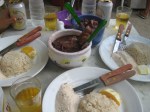
Feijoada is described as a stew, but it’s served in a more deconstructed manner. We each received a plate with separate piles of white rice and farofa, and we got two bowls of meat and black beans for the table. Stacey’s book described feijoada meat as “well larded”, and that was totally true – I am not sure what pieces of beef we got, but they had plenty of fat! Feijoada also includes different kinds of sausage. It’s very heavy but so, so good! We were glad when the chef came out of the little garage that served as the kitchen to ask us how we’d liked it (we were once again the only tourists). We had a nice little conversation about politics (Obama and Lula), economics (Brazil’s kind of in the same situation as the US when it comes to how the recession has affected the general public), and Portuguese (he said that we spoke well).

Our waiter was very nice to us too; he introduced himself to us as we got up to leave and gave us each the traditional two kisses (one on either cheek) along with the reminder, “two kisses; no shame”, which we think pretty well sums up Rio. If I get to come back sometime soon I may come find this place again as both Paulo and the chef mentioned an interest in finding a language buddy.

We needed a walk after eating all of that food, so we strolled down the street and found a number of very cute shops that remind me of the ones in Carytown in Richmond. They had some great non-tacky souvenirs, but unfortunately at this point we were running low on our reais and generally had to say no.

We had just enough time to go into a few of those shops and admire the view of the bay (Santa Teresa is on a hill) before we had to find a cab to head back to the hotel, grab our stuff, and get to the airport. We each did a quick change in the hotel bathroom before piling into the cab with all of our stuff and silently processing the fact that we were leaving Rio. I focused most of my attention on Cristo as we drove; we went almost directly underneath him at one point, and that’s the last picture that shows up in the album I created on Facebook. It truly is a stunning statue at night; the lights don’t illuminate the mountain – it’s just Cristo up there, and I already miss seeing Him.

Getting to and through the airport wasn’t particularly difficult for me and Stacey, but Mary had started to feel sick in the cab and was not doing well when we arrived. Once through security, I went off in search of some medicine to dull the pain in her ear and some agua de coco to rehydrate her. There wasn’t much in our terminal other than duty free, and Mary really wasn’t feeling well, so she decided to go back through security to the main terminal in search of a doctor or a clinic. Stacey and I stocked up on cachaça at duty free and then kept glancing anxiously at our watches as more than an hour passed since Mary had left. Finally, she came back with a nice US Airways employee in tow, only to tell us that a doctor had told her she couldn’t get on the plane because her eardrum would burst! We felt awful leaving her, but there wasn’t much else we could do, and fortunately the airline was very helpful – they helped her get some antibiotics and got her into a hotel near the airport. She is hopefully back at the airport now as I’m writing this, waiting to get on the flight tonight! You just never know what can happen abroad…

Boarding the plane obviously made me very sad; even our walk down the jetway reinforced the charm of the country we were about to leave. The flight attendants were stopping people to see passports (again) and ask about our carry-on luggage. When Stacey and I said that we had bought some cachaça, the woman laughed and said “oooh, you’re going to make caipirinhas in the United States!” And speaking of caipirinhas, if you fly first class from Rio, you get them when you board the plane.

My last view of Rio was perfect. From my side of the plane, I could see Cristo lit up in the distance looking over the city. I truly haven’t been anywhere more beautiful.

Brazil, Day 7: Sugarloaf, ANOTHER favela experience, and Lapa street party

We had designated Friday morning as the time to go to Pão de Açucar (Sugarloaf Mountain) after hearing that its views were best in the morning light, so that was our first order of business once we got up. After waiting more than 20 minutes at the bus stop and almost giving up on the bus, #511 finally arrived and took us (and the many other people packed on board) to the base of the Urca mountain (the smaller of the two in all the images of Sugarloaf). We were wholly unprepared for the line that we found there. I volunteered to scout ahead and figure out just how long it was; it may well be the longest line I’ve ever seen. It stretched about three city blocks and was sometimes as many as ten people wide. We debated for a few minutes about what to do… it seemed like waiting in line would cost us the whole rest of the day, but we also didn’t know if we’d be any better off trying to show up first thing on Saturday.

Fortunately, luck was on our side. Stacey and Mary went to do some scouting of their own and ended up meeting an Irish couple who were much further up in line. They invited us to join them in line, allowing us to cut over two hours of wait time! We soon found ourselves boarding the first of the cable cars and heading up to Urca.

The first thing we saw on that summit was the launching pad for the helicopter tours of the city. Every few minutes, a helicopter would take off for Cristo or other points around the city; we learned that the shortest journey offered – a total of ten minutes, just round-trip to Cristo, was about R$150; the most expensive was over R$1000! They seemed to have plenty of business despite the high prices.

We did a loop to take pictures from the various vantage points there; it was the opposite of our experience on Corcovado. Everything was completely visible and gorgeous. We could see many different beaches, each with its own distinct coloring, and mountains off in the distance that were half hidden by the haze and seemed not to be quite real. It’s no use trying to use words here; you’re just going to have to look at pictures.

After a quick bite to eat, we boarded the second cable car to the top of Sugarloaf. We took another round of even more spectacular photos before setting off in search of the monkeys advertised on the signs asking visitors not to feed the wildlife. We followed a set of short trails that led a through the foliage downhill and even made monkey-like sounds, but we didn’t find any… perhaps on my next trip!

After descending back to the ground level, we caught a more prompt bus back to Copacabana and grabbed about two hours on the beach. I finally joined Mary and Stacey in wearing a tanga; I was very glad to purchase a bikini with the same pattern as the famous Copacabana sidewalk, and I went into the water to put it on as soon as I had it! I must say I felt quite liberated. J

Back at Cabana Copa, we rinsed off, grabbed our stuff, and set off with mixed feelings for the hostel we had booked for our last night. Lonely Planet had recommended it, and we all thought it sounded like it would be an interesting experience. The hostel was located in another favela near the Santa Teresa neighborhood of the city; Lonely Planet described it as a guesthouse with lovely views from its porch. There weren’t too many options left in Rio by the time we realized we needed a place on Friday night, and we figured it couldn’t be that bad if Lonely Planet (a source I’ve always trusted) recommended it. Here is a description of the place on HostelWorld.com:

“The greatest view and the quietest environment you can imagine! The Hostel ‘Pousada Favelinha’ is located on a small mountain in the heart of Rio de Janeiro , between the district of Laranjeiras and the hip Santa Teresa. It is situated inside a small ‘Favela’, one of the many ‘poor’ districts that Rio has got. However, it is not ‘poor’ in cultural terms, and it is absolutely secure! You are only a five minute walk from either the metro station at ‘Largo do Machado’ which will take you to the Copacabana beach in only another 7 minutes, or from the ‘bondinho’, the old little cable car which runs through the beautiful artist´s district in Santa Teresa and right down to the center of Rio and the nightlife district ‘Lapa’.
Since there are no roads in front of our hostel, the only thing you will have to put up with is walking a small hill up (or down, wherever you come from) to reach home. This paths leads you through so many beautiful houses and trees, playing children, and old women chatting, that you would wish your stay was longer…”

Well, dear readers, let me tell you about our second adventure in a favela.

We got into a cab with a nice young driver who, together with Mary, the Lonely Planet book, and his GPS finally figured out where to take us and gamely did his best despite having no real idea where we were going. We stopped multiple times to ask for directions, and at once point we had to go in reverse about 200 yards down a very narrow street on a hill (we think we may have hit some things in the process). Finally, after about 40 minutes, we found the school that Lonely Planet had mentioned as the entrance to the hostel (something along the lines of “enter through the school” – nothing too detailed.) By this time it was dark, and although we weren’t in a favela at all like Rocinha (it was more like an older part of the city), we didn’t much like the idea of getting out of the cab and wandering around. Two men at the gate to the school pointed us in the general direction we needed to go, and we started off.

Now at this point, given the description Lonely Planet, we assumed the hostel would be just on the other side of the school or something simple like that. This was not the case. Instead, we went up and down some stairs and inclines for about 10 minutes before I popped into a little bar and asked for directions. The two men there looked flabbergasted to see me but seemed to know what I was asking for, so we set off again down another hill and bore left as they directed. Here we once again had to find someone to help us, and fortunately a young woman offered to lead us part of the rest of the way. It was at least 10 minutes before we finally found the building that multiple people seemed to think was the hostel.

Taking a deep breath (as by now we were completely out of breath from hiking around with our heavy backpacks), I knocked on the door. There was no answer, so I knocked again, and then we started calling out. (We knew someone was in the building because we’d seen people on the back porch from a distance). Finally, a man opened the door a crack and looked at us with a somewhat bewildered yet sneaky look on his face. I explained that we were looking for the hostel, and he gave us no indication for a moment that we had in fact arrived at the place in question. Instead, he asked us to hold on and shut the door.

By this time, we’d pretty much decided we couldn’t stay here even if we did find it. We wanted to go to the famous Lapa street party that night, and there was no way in hell we could have left that place and returned later in the night. We also felt 100% sketched out. This did not improve when the man opened the door again and invited us in while communicating in broken English that since we had arrived after we’d said we would that he’d given our room away. (WTF?) It was clear that something nefarious was going on; this dude definitely struck me as being high out of his mind, and we think that him closing the door the first time was to stop whatever obvious drug use or exchanges had been going on in the living room prior to our arrival.

Fortunately, he was quite nice and called us a cab to take us back to town. He left us alone for about two minutes, during which we composed ourselves (thank God we’re each good at being calm in a crisis!), came up with a quick plan, and braced ourselves for going back the way we’d just come. By the grace of God (or in this case, Cristo), we managed to figure out our way back to the school, and the cab was waiting for us when we got there.

The above narration does not do this story justice AT ALL. This was one of many instances over the trip when I really just needed to have a video camera on. It’s impossible to communicate the extent to which this place sketched us out or how angry we were at Lonely Planet – we have NO IDEA how they could have thought to recommend this place and so grossly misrepresented its location. It says a lot that the people we met inside the favela were friendlier and more helpful than the people at the hostel! Here is what I found on a Lonely Planet forum just now about the same place:

“I am urgently compelled to make this post … due to my experience on my departure after an 11 night stay. After being awoken by the owner returning at 5am with a gang of friends and playing music at maximum volume (to the point of the walls vibrating) somebody burst into my room and switched on the light. Irritating to say the least at which point from my bed I yelled several expletives. That is all I did. A few hours later, I was about to check out and I wrote a note of complaint to the male receptionist who was a gentle and extremely helpful young guy called Jorge who had only been working there a short time. I owe this guy a lot. I explained what had happened and communicated my disappointment and requested that after an 11 night stay I was entitled to a discount at least for such a terrible night. Minutes later I was then met by the female part owner who was smashing my door with a 75cm wooden club in a rage of unparalleled intensity. On opening the door she wielded the club at me and screamed and yelled what I assume to be the filthiest words the Portuguese language has to offer. In the following moments I had the bat raised to my head, I was spat at and later pelted with rocks as I left the building. …. As a practising clinical psychologist, there is no doubt that this ‘woman’ would have been sedated or restrained in any other environment and is in dire need of immediate psychological assessment.  For this reason, I urge you to give serious thought to staying here. Had she indeed hit my skull with the bat I cannot imagine what would have happened. The fact that there is a pitbull on the premises that responds to her commands and the fact that the police will not enter the favela only compounds the danger here.
After travelling in over 50 countries in the past 15 years including all of S America, this is my worst experience.”

Anyway, we had the cab take us back to Cabana Copa, where we got on a computer and managed to find a room at a hotel a few blocks away. Because we’d technically booked a room for two, we had to devise a plan to sneak the third person in. Mary volunteered to go and find food for us while Stacey and I checked in. I must say, it was a relief to check into a legitimate hotel after the adventure of the past two hours, and we felt so reassured by the assistance of the bellhop in getting our bags upstairs. We turned on the tv, found that “Erin Brockovich” was playing, and chilled out for another few minutes before Stacey went down to get Mary.

I have to give Mary major props for the food she managed to acquire in 20 minutes: she came back with an entire pizza (Brazilian style has sausage and onion on it), a burger with fried egg on top, and a grilled banana and cheese sandwhich along with some beers. We had quite a little party in our room as we celebrated being alive, having all of our belongings, and having been able to work through the situation.

Somewhat later, after showering and resting a bit, we headed out for our last evening in Rio. Every Friday night, the Lapa neighborhood has a big street party. We didn’t know much about it other than that it existed, so we were curious to see what we’d find.

The street party isn’t quite like anything I’ve ever seen in the US. Lapa is the samba district, and several blocks were closed off to traffic. The streets were filled with stands selling beer, cocktails, and all sorts of food, and the various samba clubs and restaurants were all alive with people. There were hundreds of people there ranging from age 8 to age 88. Some were in casual attire; others were in costumes. It was crazy; it’s probably the closest thing to Carnaval that anyone can experience in Rio when it’s not that time of the year. We had a blast just strolling around taking in everything and everyone. We even encountered Michael Jackson and took a few pictures with him!

Most of the samba clubs sounded amazing but had pretty long lines, so we opted to sit outside at a bar and just watch people go by while we sipped caipirinhas. Again, this was a situation that called for a video camera; words just can’t explain. It was just too cool. We all agreed that it was a great way to spend our last night; we felt like true cariocas.

Brazil, Day 6

It’s now Sunday evening, and this entry is supposed to be about Thursday… but my memory is kind of fading. I think it was generally a beach day for us – we didn’t get home from the awesome club experience until about 5, so we slept until 11 and weren’t really up and about until 12. We went to the beach in the afternoon and came back to join the rest of our roommates, a mix of guys from the US and the UK, in a group nap in the early evening before going out.

Two things to note about Thursday:

First, I think I mentioned in my pre-trip post that there is something in Brazil called Engov which will supposedly prevent a hangover. We all took some before going out the night before, but I still woke up with a little bit of a headache (not that I was drunk; it was more from lack of sleep and general dehydration). Anyway, I was not particularly impressed with the Engov, but we did get some of our trusty açaí smoothies, and I swear, my headache was gone five minutes later! Superfood to the rescue!

Second, Thursday was tanga (thong) day. Over 50% of the women on the beaches wore thongs, and we’d begun to consider it something of a diplomatic imperative for us to join them. (After all, when else would we have an opportunity to do that?) As we’d had no luck finding reasonably priced/well-fitting bikinis in Ipanema, we decided to shift our focus to the men selling them under umbrellas on the beach. We each found suits to our liking and felt quite liberated as a result!

In the evening we had another series of strikes when we tried to go out. First, we learned that banks turn off their ATMs at 10 pm, which is bad when it’s 11:00 and you need cash. Someone told us of a pharmacy on the other end of Copacabana that had an ATM, so we went there before going on a series of cab rides trying to find a place that was both open and not too posh… which took much longer than expected. We finally ended up at a cool funk club called Fosfobox. Funk/really loud music isn’t necessarily my thing, but it definitely seemed like a key experience to have in Rio. I was a bit disappointed that there wasn’t the same type of atmosphere in that club; the one the night before had very much been about dancing, while this one was about people just standing and listening to the music – no one tried to talk to us. We ended up leaving around 3.