Brazil Day 5: Copacabana, Cristo, and Clubes

This was one of the best days we had in Rio.

Mary and I got up a little early and went for a run along the beach. The cariocas take fitness pretty seriously (after all, they’ve got to look good in those tiny bathing suits), so there were plenty of other people running or biking along the beach. The one surprising thing was that everyone seems to wear much more clothing while exercising – we just ran in shorts and a sports bra, but we saw most women wearing shirts and even leggings, and there weren’t too many shirtless men either. It’s always interesting when there’s a contrast between what people wear on the beach and what they wear around the beach. (In Spain, it’s standard procedure to topless at the beach, but if you walk home with just a towel around your waist rather than being completely covered up, you will get stares!)

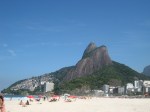
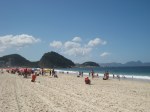
We started at the beach; we were anxious to compare Copacabana to Ipanema. Both areas have been immortalized in familiar songs, but although they’re adjacent to each other, they have some significant differences. Ipanema is a little more upscale both in terms of the people on the beach and the area around the beach; all of the fancy shopping that we saw in Rio was in Ipanema. In constrast, Copacabana is more like the Virginia Beach of the Zona Sul – it’s got a lot of people and feels a little seedy at times because its business is pretty much just the beach. We didn’t see quite as many beautiful people or as many coconuts, but we weren’t disappointed – there were still plenty of toned, mostly naked people to admire and far more stands offering alcohol. Copacabana is known for its food stands along the boardwalk; there’s one about every 25 yards, and they are like mini restaurants despite their size; many have terraces for people to sit while they eat or drink.

We saw a few other interesting things as well. There was a light-up sign with recommendations for what SPF to wear depending on your skin tone – two groups got 15; two got 30. (Even with my darker complexion, I had to go with 30 – the sun is very, very strong down there.) We also enjoyed Copacabana’s way of dealing with the hot sand: hoses at various points along the beach stretched from the sidewalk across the sand and created a path of wet sand that wouldn’t burn your feet – ingenious! I must say I’m amazed I haven’t seen that anywhere else. The hose just had tiny holes in it so that there was a fine mist every few feet.

We discovered that the surf at Copacabana is not quite as rough, which was a nice change. The beach is on a different angle, so the waves aren’t as large (not that we didn’t still need to be cautious and time our entrance and exit carefully!). There were more families at Copacabana, and that’s probably due to the fact that the water was just less treacherous.

The weather forecast had promised a cloudless afternoon after 3:00, so we had made plans to go up the Corcovado mountain to see Cristo Redentor around that time. This required our first use of Rio’s very efficient public transportation system. A huge number of bus lines go through Copacabana; there are so many that there are three different sets of stops just so that there isn’t backup on the streets from all the buses stopping one place. We didn’t immediately figure this out; every bus stop has all the lines listed, but the lines are grouped together and matched to particular stops. The ever-friendly cariocas helped us to figure this out, and we were on bus #583 before too long.

About 40 minutes later, we reached the end of the line and got out at the base of Corcovado. Unfortunately, the clouds hadn’t yet dissipated (or in fact, hadn’t existed UNTIL the afternoon), so we weren’t sure if it was worth it to go up the mountain. Employees at the cog train station said they doubted we would be able to see anything, but we decided to give it a try. I was convinced that our buddy Cristo would reward our patience if we were just willing to stick things out!

The cog train took us up the mountain in about 30 minutes. We had a couple quick glimpses of the city below before we got above the clouds, but mostly we just passed through dense green foliage. Once at the top, we climbed a set of stairs and suddenly found ourselves about two stories below Cristo’s feet.

Cristo Redentor truly is a stunning sight, no matter what the weather – it’s no wonder that Cristo has become the symbol of Rio; I’ve been back in Washington, D.C. for nine hours now and already miss the presence of that statue.

As we anticipated, it was totally cloudy at the top of the mountain. We could see Cristo, but we wouldn’t have known there was anything below at all because the clouds were so dense. Nonetheless, we decided to wait. Mary and I plopped down on the ground along with some others and just stared at Cristo for a while. Occasionally, the wind would blow enough to clear a little space in the clouds above Cristo, and when that happened, people would start to cheer. You’ll see from my pictures that it really had quite a celestial effect!

Things finally started to clear up about an hour after we got up there. We stood at the railing looking down at the city for a while, and the clouds would disperse for maybe two minutes at a time before closing in again. Sometimes the clouds covered Cristo as well; I took video of Him disappearing at one point. (Who knew He’d be such a tease?!) Ultimately, we were able to get pictures of the city, though they weren’t quite as clear or panoramic as we’d hoped.

Wednesday evening, otherwise known as attempt #3 to experience Rio nightlife, started at a Tex-Mex place a few blocks away that supposedly had a good dance scene. We arrived to find no dancing going on, but we figured we might as well get a beer at and watch people pass by. Mary inquired about where we might be able to find some dancing and got the name of another club within walking distance. On the way there we stopped at what we think might be the Rio equivalent of Señor Frog’s; it’s called the Mud Bug and seems to cater to a 20-something crowd looking to drink and watch soccer. We ordered caipirinhas and watched a guy flirting (and ultimately making out) with a girl instead; Brazilians have got good game.

I was pretty sleepy at the Mud Bug, but when we got to the recommended club, I snapped back to attention. We entered to find great music playing and a band setting up to play live samba, and the cheap drinks we ordered proved to have about twice the necessary amount of alcohol for the price, so we were immediately well pleased. We were the only non-locals there, which was very exciting! We stood along the edge of the sunken dance floor for a little while like bait before some guys finally decided to approach us.

The first group of three guys seemed to have discussed beforehand something to the effect of “those girls are American; let’s divide and conquer!” They came over together and each talked to one of us. My guy was very nice and spoke a little bit of English, but it was easier to stick with the Portuguese. I didn’t understand all of what he said, and there were more than a few moments of me laughing and saying “não entendo!” (“I don’t understand!”), but we had a lot of fun.

Later on we bumped into a different group of guys; I had a much more amusing conversation with the friend I made from this group. He spoke no English, but I was able to understand his Portuguese better than the other guy’s, so we were able to communicate fairly well. He told me that I looked Brazilian but that my friends didn’t, although he added that the way I danced was more American. Apparently in Brazil, they tend to move more slowly to music, even if it’s faster. At the time he made that comment the DJ was playing Brazilian music, so I watched and imitated him; a few minutes later I got to turn the tables when the DJ switched over to some American music, at which point he watched and imitated me.

Time flies when you’re having fun, and before we knew it, it was 4:45 and time to go! The last song was, from what I could tell, the Brazilian equivalent of the Macarena, and after some sleuthing, I found it: A Liga da Justiça by Leve Noiz! I’m going to keep practicing. It was an epic evening!

Brazil, Day 4: Favela Rocinha

Our experience on the favela tour blew my mind this morning. Warning: the following post contains information that is likely to make members of my family extremely uncomfortable; just keep in mind that I am alive and well. This experience was worth every ounce of risk, and the perspective I gained is something all of us privileged people should have.

“Favela” essentially means “slum”. Over 52 million Brazilians live in favelas; the 2002 Academy Award winner of best foreign film, “Cidade de Deus” (City of God) portrayed real events in an actual favela about 40 km outside Rio. Favelas are famous for their brightly colored buildings, horrible living conditions, and gang/drug violence. Many are controlled by drug lords; back in November, Rio’s police undertook a major cleaning up effort in a couple of favelas, resulting in the arrest of over 100 drug lords. Although the drug trade is inherently unstable and dangerous, it also can lend a sense of order and government; the drug lords understand that business is better when people aren’t afraid to leave their homes.

We joined a group of 15 others on a tour of favela Rocinha, located about 15 minutes northwest of Ipanema. It is one of the safer favelas, and the tour group, Be A Local, has run tours there for a while now. It’s a great organization that gives a significant portion of profits back to the favela.

Our guide, Patrick, gave us some instructions during the van ride to the favela that certainly reinforced the reality of what we were about to do. You might be wondering why anyone would want to tour a slum; the answer is that we (as all three of us did Teach For America) were looking for additional/different perspective on poverty, plus favelas have just become kind of synonymous with Rio (thanks in part to the movie). We were all aware of the enormous amount of poverty in Brazil and wanted the chance both to see it up close and to contribute in a very small way to community development through our tour fee and supporting the local artists who would be featured on the tour.

Anyway, Patrick told us that following his instructions would be very important in order to make sure we were all safe. This particularly applied to picture taking; certain areas are okay for pictures while others are not. The drug lords are generally very wary of photography because of the potential publication of images that might be incriminating, so we couldn’t take pictures in any open, public areas.

Traffic was unusually slow en route to Rocinha, and apparently this was because the police were doing a small raid. Patrick said they were looking for illegal cars and bikes, but regardless of how harmless those things sound, police presence was significantly higher, which just creates more tension. We saw a lot of police cars as we pulled up at the foot of the hill.

The biggest part of the adventure was right at the beginning. Since the tour route starts towards the top of the favela, we had to get up there, and there aren’t really any roads, so we couldn’t just drive up. Instead, we caught motorcycle rides with some of the locals who make money by shuttling people to the top… the favela equivalent of taxis. They were not in any way associated with the tour company, but they apparently do this every day with tourists.

After another round of instructions from Patrick (motorcycle safety tips and another reminder not to take pictures), we waited to get on our motorcycles. Mary hopped right on one, and Stacey and I waved good-bye more than a little nervously as she disappeared up the hill. We weren’t all going at once, and we didn’t know where we were going except up.

Stacey and I ended up being on the last wave to go up. I rode with Riccard, an attractive 30-year-old who pulled up, pointed to me as if to say “I’ll take her!”, and was nice enough to let me put my arms around his waist rather than holding onto the little handles behind my seat. He also told me to keep my limbs as close as possible, and I soon saw why: moments later, we were weaving our way through the traffic of cars, trucks, and motorcycles headed up the hill. It was a rush unlike anything I’ve ever experienced. We passed police carrying machine guns and cars with men pointing machine guns out the window as they drove up, and we also hit a number of curves during which I grabbed Riccard very tight and prayed to Cristo not to let us wipe out on the road. Nonetheless, part of me actually felt very safe; Riccard just seemed to radiate a confidence and kindness that reassured me greatly. We talked as much as his attention on the road and my lack of Portuguese fluency allowed, but he told me that he loves the United States and has lived in Rocinha for 30 years.

Not more than 10 minutes after leaving the bottom of the favela, Stacey and I caught sight of our group, and the motorcycle ride was over. I wish I could have taken a picture with Riccard, but alas we were definitely in a no-picture area. I thanked him as profusely as I could and joined the group.

We set to walking single-file through the narrow “streets”; they are more like passageways between the jumble of buildings. Throughout the tour, we navigated around hanging wires, trash, feces, and running water. You will have to see pictures (when I get home) to fully appreciate what the favela was like; it’s very hard to describe the extent of the poverty we witnessed.

Despite the dirty and dismal surroundings, we encountered people who were quite friendly and seemed happy. Stop 1 was in an artist’s studio, where the three of us bought beautiful paintings and took our first pictures of the view, which was incredible. They may live in a slum, but the residents still have prime real estate with amazing views of the water. Speaking of real estate, we learned that the general idea of land ownership in Brazil is essentially that if you can build something, you own that space. In the favela, this means that people often just build on top of already existing buildings, which explains the very haphazard appearance of the favela. (Both here and in the ones I passed in Venezuela, I find it hard to believe that none of the buildings have ever just fallen over.)

We stopped next to watch some teenage boys play quite an impressive percussion arrangement on paintcans (I took video). After that, we bought very cheap bracelets made, very innovatively, from internet cables. We also visited a community center that provides child care – a key service in a community where families average six kids and teenage pregnancy is almost standard procedure. Because of the police activity, no one was at the child care center. (For the record, we were among at least three tour groups in Rocinha at that time, and the guides were constantly checking in with people as we moved to make sure we wouldn’t encounter any trouble.)

Finally, we descended to the main entrance where we’d started; our final walk was through a covered outdoor marketplace where once again the police were everywhere. By this time they seemed less menacing…

Mary, Stacey, and I are still processing the experience, and I/we plan on supplementing this post as we make an effort to write down everything we saw and heard. For now, what I can say is that I am now grateful in a whole new sense for what I’ve been lucky enough to have in my life; safety, housing, food, clothing, education, and disposable income are so easy to take for granted. The 400,000 residents of this one favela live 20 minutes from the high-class area of Ipanema, but their world couldn’t be more different.

Update:

The newspapers the morning after we were in the favela all had headlines about a major police operation, so turns out they were there for more than unregistered motorcycles. Here are some of the translations from the newspapers I bought:

Front page headline in O Dia: “Police now hunt wife of the ‘powder boss’ in Rocinha”

Sub-headline on front page: “The vanity of Danubia de Souza Rangel – wife of the trafficker Nem – will be used by police to catch her. A fugitive of justice, she posts pictures on the Internet of the life of luxury she leads in the favela, which yesterday was targeted by a police operation.”

Article headline: “Nem and Xerifa of Rocinha escape from police siege: Investigation that found a R$2 million laundering scheme culminated in the hunt for drug boss and his wife in the slum”

First paragraph: “The civil police descended yesterday morning launching a megaoperation with about 200 agents to arrest community leaders and relatives of the head of the drug trade in Rocinha, Antônio Francisco Bonfim Lopes, or Nem.  All are suspected members of a money laundering scheme. An investigation discovered movements of more than R$2 million [~ US $1.3 million] in bank accounts.”

Front-page headline in O Globo: “Companies Launder Rocinha Money: Five small business in the Zona Sul  [the southern part of Rio where the beaches are] and Rocinha are under suspicion of laundering money for drug trafficking in the favela. In a local operation, the civil police seized three tons of marijuana and arrested 11 people, but the trafficking chief escaped again.”

Article headline: “Siege of ‘laundering’ of Rocinha: police operation against business that legalize the millions of profits from trafficking”

First paragraph: “Five legal small business in the Zona Sul and Rocinha are being investigated on suspicion of money laundering for the drug traffickers in the shantytown. To dismantle the gang, identified after seven months of investigations, operations opened yesterday in Rocinha, one of the last strongholds of trafficking in the Zona Sul. The goal was to meet 30 arrest warrants for people connected to the drug dealer Antônio Francisco Bonfim Lopes, or Nem, but only two of the people searched were arrested. In the action, no weapons were seized, and Nem escaped once again. Despite the claims of the residents of Rocinha that on Monday night three police officers from Leblon went up to the slum to advise of the operation, the commanders of the police denied that there had been leaking of information. The police said they could not disclose the names of the companies so as not to prejudice the investigation.”

We heard something on the tour about leading information about whatever the operation was, so it’s interesting that that shows up in this article.

Wow…

Brazil: Day 3

Yesterday was our designated beach day. (For the record, this has nothing to do with the weather forecast as every day we are here it is sunny and in the low 80’s.) We awoke to clear, blue skies, repeated our breakfast of the day before, took care of some business online, and headed down to the water.

What a change from the weekend! We had been wondering how many of the people on the beach were tourists vs. Rio residents; yesterday there was about a quarter of the number of people on the beach. This meant we had an unobstructed view of the water (win) but fewer beautiful people to admire (fail). We spread out a sheet and set to reading and tanning. (In an action that defines “oxymoron”, I read the Economist.)

Eventually, the hot sun drove each of us to the water. Let me take a moment to describe the water here. Although it’s not clear, it’s cleaner than anything I’ve seen in the US and has a lovely greenish-blue quality to it. The waves are HUGE. Yesterday we learned that swimming at Ipanema qualifies as an extreme sport. It is not for the faint of heart! Getting past the 6+ foot breakers takes a lot of daring and cunning. You run a very real risk of being clobbered and losing your bathing suit, and coming back in is even harder. I got hit very hard at one point, which resulted in me corkscrewing along the bottom and for the first time ever feeling slightly disoriented underwater as a result. I also think if you stay in too long that you’d get seasick from the height of the waves. Nonetheless, I have to wonder how to place Ipanema on my list of favorite beaches. Although it does not meet criteria #1 of clear water, it meets the next two (sand and waves). I think the size of the waves merits some bonus points, as do the coconuts to drink (check out my new profile pic on facebook), and the people here provide a stunning visual similar to beaches with clear water. I have to keep mulling this over.

We came back from the beach in the late afternoon. My back is burned, but the rest of me started on a nice tan. After showers and an application of aloe, we set off in search of Havaianas, Gilson Martin purses, and Brazilian bikinis.

The Havaianas store we found did not disappoint, and there is a larger one awaiting us in Copacabana. I was thrilled to find Croatia flip flops amidst the international selection and also bought a pair of the standard whites with the Brazilian flag.

Gilson Martin is a Rio purse brand, and the store completely overwhelmed us. Almost all of their accessories have images of Cristo Redentor and Sugarloaf Mountain on them, and they come in all sorts of colors and shapes. After agonizing for half an hour and making friends with both the staff and other clientele, Stacey and I each bought an incredible goldish-bronze purse with a Rio landscape on it that is worth every penny. I was equally thrilled to meet a Colombian woman while checking out; she told me that I spoke Spanish without an accent and had to ask where I was from! That’s pretty much the best linguistic compliment it’s possible to receive!

Speaking of linguistics, let me take a moment to say that I’ve never had such a good time attempting to speak a language in which I am not highly proficient. The Brazilians are very friendly and patient and seem to truly enjoy the fact that we make the effort. I managed to talk to a Gilson Martin employee about why she had a tattoo in English on her arm, another about the best type of Cachaca to buy, and a bikini saleswoman about whether Brazilians are more likely to learn English or Spanish as a second language (English).

We went into several bikini shops; Stacey and Mary tried on a few and learned just how itsy-bitsy teeny-weeny the suits are here. Mary bought a lovely one with crochet flower detail.

For dinner we visited a pay-by-the-kilo restaurant that provided a delicious buffet. I got to sample a number of veggie dishes along with steak, squid, salmon, and cod. Mmmmm!

We finally got back to the hostel around 9:30 and got ready for our first real attempt at clubbing. We headed to a place at the border between Ipanema and Copacabana, discovered we were too early at 11, and spent 90 minutes sipping beer at a stand overlooking the beach. Copacabana appears to have significantly smaller waves.

The club proved to be fun although not what we expected from our Lonely Planet guides. Stacey requested Lady Gaga and got “Born This Way” 40 minutes later; needless to say, it was awesome.

Brazil: Day 2 – continued

Last night we decided to forego the funk party in the favela as it a) was expensive without including drinks, b) took place in a favela so far they couldn’t show us on the map, and c) would have required that we stay out until 5. We figured it would be better to save our energy for other evenings.

Instead, we headed off to dinner at an outdoor restaurant just down the block. Once again, we went for a tapas-style approach to the meal so we could share different things. No disappointments: in addition to caipirinhas, we enjoyed meat fritters, some salade nicoise, steak, grilled veggies, and sort of a farofa (the fried flour) covered scrambled egg. All was delicious; in Brazil, they keep flavors pretty simple. They just throw on some salt and grill the meat, so we really got to savor the flavor of the steak.

Our plan after dinner was to buy some beer and head to the beach, but the markets had closed by the time we finished dinner. However, as we headed towards the beach, we passed a samba bar that appeared to have a line outside the door, and we thought that might be fun to try later.

The beach proved to be a disappointment in terms of providing drinks; it was practically deserted (quite a change from the daytime). The large waves crashing in the moonlight along with the outline of the lights in the favela in the mountain to the west made for beautiful scenery, though.

We decided to head back to the hostel and get another drink there. At this point it was about 11:15. We arrived to find the downstairs full of people but the bar closed! We quickly formed a new plan: drop everything we didn’t need and head to the samba bar.

Fail #4 happened at the samba bar. They wouldn’t let us in because it was closing at midnight! Lesson learned: Rio does in fact have limits on drinking and fun. (I find it terribly ironic that the Green Leafe in Williamsburg stays open longer on Sunday than anything we experienced in Rio.)

Defeated, we returned to the hostel and settled in for the night. We now possess the three bottom bunks in our room, which makes things significantly more comfortable for us. The room is quite small; three sets of three-tiered bunk beds line the walls, leaving an open space in the center that’s maybe 5 x 9 feet. Controlling the floor helps!

Brazil: Day 2

Boa noite!

We’re back at the hostel now after a pretty full day. We started with a breakfast of ham and cheese on rolls, watermelon, and cafe com leite, which we enjoyed while sitting in hammocks on the patio. After that, we packed up and set off for the Ipanema Hippie Fair.

The fair is a large market that happens every Sunday in the eastern part of Ipanema. Our hostel is technically in a western area of Ipanema called Leblon, so we had a nice long walk to get there. I’ve been trying to figure out if Rio reminds me of any other city, and after walking through more of it this morning, I have to say that I haven’t seen anything quite like it before. The streets are shaded by trees with hanging vines; the clean sidewalks are made with stones, meticulously placed to form designs. Building styles range from a few typical old hacienda-type facades to more modern, but all are lovely. Residential buildings have gates in front and tiny garages in which residents can park their cars.

As we walked, we played a game that may well result in its own album on Facebook: Hide and Seek with Cristo. The statue of Christ the Redeemer (whom I’ve fondly begun to refer to as Cristo, as if we’re friends) sits on a mountain due north of Ipanema, so when buildings don’t block the view, it’s visible from here. Between the buildings and the clouds (there aren’t many, but there seem to be enough up there to give it a sense of the celestial), we never know when we’ll spot Cristo next. We have pictures of Him now from various angles and with varying degrees of visibility. One particularly cool shot allowed us to see only the statue, not the mountain beneath, as if Cristo were just floating in the clouds.

Anyway, we finally arrived at the Hippie Fair and were quickly sucked in by the huge variety of quality goods for sale. We looked at lots of jewelry, clothing (including leather overalls), souvenir t-shirts, mini Cristos, purses, shoes, and other handicrafts. We got to practice our numbers by asking “quanto e?” at practically every stall. Two hours later, we left satisfied with our purchases and wishing we could come back again.

To mix things up, we walked back on the sort of boardwalk next to the beach. We bought some sarongs of the Brazilian flag (a key souvenir here) and continued to enjoy the views of the many attractive Brazilians. They play a type of volleyball here in which they don’t use their hands – it’s like hackey sack on a volleyball court. Food stands every few yards offer all sorts of tropical foods and beverages, and vendors also stroll the beach offering drinks, ice cream, leather bracelets, and bikinis. (The bikini vendors carry umbrellas from which the suits dangle.)

After getting hot in the sun, we crossed back over to a shadier street on the interior and searched for some bikini shops. We didn’t find more than one, but we did go into a mall that proved something we’d already been thinking: cariocas (residents of Rio) are very stylish. The stores were all too expensive, but if I were rich, I’d totally buy all my clothes there. We are surprised that we haven’t heard more about Brazil as a fashion-forward place.

Finally back in Leblon, we changed into bathing suits, picked up some smoothies (this time I got acai with banana, which was very good) and headed down to the beach. By this time it was about 4:00, so we didn’t have a lot of sun left. (Taller buildings are partly to blame for that, but the sun also sets earlier here. I finally figured out this afternoon that that’s because we’re in the southern hemisphere, where it’s fall, so the days are getting shorter.)

The waves here are HUGE. At least 6 feet. They break beautifully and are great to watch; they also make for an exciting time in the water. We haven’t done much yet other than get hit by the breakers, but tomorrow we are going to spend more of the day at the beach.

That’s all for now – time for dinner and caipirinhas. 🙂

Brazil: Day 1

Good morning from Rio de Janeiro, “a cidade maravilhosa”, the marvelous city! From what I’ve seen, this is an apt description.

My post will be brief as I am in fact typing this on my iPhone. Oh, technology!

Mary, Stacey, and I arrived in Rio with no problems. Mary even sat with someone from Brazil on our first flight and learned some good phrases and important words like “chope”, a small, ice-cold draft beer. I used my new Cabin Pillow, a large inflatable pillow designed to sit on the tray table and help you sleep bent over. I think I slept more on our 9-hour flight than I have before, so it was a success!

Upon clearing customs, we exited into an airport not unlike the one in Caracas, where many solicitous men offered taxi services both in and outside the terminal. We spoke with a helpful woman at the info desk to find out where to catch a bus into the city, and she complimented us on our Portuguese!

After an hour’s wait (as the first bus was full), we boarded a very nice bus with air-con (no one says air conditioning here) and enjoyed a trip through Rio to Ipanema. The airport is at the northeast corner of the peninsula, and Ipanema is down in the southwest, so we got to see quite a lot. We were thrilled to catch many glimpses of Cristo Redentor, high atop Corcovado, with His arms stretched out as if to welcome and/or hug us.

After checking in at our hostel (located a convenient one block from the beach), we cleaned up, donned bathing suits, and set out for sustenance. We checked off two things from our list of foods to eat in Brazil: smoothies and acai. I got a smoothie with acai and strawberry that was delicious.

We spent the next two hours on the beach, surrounded by beautiful, tan people clad in thong bikinis and boxer briefs drinking straight from coconuts. It’s the stuff of dreams, but here it is real! We plan to drink from coconuts today.

After the beach and showers, we headed to a grocery store. I love going to grocery stores abroad; you learn so much and see such interesting things! We saw fruits that were completely unfamiliar, juices that don’t exist in the US, and dried cod, among other things.

From there we returned to our hostel for the final 20 minutes of the Real Madrid/Barcelona match and our free welcome caipirinhas. Oh, my. New favorite drink. So good and so strong.

For dinner we ventured a little further to a place called Jobi that one of my guidebooks recommended. We enjoyed some beer and a host of fried but very Brazilian appetizers: cheese balls, cod fritters, yuca fries, and fried manioc flour with ham and egg. It was all delicious!

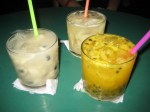
Our final stop was at the Academia de Cachaca, where we sampled caipirinhas flavored with passionfruit, pineapple, and something unidentifiable but tasty.

I love it here!!!

Brazil: Day -1

A few people have asked me in recent days, “why are you going to Brazil?”

For me, the answer is very clear: “why would I NOT go to Brazil?” But I guess it’s understandable – for some reason, Brazil isn’t a country that Americans really know much about. We know it’s that big country in South America, and maybe we know that they speak Portuguese rather than Spanish, and we’ve all heard “The Girl From Ipanema” and references to Rio’s Carnaval and the images of beautiful, scantily-clad people (like Carmen Miranda) that it conjures. We might know it’s hosting the next World Cup and the summer 2016 Olympics and that soccer (or more correctly, football) is huge there. We might occasionally spot the Brazilian flag on flip flops. And the more internationally-focused of us might know that Brazil is one of the countries vying for a permanent seat on the UN Security Council or that its former president, Lula, made great strides in stabilizing Brazil’s economy and taking the edge off its enormous poverty.

But aside from these things, what do we really know about Brazil? For being such a huge country (it’s the 5th largest in the world in terms of both land mass and population!) we know surprisingly little about it. Here are some interesting facts:

  • Voting is mandatory in Brazil between the ages of 18 and 70.
  • Rio de Janeiro has a population of nearly 12 million (that makes it 1.5 times the size of New York City); São Paulo has a dizzying population of 20 million.
  • Brazil ranks 57th on the list of education expenditures as a percent of GDP (behind the United States but ahead of Canada).
  • The capitol is Brasilia, a city that was built from scratch in the last century.
  • Brazil elected its first female president, Dilma Rousseff, in the fall.
  • Unlike many of its South American neighbors, Brazil has a pretty strong currency: the real is currently worth about $1.50.
  • Brazil was the first country in South America to accept women into the career ranks of its military branches.
  • Slavery continued in Brazil long after it ended in the United States; it wasn’t abolished until 1888.

I’m excited to get a sense of the real Brazil (as much of it as I can get from staying in Rio de Janeiro). In addition to generally hanging out and observing life in “the marvelous city”, I’ve got a list of things that I hope will help me better experience Rio:

  1. Devote an afternoon to eating feijoada, Brazil’s national dish. (It’s so much food that it’s typically made only on the weekends because it takes so long to make… and to digest.)
  2. Become a connoisseur of cachaça and learn how to make the perfect caipirinha. (We’re checking out a place called the Academia da Cachaça in Ipanema.)
  3. Dance samba with a Rio native. (Preferably: dance samba well with a hot Rio native.)
  4. Get a more direct prayer line to God while standing at the base of the immense statue of Christ the Redeemer. (High up in the air + beautiful views + 130-foot-tall statue of Jesus = religious experience?)
  5. Find out whether something called Engov really prevents hangovers. (It’s available in pharmacies and contains “a cunning blend of antacids, antihistamines, aspirin, and caffeine” and is meant to be taken with the first and last drinks of a long night.)
  6. Add a new bizarre food to my list. (I’ve heard chicken hearts and pig ears are available, though neither will beat the jellyfish I ate in China in weirdness.)
  7. Speak as much Portuguese as possible. (When in doubt, try to speak Spanish before English.)
  8. Tour a favela (slum) – they’re not all as dangerous as the one depicted in the 2002 film “Cidade de Dios”, and the tours include opportunities to buy the art and handicrafts of the residents so that you give back to the community.

 The journey begins in a few short hours. My friends Stacey and Mary are coming with me on this adventure; we leave BWI tonight for flights to Charlotte (short) and on to Rio (9 hours there, 11 hours back). We should be in Brazil around 9:15 tomorrow morning! We’ll take a bus from the airport to our hostel in Ipanema/Leblon, then figure out what to do first. (Given that the weather forecast while we’re there is pretty much 80 and sunny every day, it’ll be hard to avoid the beach at least once a day…)