Catch-Up: Istanbul, 2015

I somehow never got around to writing about my trip to Istanbul despite the fact that it was AMAZING and wholly deserving of detailed praise! I’m saddened by the string of terrorist attacks in Turkey, so I want to capture my good memories to keep the positivity alive.

Istanbul was the fourth and final city on the trip my friend Mary and I took in August 2015. We flew to Istanbul from Casablanca after spending more than a week in Morocco, which as related in that post was a really mixed experience that by the end made us very ready to leave. Istanbul was the total opposite: we loved everything about it, and for the first 24 hours we kept saying “upgrade!!!” to ourselves as we walked around.

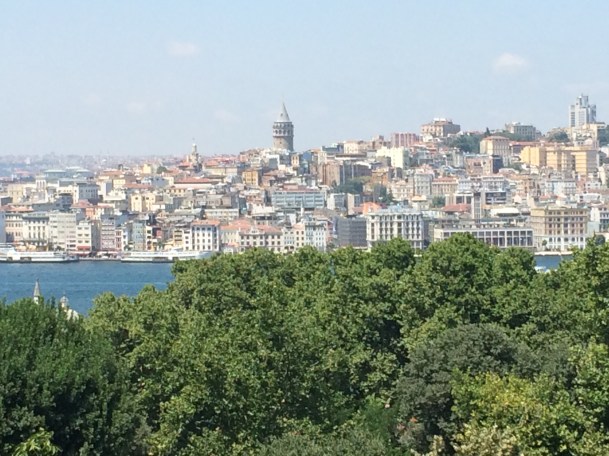
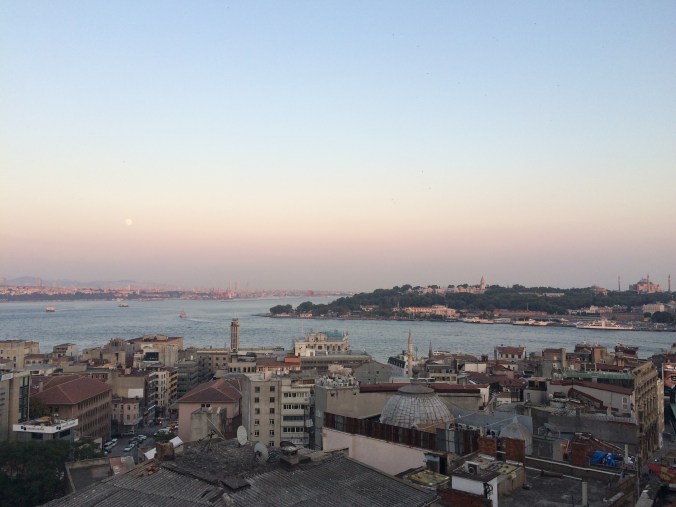
Istanbul has three parts, all separated by water. We stayed in the newer part of the city near Galata tower, in an Airbnb apartment with access to a rooftop with this view:
img_6732

Nearer across the water you can see the Hagia Sophia on the far right and Topkapi palace to the left; the land mass further away on the left is Asia!

We never tired of this view, which was also gorgeous at night with the moon rising over the Bosphorus. I also loved listening to the call to prayer from up here.

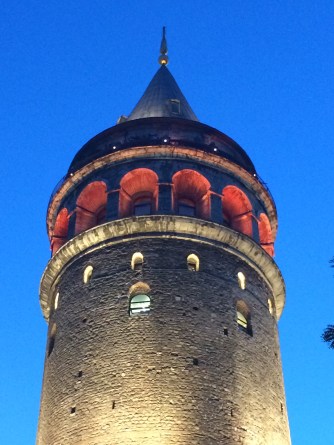
Here’s Galata tower, just a block or two further up the hill:
img_6741

Aside from our gorgeous view over the Bosphorus, we found plenty to praise and further points of cultural curiosity in Istanbul. The food, as you’ll see, never disappointed us. (And indeed, even before this trip, I had a proclivity for Turkish food, so I was thrilled to have the chance to eat some that was extra authentic.) I always love cities with rich histories, and Istanbul certainly qualifies. For me it had always seemed like this mysterious, exotic destination – the seat of the mighty Ottoman Empire, home to the sultans and their famous harems, and before them to Alexander the Great! I think the Turks, like the French, take great pride in their history of having power over huge portions of the globe, and I think that explains things like the effort and expense they have put into maintaining the city. Its most famous tourist sites are truly stunning, and I’ve never been in a large city so clean. I was quite impressed.

We also felt instantly more safe and comfortable than we had in Morocco. I’m not sure what exactly accounts for that. As much as I’d love to declare us such seasoned travelers that our increased comfort had nothing to do with the fact that Istanbul felt distinctly more European, I think that certainly contributed to it. We felt like out of place foreigners the entire time we were in Morocco, but in Istanbul, we felt like tourists in any other European city. It was easier to navigate through Istanbul, to be sure – there’s one tram line that takes you pretty much everywhere you’d want to go, which was a huge improvement from the maze of the medinas and the chaos of trying to find a taxi in Rabat and Casablanca. And we were better able to blend in – although we saw plenty of women wearing hijabs, plenty more weren’t wearing them, and in general we didn’t feel nearly as much pressure to dress conservatively. (Whereas in Morocco we’d worn only maxi dresses and kept our arms fully covered, in Istanbul we switched to knee-length dresses in the evenings for dinner.) I suppose you could say that Istanbul just required less effort, which was a relief (especially after feeling that our effort in Morocco often didn’t make things any better for us).

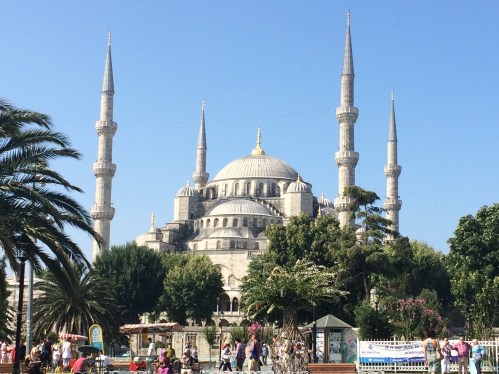
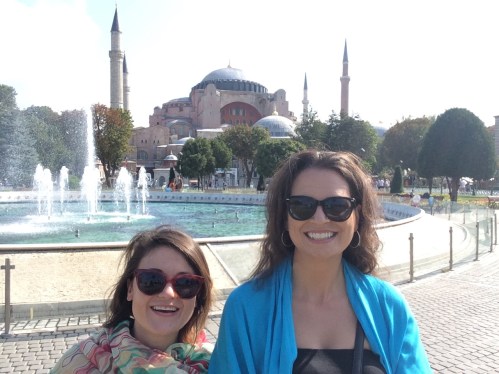
Anyway, our first full day in Istanbul was the day of hitting most of the big tourist sites: the Hagia Sophia, the Blue Mosque, Topkapi Palace, and the cistern, all across the bay from us and easily reached via the tram. It was a beautiful day, and we took lots of pictures while standing between the Hagia Sophia and Blue Mosque, which face each other and are separated by a plaza/park.
img_6765

in front of the Hagia Sophia

img_6766

the Blue Mosque

We started in the Hagia Sophia as we figured that would have the longest line. I’ll let you research the fascinating history of this religious space and instead let you marvel at its interior.
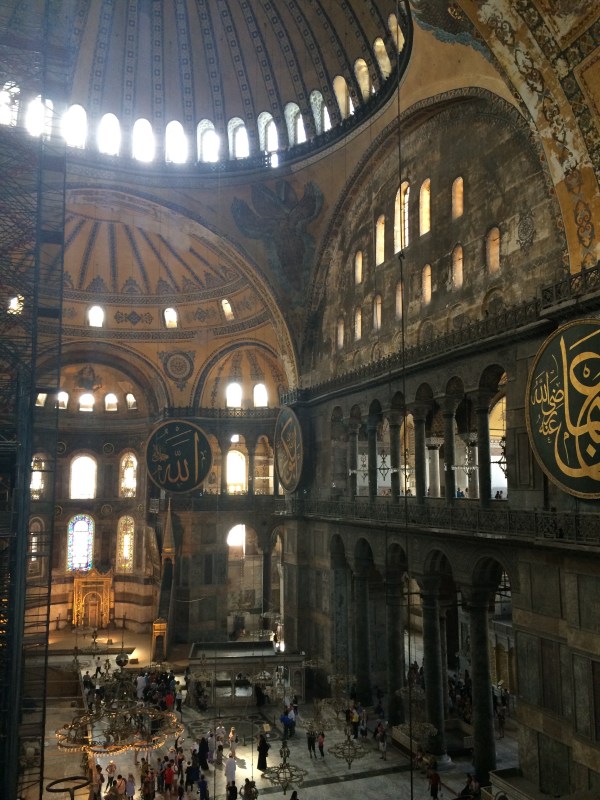
img_6773

The Hagia Sophia, like Notre Dame in Paris, is one of those places where you never stop being aware of the fact that you’re in an awe-inspiring, very old space for spiritual activity. Despite the many people moving around inside, there was still a pervasive sense of calm and quiet. We spent probably about an hour inside, relying on Rick Steve’s tour to work our way around and take in all of the detail.

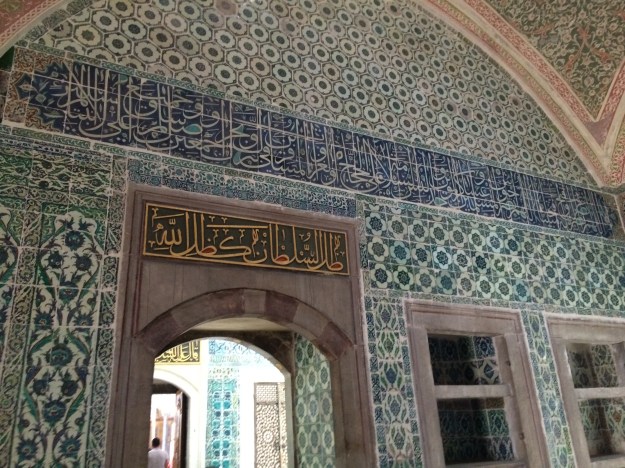
From the Hagia Sophia we moved on to Topkapi Palace, the former home of the sultans. I was pretty excited to see this too, particularly its famous harem. It’s a sprawling complex – we invested in some audioguides to help us navigate our way around. We started in the harem, which didn’t quite conjure the visions I was expecting but was nonetheless full of impressive architecture and interior decoration:

img_6799

The tile art…

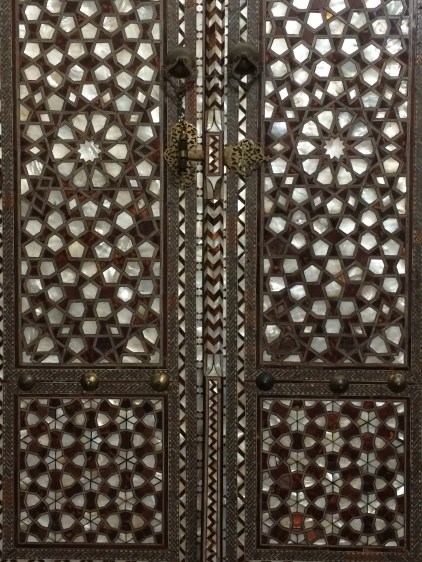
img_6807

the most beautiful closet door!

img_6808

THE TILES!

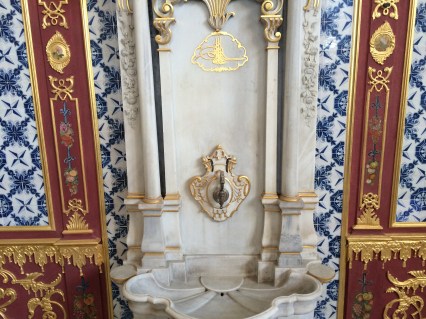
img_6813

just your typical sink.

img_6829

View from Topkapi Palace to our side of the city

After the palace, we needed to beat the mid-afternoon heat, so we backtracked and went to the underground cistern, which turned out to be my favorite place of the day. The underground cistern is essentially a massive pool of water hidden under the street, quite close to the Hagia Sophia. It dates back about 1400 years, and you can tell; the place is even more of a time capsule than the Hagia Sophia.
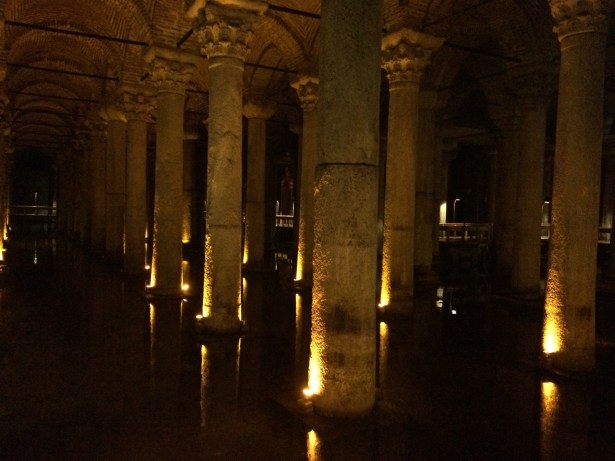
img_6784

the Underground Cistern

Visitors make their way around on a series of platforms above the water, which is only a few feet deep but hosts plenty of large fish, who must have a very peaceful life down there. This would be the ideal place to come in the middle of a stressful day – you feel completely removed from the outside world! I would also love to go to one of the concerts that regularly take place down there; the sound must be incredible.

The underground cistern is also famous for its two giant Medusa heads, whose presence (and orientation) is unexplained. One is upside-down, and the other is sideways. It’s thought that they are leftovers from some previous structure and just happened to be the right size to hold the columns that rest on them…
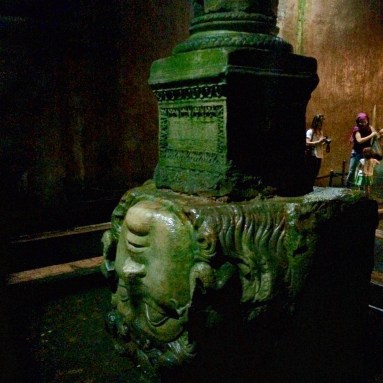
img_6862

the upside-down Medusa head

Our last stop on the tourist trail that day was the Blue Mosque, which as you can tell from the picture above is massive. We learned that they take the dress code very seriously; to my chagrin, I was handed a supplemental covering to wrap around my waist because my maxi dress had slits up to the knees that allowed some leg to be visible when I walked. (At least I was better than many of the other tourists who showed up in shorts!) Here’s the inside of the Blue Mosque:
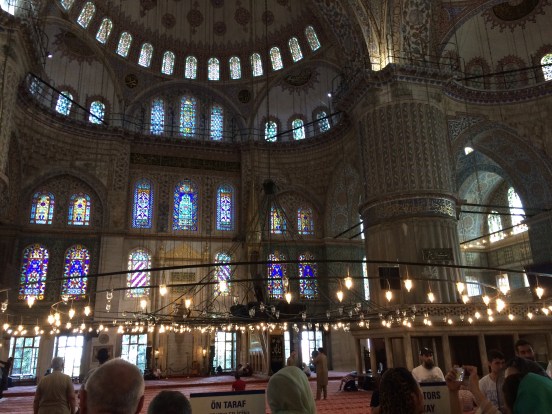
img_6849

I feel a little disoriented even now looking at the picture of that chandelier (if that’s even the right word for something so wide) – it’s only a foot or two higher than standing height!

I have fewer pictures from our other activities around Istanbul. The Grand Bazaar and the Spice Market, for instance, are both busy enough that walking around with a camera isn’t the most practical. Both are quite an experience. The Grand Bazaar is huge; there are probably at least 15 very, very long rows of stalls inside the building, and saying “I’ll come back here after I’ve looked around more” didn’t end up being the easiest strategy! We were a bit disappointed to see that many of the clothing stalls were selling designer knock-offs – not because we were so opposed to knock-offs but more because they detracted from the authentic, historical feel of the place! I was, however, quite satisfied with my purchase of knee boots featuring a cool blue/green/gold tapestry-like stitching on the outside. I bargained HARD; the transaction took about 15 minutes. (As I think I’ve mentioned before, I am horrible at bargaining. It makes me really uncomfortable, particularly in situations where I’m fully capable of paying the first price given. In this case, the boots were still not a steal even after I got the price cut in half, so I was a lot more motivated to negotiate.) The vendor, in gratitude for my business, a) asked me to get a beer with him later and b) led us halfway across the bazaar to the stall of a friend of his, who proceeded to offer us tea and join in the pleas to get us to go out with them. (I don’t even remember what wares we were supposedly viewing at the second place!) We did not end up taking them up on the offer of the beer, but it was a very amusing exchange nonetheless.

Another activity (which strangely I appear to have no pictures from) was taking a cruise on the Bosphorus. I learned two important lessons from that experience: 1) everyone should aspire to have a mansion on the Bosphorus, and 2) giant wafer cookies (about eight inches across) are THE snack to eat on a boat in Istanbul. The cruise took about two hours; we traveled beyond the limits of Istanbul up the Bosphorus and passed countless charming mansions right on the coast (some looked more like houses in Venice, where you could essentially open a door and step into the water).

We saw plenty of the Asian side of the greater Istanbul area from the boat, but we didn’t actually set foot on Asia until our last day, when we went to Asia for lunch. (That statement makes me smile just as much now as it did then! Just a cheeky trip to Asia for lunch…) The Asian side has a slightly different feel, though I’m not sure how to describe it – perhaps that’s it actually; the Asian side is just a bit more nondescript, as opposed to the European side which is so steeped in the visible history. We heard that more and more Istanbul residents are moving to the Asian side, so it will be interesting to follow how that part of the city evolves in the coming years. It couldn’t be easier to get there despite the fact that it looks kind of far away across the water: there’s an underwater train that runs from a station on the European side near the palace to a point on the Asian side across the Bosphorus, and it takes less than 10 minutes.

Finally, before I get to all of the food we ate, I have to talk about the whirling dervishes. I’m sure that you, like me, have certainly heard of “whirling dervishes” but would be hard pressed to explain what they are or even link them to Turkey. The dervishes fascinated me every bit as much as all of the other aspects of Islam that we encountered in Morocco and in Istanbul. I will again refer you to Google to learn more, but essentially, dervishes are sort of like monks, and they practice whirling (twirling) as a means of getting closer to God. There is one place in Istanbul where, once a week, you can watch the whirling dervishes perform a full ceremony. It is truly one of the coolest things I’ve ever seen. There are different stages; they aren’t whirling the entire time, but they do it for waaaaay past the point at which I would have fallen down from dizziness.

What I most wanted to understand, and unfortunately still haven’t been able to find out, is the significance of the positioning of their various parts of the body. Their heads, for example, are kept tilted at an angle; you’ll notice if you look hard at the picture above that they all have their left and right hands oriented in a different way as well. They plant one foot and rotate around that foot (using the other foot to spin themselves around). The whirling is just slow enough (I imagine) to moderate the dizziness but is still pretty fast.

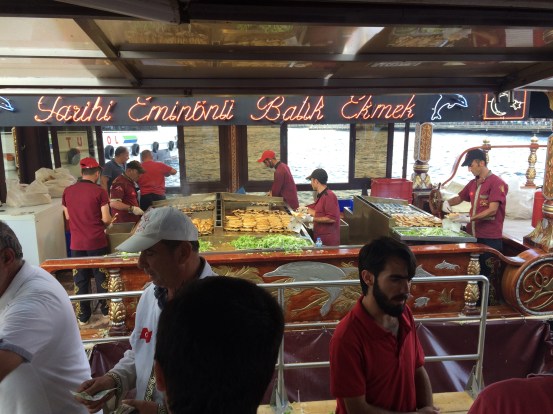
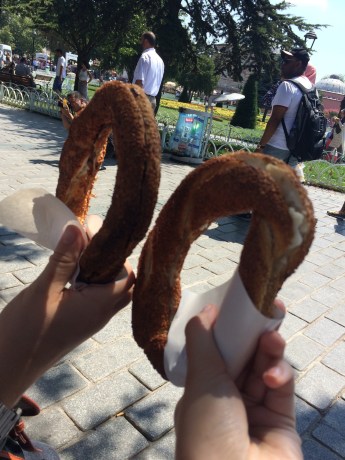
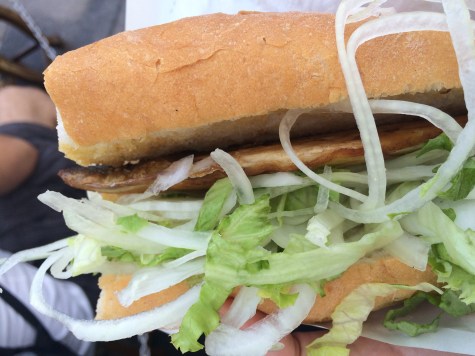
Finally, the food. We ate so well in Istanbul, both casually and formally. For snacks, we had simits (essentially a Turkish take on the pretzel), strange ice cream with a consistency closer to taffy (such that the vendors liked to play tricks on the buyers, with lots of upside-down flips of the cone), freshly fried fish sandwiches cooked on a boat, kebab wraps from a place visited by Anthony Bourdain, and even a special Turkish hamburger whose bun is covered in a tomato sauce. Here are a few of those:
img_6795

Simits (plain and with cheese)

img_6868

It doesn’t get much fresher than fish friend on a boat.
img_6869

our fried fish sandwich

img_6923

spicy kebab wraps

By far our most memorable meal in Istanbul (which is saying something) was our brunch. Anyone going to Istanbul should prioritize having a proper Turkish brunch. It was a thing of beauty. Observe our table:

img_6888

the best brunch of my life.

Brunch included: spinach pita sandwiches, a delicious and spicy egg, tomato, and sausage dish, sliced veggies, olives, several types of Turkish cheese, homemade spreads and jams (including a homemade hazelnut spread), bread, juice, and, of course, Turkish coffee. We at this at a table set up literally on the street in a residential area not too far from our own neighborhood, and it was clearly the place to be on a late Sunday morning; taxis regularly dropped people off next to us.

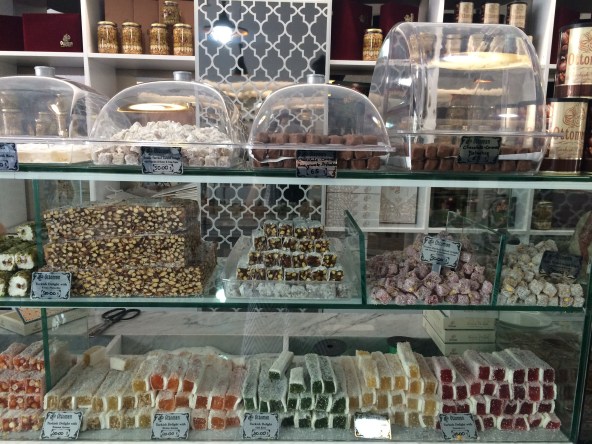
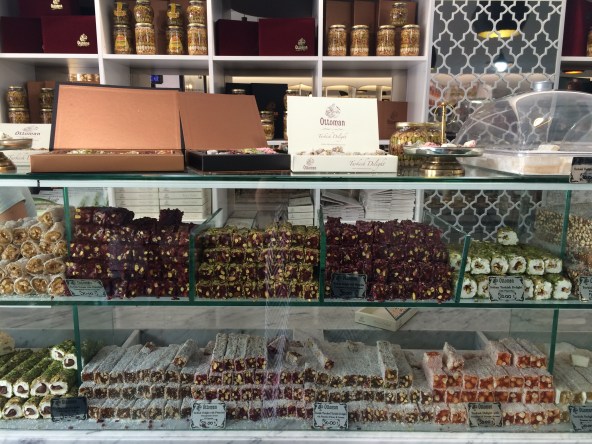
You might be wondering what authentic Turkish Delight is like. I can’t claim to have eaten a lot of Turkish Delight in my life, but I can say that nothing I’ve had before or since this trip has been anything close to what we ate. Here is the Turkish Delight shop near our apartment where I filled a big box to bring to my colleagues.
img_6943

img_6944

Turkish Delight comes in a huge array of flavors, and all of them are delicious!

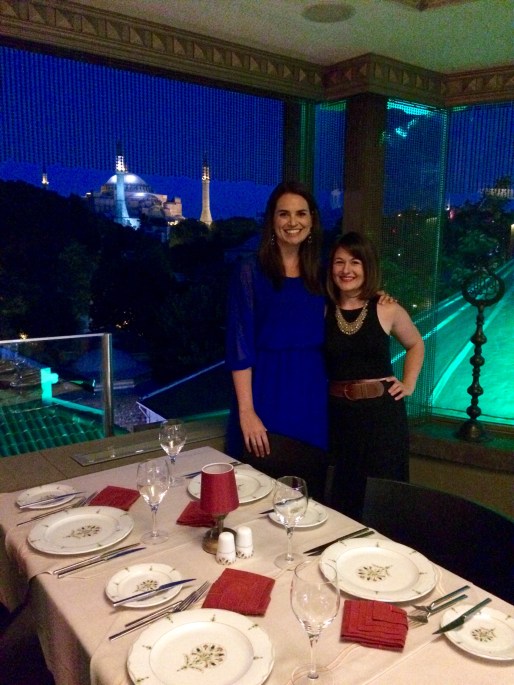
Mary and I decided to end our trip by staying in a five star hotel on our last night; we crossed the river and stayed closer to the main tourist sites. We ended up having our last dinner in the rooftop restaurant of our hotel, and while the meal itself was wonderful, the view was the best part.
img_6968

Me and Mary, with the Hagia Sophia in the background

In summary: Istanbul was a beautiful city, one in which I could easily imagine living. It’s right up there with Paris and Rio in terms of cities where I have felt a real connection, as if it’s possible I lived there in a past life. I’ve been watching a Turkish television show on Netflix recently, and it has only increased my desire to learn more about Turkish culture and see more of the rest of the country, as I recognize that Istanbul is but one city in a very large country. I hope that the security situation settles down so that everyone can soon feel comfortable going there again, and I look forward to visiting Istanbul again sometime in the future.
Solo Trips from 2016: Bilbao and Lyon

Last week I discussed my experience as a solo (and female) traveler with one of my high school teachers, and I realized that I had failed to recount those experiences here. One of the side effects of living in Europe and the comparative ease of international travel in this region is that weekend trips to other countries feel much the same as weekend trips to other states within the US; as a result, it’s easy for me to forget that they qualify as the type of travel on which this blog focuses!

I posted previously about my first solo trip, to Barcelona just after my 30th birthday in 2015. That trip was a great success and gave me the confidence necessary to embark on further solo trips, at least to places within Europe where I can speak the language and feel the minimum level of comfort necessary for such an undertaking.

Bilbao

I booked the trip to Bilbao in March. After such a great time in Argentina for New Year’s, I was aching for another chance to speak Spanish, and I remembered that the New York Times had recently done one of its “36 Hours” features on Bilbao. I booked on a Monday and left on Friday night.

According to what I’ve read, Bilbao’s reputation is in the process of transitioning from that of an unpleasant industrial city to that of the more modern and chic variety. I had a hard time believing that anyone could have previously disliked Bilbao: I found it charming. It is a relatively small city whose center can be easily traversed on foot in 35 minutes or so. I stayed right in the middle of everything, in a hotel about a 15-minute walk southeast of the Guggenheim.

I arrived late on Friday night and didn’t pressure myself to accomplish anything in particular upon my arrival, especially since it was raining. Nonetheless, feeling that it would not be acceptable to simply go to sleep, I grabbed an umbrella and set off on a reconnaissance mission of sorts. I had a list of pintxos and cocktail bars that I wanted to scope out for the following day, and I walked a big loop to see a few of them and generally get a feel for the geography. Bilbao’s center is organized in a simple grid, so it was easy to find my way around without relying heavily on my phone.

I wasn’t hungry and hadn’t yet summoned enough courage to enter a bar alone, so after my little walking tour I went back to the hotel and took pleasure in watching Spanish Netflix. (The UK Netflix library is awful – those of you in the US should not take for granted the far superior titles available to you!) One of the beautiful things about speaking a foreign language is that you can do something like watch a movie in that language and feel like you’re accomplishing something intellectual. I happened upon a Spanish television show telling the story of Queen Isabella (in my the same style as “The Tudors”) and quickly became engrossed, not only because the story was interesting but also because the dialogue took place entirely in the Spanish that was spoken at that time. I could only watch with Spanish subtitles, which were actually very helpful. I am a big language nerd and was fascinated by the linguistic differences!

In a similar vein, one of the nice things about traveling alone is that you do only what you want to do. Had someone else been with me, I likely wouldn’t have felt comfortable staying in my room and watching Netflix even though, as explained above, for me that was an entirely enjoyable and useful activity. (Sure, it can feel a little sad or weird to be in a hotel room by yourself and without a friend nearby, but sometimes that’s just life!) I think one of the lessons of solo travel is becoming more comfortable in your own skin; somehow being alone in a foreign place feels different from being alone in your home city.

Saturday was a busy day for me; I had a long list of things to see, many of which would involve eating. I had prepared a Google Map of the city with all of my destinations saved, so it was easy to navigate efficiently. I had relied entirely on TripAdvisor, and I think almost everything I ate or drank came from one of the places for which I’d read a recommendation.

One of the lessons I learned, to go back to the idea of feeling comfortable when traveling alone, is that there’s no harm in trying to transplant a bit of your usual routine or something familiar into the new place. For instance, I happened upon Sephora, the French cosmetics store I came to know intimately while living in Paris. We don’t have Sephoras in the UK, so I was justified in going in, but my time in Sephora served the dual purpose of helping me take a break from feeling the foreign-ness of where I was and what I was doing. It was something familiar, except that the product labels were in Spanish! Watching Netflix qualifies as the same type of activity – it wasn’t just like being at home because I had access to an entirely new library of films and shows, but it also wasn’t something that further highlighted the fact that I was in a strange place alone.

My favorite part of Saturday was going to the Corte Inglés, Spain’s principal department store. My hotel was a five minute walk away, and I logged over an hour inside. I delighted in the kitchenwares section, where I found a pan designed specifically for making tortilla española (and in this case, for people like me who have not yet mastered the art of flipping the tortilla halfway through). I also bought two glass champagne coupes (now the vessel of choice for many artisan cocktails), which I mention because a) I’d tried to find ones of exactly the right shape and height all over London, including in antiques shops and b) they cost a mere 3 euros a piece – go figure! I spent probably an additional 40 minutes in just the books department; whenever I am in a bookstore in a Spanish or French-speaking country, I feel so tempted to buy a bunch of books; they appeal to two sides of my nerdy nature: I am a girl who loves to read, and I am a girl who loves foreign languages. Combine the two and… I have to exercise real restraint, especially since my track record of actually reading books purchased in such circumstances is not the best. I managed to withstand the temptation and instead spent the equivalent amount of money on chocolate. 🙂

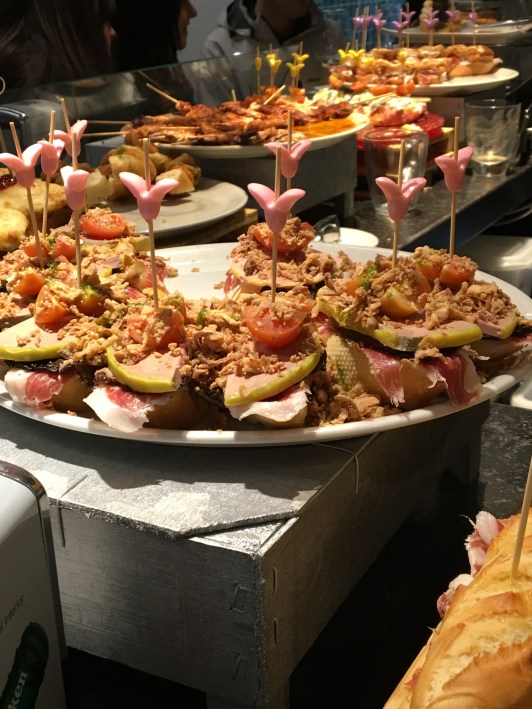
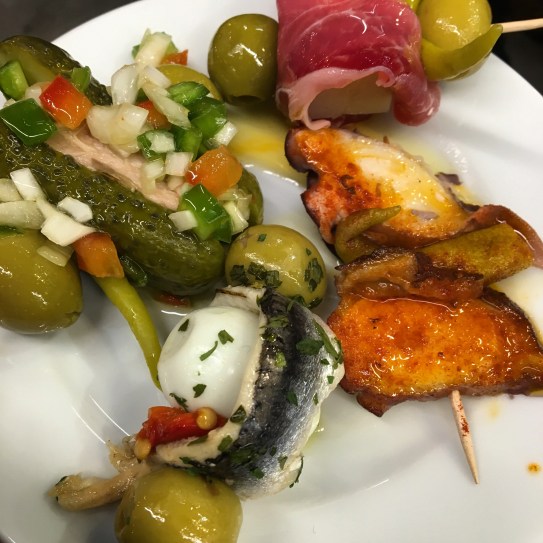
The highlight of the trip was of course the food. Bilbao is part of the Basque region (more on that later) and is famous for its pintxos (tapas), which are even more ubiquitous there than in the rest of the country. Practically every block had at least one pinxtos bar, where throughout the day and night a colorful medley of pintxos were laid out on the bar, ready to be grabbed and eaten along with a cheap (but delicious) glass of wine.

img_5967

My introduction to this experience was the covered market across the river, which like the famous market in Barcelona was a mixture of produce, meat, fish, and cheese stands as well as pintxos establishments. The place was packed on Saturday afternoon, and the only thing harder than finding a place on which to put my food was picking that food in the first place. I got a bit of everything and even took advantage of some free wine tasting. The market was the perfect place to come alone because there were so many people around, and the atmosphere was totally distinct from that of a regular bar or restaurant.

img_5965

My culinary experiences later in the day were just as satisfying from a taste perspective but more difficult from a solo traveler perspective. The clientele at the pintxos bars I visited later seemed generally disinclined to engage with me as someone there alone; everyone seemed to be there in large groups or in a couple, so no one was looking for someone else to talk to. (I wonder now how many times I might have failed to notice someone alone in a similar situation.) I was more surprised that the men behind the bar weren’t inclined to chat with me – it’s been my general experience (recognizing that my experience being in similar situations is limited) that men serving drinks are not unwilling to chat with women, and it was obvious that I spoke Spanish, so I was disappointed that no one struck up a conversation with me. The only time in the span of about three hours that I did talk to someone was when standing next to an older couple. I don’t remember how we started talking (something must have triggered them saying something to me), but I spoke with them for about 10 minutes and was grateful for the interaction. I don’t think eating alone is as hard as I had previously thought, but in this case it was made more difficult by the fact that I was always standing at a bar – I wasn’t seated at a table where I could get out a book and tune out what was going on around me.

I did manage to have an extended conversation later in the evening with the owner and chief bartender of a cocktail bar that was surprisingly devoid of patrons, even at 11 p.m. I had walked past the night before and found it similarly empty, but I had read a lot about it and really wanted to try one of their drinks, so this time I was undeterred by the emptiness. The owner asked me what I wanted to have and (this is the mark of all good bartenders) readily invented something for me based on my response. I had finished the whole drink by the time anyone else entered the bar! I still don’t know how a bar was empty on a Saturday night.

I did feel a bit discouraged and lonely after the evening, but I was proud of myself for sticking it out. After all, I could have just eaten a bunch of pintxos in just one bar and then given up and gone back to the hotel at 8 pm; instead, I stayed out for five hours and went to five or six different places, which is worth celebrating even if I didn’t do much talking!

The next day I was more social because I had arranged to go on a date in the hours before my late afternoon flight! I started the day at the Guggenheim museum, which really is a very cool piece of architecture, and there is a lot of thought-provoking art inside (even if I’m still not the most appreciative of modern art). As a side note, going through museums is the best part of traveling alone – you can go at exactly the pace you want, not spending a moment more or less than you want to spend on any particular piece. Anyway, Iñigo came and picked me up at the Guggenheim around 1:00, and that was the last time I spent alone on that trip.

There is a new trend of “Tinder Tourism” – using Tinder as a means of meeting people while traveling. (For anyone who may not know, Tinder is a dating app that uses your location and shows you a seemingly unlimited array of candidates – you can usually see a few pictures, and you find out their names, ages, and any other small amount of information they want to include on their profile.) Mary and I have previously tried using Tinder together (creating one account with pictures of the both of us and indicating that we’re two friends traveling together) without success, but this was my first time using it successfully as a traveler. I changed my profile to have a message in Spanish explaining that I was an American living in London who was visiting Bilbao for the weekend and interested in sharing pintxos with a local. I love using Tinder outside of London because a) the men always seem to be more attractive (in every way) and b) the men are always more responsive. I got messages from a handful of guys but “hit it off” best with Iñigo. I should appease the worriers out there by saying that of course I approached this with some caution, but really, meeting up with a total stranger in a foreign city isn’t radically different from meeting up with a total stranger in the city where you live!

Iñigo turned out to be a very nice guy; we spoke Spanish the whole time, of course, and he told me more about what it’s like to live in the Basque region. As in Barcelona (where Catalan is the official language), all of the street signs in Bilbao are in both Spanish and Basque; according to Iñigo, everyone grows up speaking both interchangeably; both are taught in school. (This is pretty impressive because Basque is a totally different language, unlike Catalan, which isn’t all that different from Spanish.) We didn’t discuss the grittier political issues like the movement for Basque independence from Spain, but we kept our general conversation going pretty easily. (First dates are wonderfully low key when you go into them knowing that they are also, in all likelihood, the only date you’ll ever go on with that person!) Iñigo took me across the river to the old town (part of which I’d explored the day before) and to a crowded pintxo bar just off a big square. It was clearly the place to be on Sunday afternoon; people seemed to be there with their entire family, and everyone from the age of six months to 85 was enjoying the array of food and drinks. We grabbed a bunch of pintxos, including one that was not immediately identifiable to me, and we had a funny couple of minutes as Iñigo tried to convince me I didn’t want to know what it was – it turned out to be blood sausage, which I quickly explained was no big deal and something I was quite fond of eating! After spending a while there, we wandered around for a bit and eventually decided to spend the remaining time I had drinking beer at a place down the street from my hotel. It was a really nice way to spend my last few hours in Bilbao; travel is always enhanced by the interactions you have with locals, and what better way to interact with a local than to go on a date with one?!

In summary: overall I had a very nice time in Bilbao. It was a stress-free and refreshing weekend away that, despite not being quite as socially engaging as my trip to Barcelona, was nonetheless quite enjoyable (the food was so good…) and helped me feel a different type of confidence and self-reliance about traveling alone. I was fortunate to go on a lot of great trips in 2016, but my trips to Bilbao and Lyon are ones that pop into my head especially frequently – perhaps because I shared them with no one but myself.

Lyon

I went to Lyon at the end of the summer, over the UK equivalent of Labor Day weekend. I knew it was likely my last time to get away for a while, and I decided it was high time that I forced myself to go somewhere other than Paris in France. Of course, I still allowed myself some time in Paris – I arrived in Paris on Friday and took the train to Lyon on Sunday morning.

Thanks to my friend Colleen who had studied abroad in Lyon during undergrad, I arrived in the city with some more personalized recommendations, and as I’d done for Bilbao, I plotted everything onto a Google Map. I checked into my Airbnb apartment in the center of town and then did a small loop around the neighborhood before sitting down for lunch. Lyon forced me to get comfortable eating alone – I ate two lunches and two dinners in restaurants, so I really had to face the fact that there was no one sitting across from me. For this first lunch, I was sitting outside, so the passersby provided some distraction.

After lunch, I walked about 40 minutes over to the History Center of the Resistance and Deportation, which is a museum dedicated to France during World War II. Everything is in French, so there was plenty of opportunity for me to practice my reading! I knew very little about occupied France and the Vichy government and even less about the treatment of Jews during the occupation, so this was very educational for me. I ended my visit with a 40-minute mini-documentary about the trial of Klaus Barbie, one of the Nazi officers in France who was ultimately convicted in France of crimes against humanity. Since international criminal law is my passion, I really enjoyed getting to watch the footage of the trial, and the statements from the witness helped to contextualize everything I’d just seen in the exhibits.

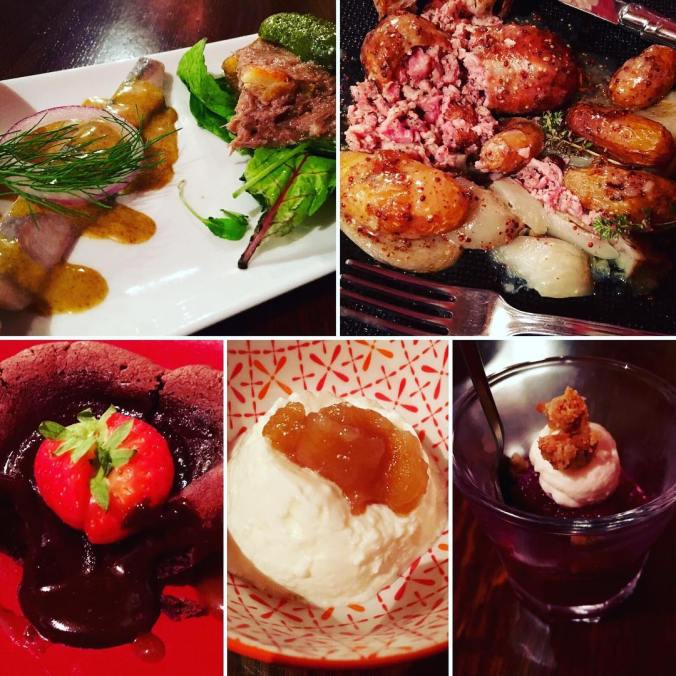
I spent the remainder of the afternoon walking around even more and covered a lot of ground. I eventually made my way to the Le Bouchon des Filles, which was my dinner destination. Lyon is famous for its food (even in a country already famous for its food), and bouchons are its claim to fame. They specialize in what might be categorized as “country” fare, made with simple ingredients that often include parts of the animal that many might prefer not to have identified. I had heard from multiple sources that Le Bouchon des Filles was one of the best, so I made sure I was there when they opened in order to get a table. What a spread and what a value: I paid a total of 26 euros for a starter of smoked flounder and chilled beef tenderloin, a beetroot amouse-bouche, a main of andouillette (sausage featuring that meat you don’t want identified), and a dessert of fromage blanc with pear compote and a gooey chocolate cake with salted caramel. It was INCREDIBLE. And although I felt a bit awkward eating in the restaurant alone (it’s definitely harder inside), I was in good company; another woman came in by herself a few minutes after me and was seated near me. (I was tempted to ask her to join me but couldn’t quite work up the nerve – partially because I couldn’t tell if she was French or something else.)

14063624_1613236568975014_2028644138_n1

On Monday, I visited the Musée des Beaux-Arts, which was huge and had plenty of items to help me pass the time – I didn’t see everything. When I was ready for lunch, I returned to a place I’d passed the day before that looked great and specialized in tartines. It had been very crowded on Sunday and was no different on Monday, but I had nothing else to do and was willing to wait. I had a heartwarming conversation with a waiter:

Waiter: Can I help you, mademoiselle?

Me: Do you have a table available for one person? I’m alone.

Waiter: You are not alone, mademoiselle! I am here with you, and I will take care of you!

And sure enough, the kind older man had me seated at a table (sadly, not in his own section) less than five minutes later. (A linguistic note: in French, the word “seule” means both “alone” and “lonely” – at least in Spanish, where those two words are “sola” and “sóla”, you have the accent to differentiate! This is not the first conversation I’ve had where I haven’t been entirely confident that my use of the word “seule” was taken as “alone” rather than “lonely”.)

At any rate, I had a delicious tartine featuring three different kinds of cheese. It was a grilled cheese sandwich the likes of which I could never dream of in the US…

My last meal in Lyon was my most anticipated as I’d managed to get a restaurant at a relatively famous restaurant: Le Sud, one of four restaurants in a chain (each named after a direction – there is also Le Nord, L’Ouest, and L’Est) owned by a famous chef. Fortunately for me, I was able to sit outside, and I ended up not touching the Kindle on which I’d expected to rely. I had a prime view of not only the passersby (and we were just off a huge square, so there were plenty) but also a gorgeous sunset taking place behind a church. The meal itself was lovely; my favorite course was the dessert, for which I allowed myself the indulgence of waffles with a variety of homemade sauces and compotes.

I had more reason to feel isolated in Lyon than in Bilbao. Because I was there on Sunday and Monday, none of the bars I would otherwise have visited were open, so my only nighttime activities were eating dinner and walking around; there wasn’t really an opportunity to meet other people. I did dabble in Tinder again but didn’t get as far as I had in Bilbao. So essentially, I spent about 48 hours not only by myself but also without really talking to anyone except waiters. But that was okay too; as I discussed earlier, one of the tricks of solo travel is to just incorporate something from your usual routine. I usually FaceTime with Mary on Sundays, so that’s what I did on Sunday night there after I returned from my dinner at Le Bouchon des Filles. I also watched a little Netflix (again, the French library is superior!) and did give in to my urge to buy a French book, so I had that to read as well. And despite all of the quiet, I look back on that trip often and fondly.

~~~~

2017 is going to be a big year for me (I am about to move back to Paris!), and I’m not sure what sort of travel it will hold – but I am glad that I pushed myself in 2016 to go on these two trips. Both have made me better prepared for future solo travel, and while I think my preference will always be to travel with someone else, I’m no longer afraid to go by myself and can appreciate certain ways in which it can actually be quite nice to travel solo. I hope others reading this will feel similarly comfortable and will have the courage to go it alone! Travel is too important and too enjoyable to avoid simply because of a lack of partner.

Rome… in 2002 and 2016

I spent my four-day Easter weekend in Rome. This trip had special significance for me because Rome is the very first city that I visited outside the United States – and I hadn’t been back there since 2002.

I wish blogs had been a thing back then. It’s so strange now to think about how much things have evolved even within this millennium. The last time I was in Rome, none of my friends had cell phones; we took pictures on non-digital cameras with actual film inside and called home occasionally using a calling card at a pay phone. I scanned some of those photos but have long since discarded the original prints. However, I do still have the journal I kept during the trip.

I was last in Rome as part of a high school trip with about 30 other kids, including a fair number of my closest friends. My high school’s theme of government and international studies meant that we all studied multiple languages and that we had our choice of a few international trips to help us apply our studies. The Italy trip was the longest running and most popular of the trips, partially because, well, Italy, and partially because the three teachers who ran it couldn’t have been more qualified to do so. We had with us a Latin teacher who knows everything there is to know about the Roman empire, an Italian teacher (who also happened to be my French teacher), and an art history teacher – all of whom, in addition to being exceptionally knowledgeable about their respective areas of expertise, are amazing people who treated us with a degree of trust and equanimity not often bestowed on high school students.

That trip was a major turning point in my life. We can all identify experiences that changed us and set us on different paths, and in some ways the Italy trip is the most formative experience I’ve had in my nearly 31 years of life. It’s easy to see why. I had my first (limited) exposure to foreign languages in elementary school, when my principal used to give us a few Spanish lessons on random afternoons. I loved the idea of learning how to say things in a different language, so when I had the good fortune to go to a middle school with a French teacher renowned throughout the city, I dug a deeper foundation for a love of foreign languages. During that time one of my friends pointed out to me that I should be a lawyer because I always win my arguments, and when I related that to my mother, she said “you should be an international lawyer!” And then what did I do? I went to my internationally-focused high school, where I studied French, Spanish, and Italian, and then went to college, where I majored in International Relations and Hispanic Studies and spent most of my free time doing Model UN and planning my future career as a lawyer working abroad. What am I doing now? Working as a lawyer in London (and getting to use Spanish and French upon occasion at work). Pretty cool.

But I probably wouldn’t have had nearly the same drive to pursue a career abroad were it not for that trip to Italy when I was 17. It’s hard now to know to what extent I was really conscious of this during and immediately after the trip, but certainly when I think back now I think of that trip as the origin of my desire to live outside the United States. Speaking another language was just as enjoyable in real life as it had been in the classroom. I marveled at how delicious the food was, how much older everything was and looked, the history that oozed out of every stone, the fashionable dress of the Italians, the completely different approach to city planning, and the innumerable other differences, large and small, between the United States and everywhere we went in Italy.

Because we received academic credit for the trip (and it really did involve quite a lot of formal learning; we had to give presentations), we had to keep journals, for which we were also graded. When I read mine now, I have to laugh. It sounds exactly like the journal of a 17-year-old American who is abroad for the first time. My next major experience in Europe was when I spent the summer studying in Spain in 2005, and at that time I had very firm opinions about the right and wrong attitudes to have when being abroad, first and foremost appreciating the distinction between “different” and “weird”. I have always assumed that I had that attitude in 2002 as well, but judging solely by my journal, I’m not sure I did. I loved many things that were different about Italy, but I was more likely to note the things that were different in a not-so-good way, with or without a judgmental tone. Like my decision to live abroad, I think my “how to be a good traveler” inclinations can be attributed to the Italy trip, but they perhaps took root just afterward rather than in the midst of the experience.

At any rate, I have no idea why it took me so long to get back to Rome; it was my favorite place that we visited on that trip and remained at the top of my list of favorite cities for quite a long time, perhaps until I went to Rio. I’d never had an experience of going back to a place I had been once before after such a long lapse of time, and I was curious to see what I would remember.

Two things about Rome stand out very clearly in my mind from my 2002 trip: it gets blazingly hot in the summer, and the fact that we walked everywhere only made the memory of the heat more pronounced. Rome was our first (and last) stop on the three-week trip, so naturally it was there that my specially bought walking sandals gave me horrible blisters that made the walking – for which we, as Americans, were not naturally prepared – all the more unpleasantly memorable. There’s a point in my journal where I complain (or brag?) “Mr. Ross walked us across half of Rome today!”

I don’t doubt the veracity of that statement, but it’s funny how perspectives change. Of course my 17-year-old self was astonished by the idea of walking across half of a city; we drive everywhere in the US, and the bulk of my physical activity came from swim practice. Walking to a place that was a five-minute drive away had never occurred to me; why would you walk instead of drive, even such a short distance? So you can imagine how mind-blowing it was that we were walking distances that would have taken as much as 20 minutes to drive.

It took me about 10 minutes of being in Rome this time around to realize how skewed my perception had been. Now that I’ve been living in Europe for nearly three years, I’ve grown quite accustomed to walking and actively embrace the opportunity. In Paris I often spent 70-90 minutes a day walking to and from school, and now I have a 20-minute walk between my house and my office (and I live where I do precisely because I want to be able to walk). Once I had dropped my suitcase at my hotel on the northeastern edge of the city center (near the Termini train station), I needed to get over to the Vatican for a 1:30 entrance time to the Musei Vaticani. If you look at a map, it’s not a short distance, and I was a little concerned about time, but I went for it anyway, and pretty soon I realized a few things.

First, Rome (or at least the center) is not nearly as large as I thought. The journey from my hotel to the Vatican only took me about 45 minutes, and I was essentially walking from one edge of the center to the other. Second, I hadn’t learned much about the geography of the city last time because our teachers led us everywhere. We got to go off for lunches on our own, but we never ventured beyond the confines of the neighborhood in which we were, so I never had the opportunity to independently connect the dots between, say, the Pantheon and the Trevi Fountain. (Our teachers also often didn’t tell us where we were going while we were on the move, so we weren’t usually in a position to make those connections. I distinctly remember that on our first morning in Rome we set off from Termini without any idea of where we were going and that after walking through a bunch of smaller streets we turned a corner and suddenly the Colosseum was in front of us. I’ve sometimes wondered if Mr. Ross did that on purpose for dramatic effect.) Third and finally, Rome’s not as confusing to navigate as I thought. I remembered a tangled web of narrow streets without much visibility about where things led, but I found it remarkably easy this time around to rely on my sense of direction in order to get from one point to another.

Aside from the big realization about the size and navigability of the city, my other big take-away from the 2016 trip was that I remembered almost nothing of what I’d seen in 2002. Yes, I vaguely remembered being inside the Colosseum (enough to know that it was different this time) and Saint Peter’s and the Sistine Chapel and the Forum… but in terms of small details within museums and churches (or churches generally), I might as well have never been there before. My first day (Friday) was my “take a trip down memory lane” day, so I went to the Musei Vaticani and the Musei Capitolini – the two museums that stick out in my mind as being the most significant on our 2002 trip.  I tell you, a grand total of two things were familiar to me about the Musei Vaticani: the Sistine Chapel (specifically, that everyone takes pictures despite the staff interspersed throughout the crowd) and the spiral staircase at the exit. That is literally it. The room with Raphael’s “School of Athens” was such an unfamiliar space to me that I actually passed through without realizing it was there (which is really sad because that painting was something I had really wanted to see again, and once you go through it’s hard to turn around).

The Capitoline Museums were slightly more familiar to me, but only from the outside. I remembered that they overlooked the Forum, that there was an equestrian statue of Marcus Aurelius in the center of the courtyard, that a grand staircase led down to the street, and that we often used to reassemble after lunch in the shade of the portico on one side of the courtyard. I definitely had a moment of looking at that spot in the shade and remembering us drinking our water in a futile attempt to beat the heat. Inside the museum, however, I was just as clueless as I’d been at the Vatican. I feel like we spent a LOT of time in that museum and that it contained a LOT of stuff that was really important, but nothing looked familiar to me… and without Mr. Ross to explain everything in detail, it was a pretty empty experience, except for the following.

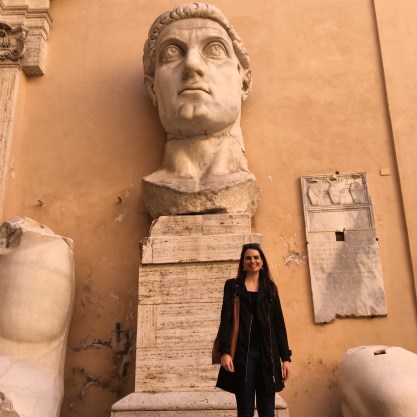
It had become tradition for each Italy trip to take THE group photo of the trip with Constantine’s head at the Capitoline Museum. Finally seeing that head was an exciting moment for me in 2002; I’d seen it in pictures from trips past and couldn’t wait for us to have our own shot with it. I still have the (scanned!) picture from 2002:

1930399_533660263467_8052_n

The GSGIS 2002 Italy Trip

(I’m the third from the left in the back row.) Obviously, one of my first thoughts in approaching this return trip was “I have to take a new picture with Constantine.” So here we are, me with Constantine in 2016:

IMG_6054.jpg

I feel lonely in this picture!

To close out the nostalgia, I’ll just note that I didn’t feel particularly sad to find that so much had become unfamiliar to me. It actually almost seems appropriate. As much as the 2002 Italy trip was a bridge into the future that has become my present, it was also the end of another era of my life. I’m glad that forgetting so much allowed me to have an almost entirely new experience this time.

(One final thing for the record. Many people, in discussing how my trip to Rome in 2016 would be different from the one in 2002, commented about how I’d probably drink the same amount of alcohol. I just want to note that although wine was sometimes inevitably served at our dinners – our teachers often knew the proprietors of the restaurants where we’d go as a large group, and Italians are obviously completely used to teenagers drinking wine at meals – I was essentially a goody-two-shoes back then and also had no appreciation for wine, so my consumption was very minimal.)

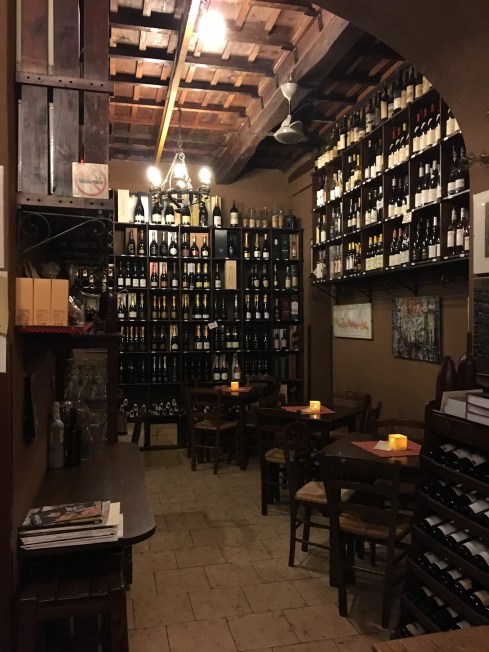
Which is why it’s appropriate that my first evening in Rome began at a wine bar. I met up with an Australian friend of mine from London (we became friends thanks to a book event about Paris, which just goes to show that the magic of Paris extends beyond the French border) and her boyfriend, and we accomplished the truly remarkable feat of finding a place that seemed to be crowded with Italians rather than tourists. We got there just as it opened at 6:30, which was lucky because by the time we left the place was completely full. Isn’t this exactly how a wine bar should look?

IMG_6072.jpg

We had a lovely bottle of Italian red and, of course, some bruschetta and anchovies. (It was Good Friday, so we were trying to be good and avoid meat – which was surprisingly difficult to do in the city that has been home to the Catholic church all these years.) After the wine bar we moved on in search of a restaurant just north of the Piazza Navona that had been recommended to them, and although we didn’t find it, we ended up in a place that suited us just as well. We got what was marketed to us as ONE appetizer, a collection of Roman antipasti. Look at what that one appetizer included:

IMG_6075.jpg

artichokes, green beans, mushrooms, zucchini, cauliflower, buffalo mozzarella, prosciutto (whoops), and of course bread

Next we enjoyed what was essentially a flight of pastas. We ended up with only two, which I think is only because we communicated that we really couldn’t have possibly each had a third plate of pasta. Both were delicious; the second boasted a sauce made entirely of a reduction of two types of cheese. YES PLEASE. And, obviously, they gave us some limoncello “on the house” at the end of the meal to aid our digestion of their food as well as the gelatto that we felt was our cultural imperative to have as dessert.

Not that I would have felt guilty about all of this food in the first place (that’s just a losing battle if you’re in Italy and completely misses the point of being there), but I walked about 30,000 steps – almost four trips across the center of the city – that day, so I totally earned it.

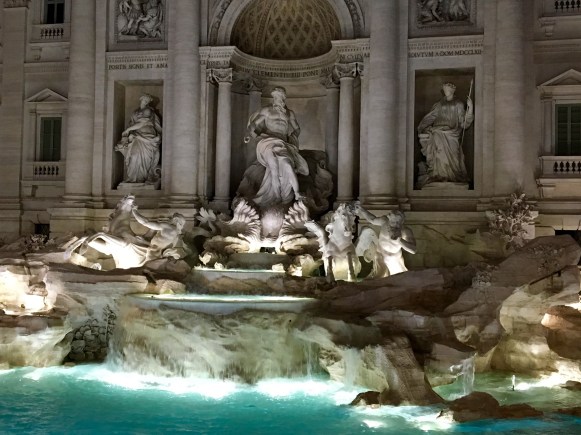
My last stop of the day was at the Trevi Fountain. This picture (for whatever reason) now holds the record of the most likes I’ve received for any picture I’ve posted on Instagram:

IMG_6079.jpg

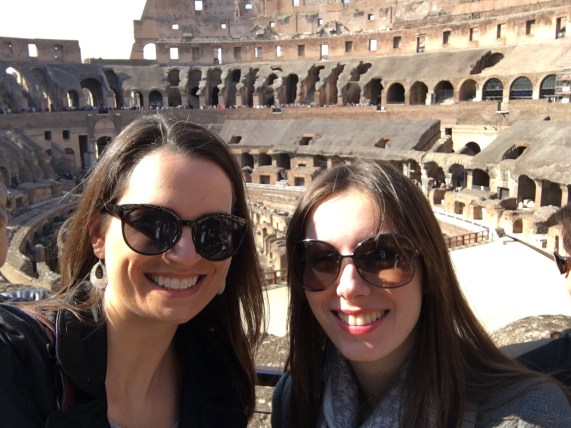
My Croatian friend Iva joined me on Saturday; it was her first time in Rome, and by then I’d familiarized myself enough that I could lead us around pretty easily. The weather was gorgeous – completely clear blue sky and warm enough in the sun that I took off my jacket (for the first time in months). We spent the afternoon at the Colosseum (including a rather long wait in a confusing line, but whatever) and the Forum. I once again missed having Mr. Ross as my tour guide; I remember him having so much to say while we were in the Forum.

IMG_6087

me and Iva inside the Colosseum

IMG_6067

the still awe-inspiring Roman Forum

Easter Sunday was just as lovely in terms of weather. Now, I should note that I hadn’t chosen to come to Rome that weekend because it was Easter specifically; I came because I had a four-day weekend, and I felt that I needed four days in order to do Rome properly (which was true). The fact that I am a Catholic [who doesn’t go to mass] was just icing on the cake. Iva is more of a practicing Catholic than I am, but I think we were ultimately equally excited about the prospect of being in Saint Peter’s Square on Easter Sunday.

We decided to approach things casually. Because the Brussels terrorist attacks had taken place earlier that week, we weren’t sure how many people would actually turn up in the square (we’d heard that a lot of pilgrims had cancelled their trips). Iva is from a major city in Croatia, but any city in Croatia is small compared to other major European capitals, so she was feeling nervous about being in a place that was naturally more of a target. We figured as long as we could see the Pope’s balcony and hear the noon blessing, we’d be happy.

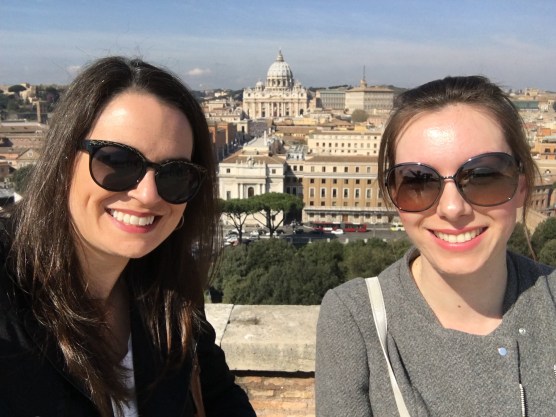
We started the day nearby at the Castel Sant’Angelo. I actually didn’t go here in 2002, so it was cool to do something entirely new! It’s well worth a visit; the views of the Vatican are great, and the views of the rest of the city are arguably better than those from the dome of Saint Peter’s (not to mention exponentially easier to achieve).

IMG_6164.jpg

We had a pretty clear vantage point of the way leading into Saint Peter’s Square and didn’t feel particularly pressed to get over there – from what we could tell, people hadn’t extended much beyond the square itself. We arrived at the security checkpoint on that street (about four blocks back from the square) around 11:30. There were barricades to control the flow of people, and policemen were checking bags, but otherwise it wasn’t a particularly complicated procedure.
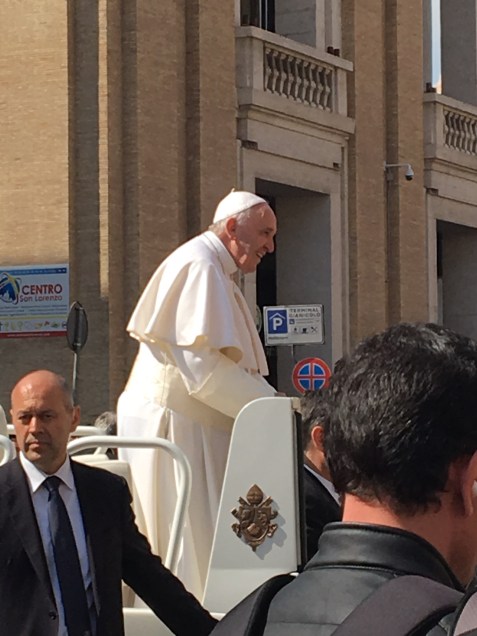
We had made it to what seemed like a final barricade in the middle of the street and were prepared to stand there the rest of the time when suddenly I looked a little further ahead and realized that the Pope was in the Popemobile and driving straight at us! Neither of us had any idea that this would happen, and it was pure good luck that we happened to be in the right place at the right time. We were in the front of the barricade and ultimately weren’t more than five meters away from him!

IMG_6183.jpg

Pope Francis!

We spent the rest of the day (and the rest of the trip) periodically commenting to each other, “we saw the Pope!” It was such a cool surprise, especially given that as it turns out you can barely see him when he’s on the balcony. We had a clear vantage point (from just outside the square) by the time he came out at noon to give the blessing, and although we could distinguish individual people, that was the greatest detail we could see. I’m so glad that I got the chance to see someone whom I admire so much and who is doing so much to lead the Church towards a more liberal approach to the modern world. And it was great to be part of that crowd of the faithful on Easter Sunday.

After the blessing, we joined the throng filing out of Vatican City and walked for a while along the south side of the Tiber until we got to Trastavere. We ate some pizza on the steps of a fountain (mine had truffles on it; amazing) and then got gelatto to celebrate Iva’s post-Lent ability to eat sweets.
IMG_6197.jpg

Tiramisu and dulce de leche. Sinfully delicious.
After walking quite a bit further through the south side, we crossed back over to the north side and into an area of the city that I vaguely remembered as being a little seedier. (I noted in my journal that while walking to see a church we passed a man who was wanking off on the side of the street, which needless to say was somewhat traumatizing for me.) We walked to see Rome’s random Egyptian pyramid and then backtracked a bit to rest in a rather dirty park where some Italians were lying in the grass or having Easter picnics. Finally we had a nice little uphill hike to see something else I hadn’t seen before, the famous keyhole of the Knights of Malta. Until we reached the square with the keyhole, I think we had spent nearly an hour without seeing any tourists.

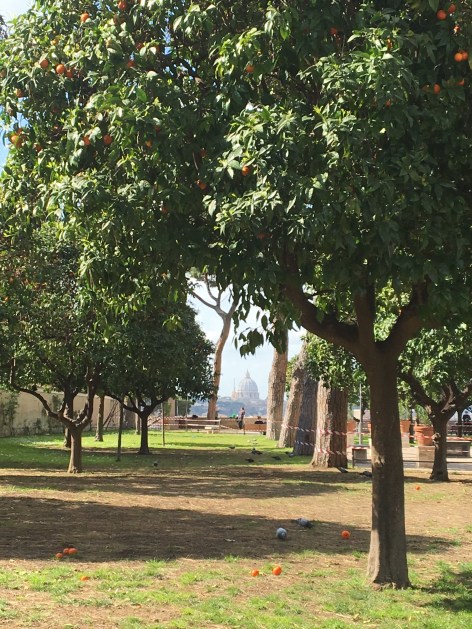
The keyhole was underwhelming, and I do not recommend seeking it out. It’s cool in that yes, you look through a keyhole in a large door and see Saint Peter’s with trees on either side, but you can’t take a picture of that image, and you have to wait in line for about 15 minutes for that five-second experience. Not worth it! However, the immediate area is lovely. We continued down the road and looked inside two very old churches, then we sat in the lovely orange and rose garden with a great view:

IMG_6206.jpg

That’s Saint Peter’s beyond the trees.

We decided to find the Spanish Steps before calling it quits for the day, so we walked about 30 minutes north from there. Part of the steps are covered with scaffolding now, so I didn’t take a picture, but we had a good time seeing where all of the good shopping in Rome is. (Gucci, Prada, etc. are all around there.)

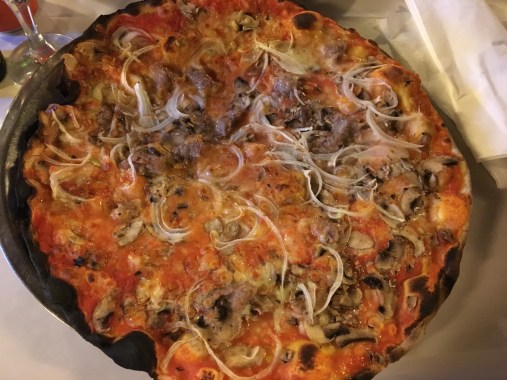
On Sunday night we managed to score seats in the famous Pizzeria da Baffetto just down the street from our apartment. The previous night there had been a continuous and very long line to get in, so we hadn’t been optimistic, but on Easter it went from being completely closed (no one inside) at 6 p.m. to being open at 6:30, and we got there around 6:45. Neither of us thought it was the best pizza we’d had; mine looked great, but I couldn’t really taste any of the tomato, and that’s a pretty important part! I did, however, spark the interest of our waiter, who whispered to me on our way out, “I love you!”

IMG_6219.jpg

Iva had her heart set on getting some chocolate cake to make up for the sweets she hadn’t eaten during Lent, so we ended up at a cute restaurant a little further away with a very effective guy in the role of front of the house – he saw us pass on the street, told us to come back in two minutes, and had us seated three minutes later. This place was just off the southern end of the Piazza Navona, so there was great people watching, and that guy and one of his waiter colleagues proved very entertaining as well. The waiter took a fancy to Iva, while the other guy seemed most interested in me. At the end of the night, Iva received a handwritten note from the waiter with his name, phone number, and “see you later! kiss!” on it. We were chuckling over that when the other guy came over and commented “I’m more efficient”, proceeding to hand me a small piece of paper on which was typed his name, his number, and the tagline “Love in Rome.” I’m 100% serious, and if I were skilled enough with photo editing to blur out his name and phone number, I’d put a picture of the note here. They weren’t keen to let us leave and tried very hard to extract from us a promise that we’d come back in 45 minutes when they’d be off work and ready to share a glass of wine with us. We weren’t interested in doing anything physical with them, and we couldn’t think of anything we’d have to talk about, so we didn’t take them up on the offer… but it was flattering and amusing nonetheless!

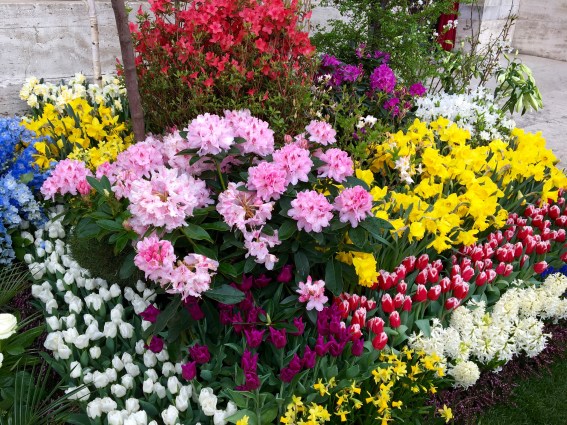
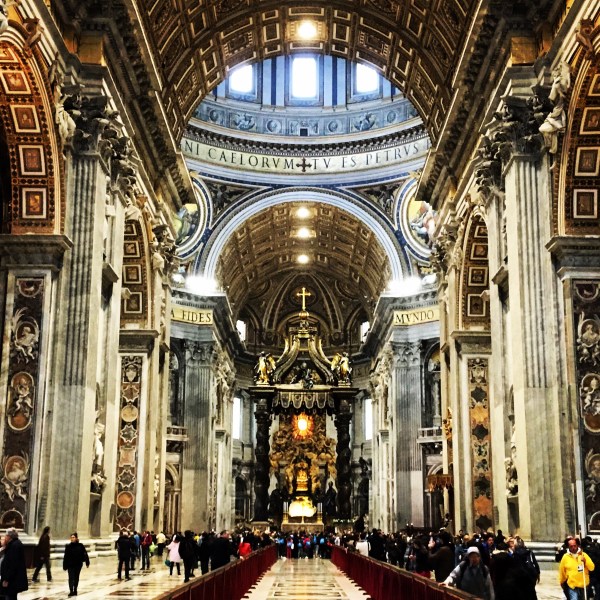
On Monday we got up earlier and spent my last few hours in Rome at Saint Peter’s. The interior was moderately familiar to me; I was glad to re-touch Saint Peter’s foot. The outdoor display from the day before was also lovely:

IMG_6228.jpg

one of several large floral displays on the steps of St. Peter’s, just under the crucifix

IMG_6229.jpg

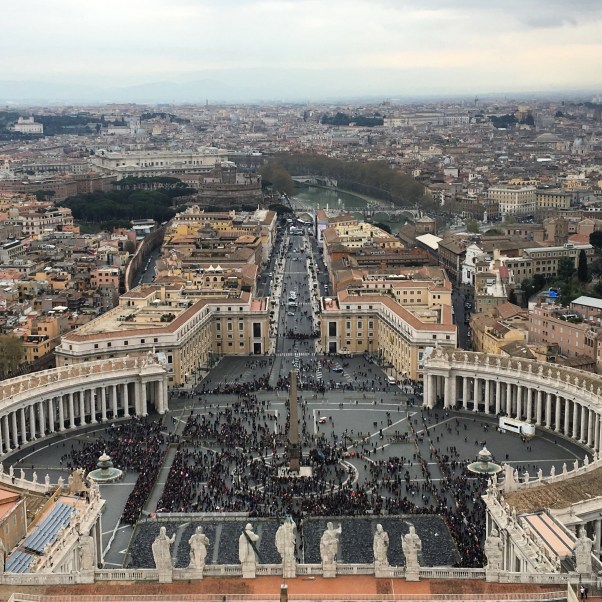
We climbed to the top of the dome (which was actually a bit more arduous than I remembered) and, perhaps because it was cloudy and perhaps because it was just extremely crowded, we weren’t at all sure it was worth the energy or the time. I saw a teenage Italian girl blatantly add her name to the graffiti on the wall and wanted to smack both her and her mother, who handed her the pencil. The nerve! I also saw that a student from Boston College had inscribed her full name along with her school affiliation and was seized by indignation and the desire to contact the [Catholic] school and tell them that their students clearly don’t think much of the Church if they’re willing to deface Saint Peter’s. It’s one thing to write your name in a random bathroom stall, but I found it utterly appalling how many people had written something (or stuck their gum!) on the walls on the top of the dome. I’m sorry to end it on that angry note, but that was the last thing we did before I had to go to the airport!

IMG_6242.jpg

In sum, it was wonderful to go back to Rome – to see things that were familiar yet new, and in the comfort of 65-degree rather than 95-degree weather. Now is the perfect time of year to see the city, and despite it being Easter weekend, I actually thought there were fewer tourists than I’d been expecting. I definitely think I could live in Rome, and it’s now more firmly back towards the top of my list of favorite cities.

New Year, New Country: Uruguay

My last full day in Argentina was actually spent mostly in Uruguay!

The old town of Colonia del Sacramento (now a World Heritage site) is a mere 75-minute boat ride from Buenos Aires, and since Uruguay has the misfortune to just be Argentina’s forgotten neighbor without any individual claims to fame*, we figured we’d better go see it while we had the opportunity… when in doubt, get another stamp in the passport! Uruguay brings my country count to 31 and my Spanish-speaking country count to 9, if you include Puerto Rico. Not bad!

*Note that our favorite red-shirted bartender from Rey de Copas essentially agreed with this assessment; after all, he was an Uruguayan living in Argentina!

Given the utter chaos we’d witnessed at the boat terminal on Wednesday, we were more than a little anxious about whether we’d even make it to Uruguay. As it turned out, we had absolutely no reason to be worried. We arrived a bit over an hour ahead of the boat’s scheduled departure and found the hallway that had previously been jammed with people to be practically deserted in comparison; we got our boarding passes easily and then went through customs, just like you do if taking the Eurostar from London to Paris.

The only problem was that it was raining. It had been cloudy when we woke up, and then about 10 minutes before we left the apartment, despite absolutely no forecast for rain, it started pouring. I looked out the window and remarked “well, at least the street isn’t flooding like it did when I was in Caracas and it rained like this,” but five minutes later I changed my mind – there was a river of water about three feet wide extending into the street from the sidewalk! It wasn’t supposed to be raining in Colonia either, so we weren’t sure what to make of the fact that it was raining in Buenos Aires.

I snoozed the entire trip over, and when we pulled into port, the rain had stopped. We didn’t have any kind of plan for the day, especially since we had no way of knowing what would be open since it was New Year’s Day. (Buenos Aires had been a ghost town – NOTHING was open, and only a few cars were on the roads.) I had a map from my guidebook, and we ultimately just walked out of the terminal and turned left to follow the coastline.

We had made it a block or two into the old town when it started raining again. Mary had an umbrella, but this wasn’t the tranquil kind of rain for which an umbrella will suffice; we rushed into the nearest place with an open door, which turned out to be a nice hotel, and took advantage of their wifi for about 15 minutes before, thankfully, the rain stopped and the sun began to peek out.

IMG_5712.jpg

From that point on, it was a lovely day. The old town reminded me of Old San Juan or the walled part of Cartagena, except smaller and more quaint. We wandered a bit and then found a restaurant recommended by both our guidebooks called The Drugstore. I have no idea why it was called that, but it was a fantastic place to spend a few hours of the afternoon. All of the doors and windows were open to let in the warm breeze, and a woman was singing to set the mood.

IMG_5723.jpg

The right half of this picture was one of the restaurant’s kitchens – just a few yards from our table!

IMG_5724.jpg

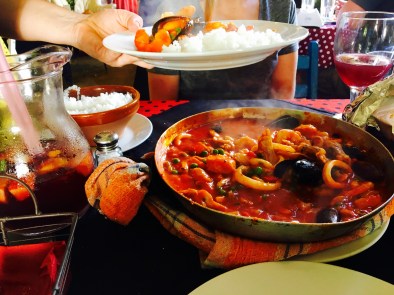
We had a horrible time trying to decide what to eat (there were too many good options), but we eventually went with the recommendation of our waitress and got a seafood stew which was incredible:

IMG_5732.jpg

Fish, squid, mussels, shrimp, and some other creature I couldn’t identify…

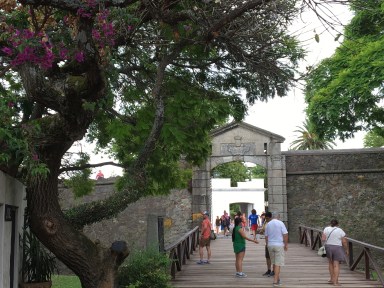
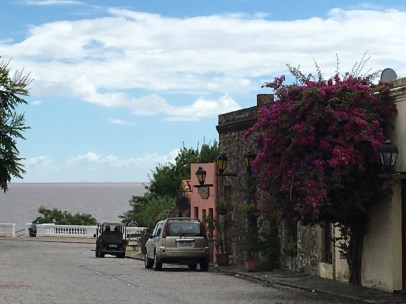
We lingered there, eating the stew and drinking sangria, until about 4:00, at which point we figured we’d better keep exploring. Here are a few pictures of the rest of the town:

IMG_5714.jpg

The gate to the old town

IMG_5720.jpg

IMG_5721

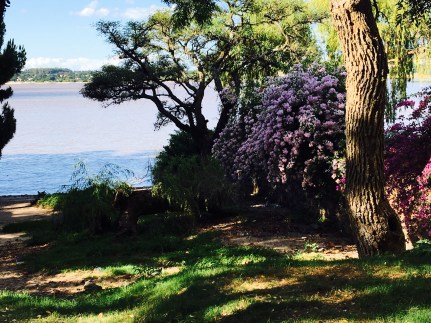
We eventually found a beach and spent a pleasant half hour catching some late afternoon sun in the sand! The surrounding area was really beautiful too.

IMG_5736.jpg

IMG_5734.jpg

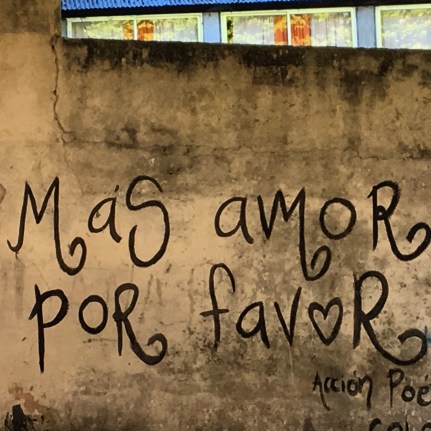
I also loved this message on the wall:

IMG_5745.jpg

“More love, please!”

We had an 8 p.m. ferry back to Buenos Aires, during which we both napped again. Because there still wasn’t anything open, we ended up just spending our last night at home, which was fine. We did a little research on Uruguay because we realized we both knew very little about it and learned that it has a few claims to fame that seem not to have become popular knowledge:

  • It’s the second smallest country in South America after Suriname and is home to only 3.3 million people. (I didn’t think it was nearly that small!)
  • According to Wikipedia, Uruguay is ranked first in South America for all of the following: democracy, peace, lack of corruption, and e-government; it shares first place for press freedom, size of the middle class, and prosperity.

WHO KNEW!

Uruguay’s beach town of Punta del Este is supposed to be the Hamptons of South America… perhaps maybe one day I’ll make it there. At any rate, I’m glad to have seen Colonia and definitely recommend it as a day trip for anyone going to Buenos Aires!

New Year’s in Buenos Aires

Mary and I allowed ourselves to sleep until 11 on New Year’s Eve – after several nights in a row of going to bed past 3, it was necessary, especially given the fact that we wouldn’t be able to sleep late the next morning due to our trip to Uruguay. We had a lazy start after that, taking an hour to lay in the sun by the rooftop pool before really getting started with the day.

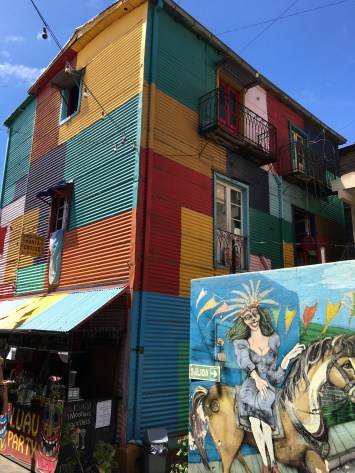
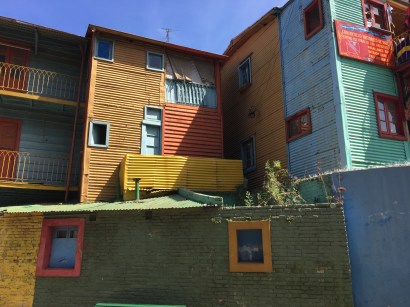
We spent a couple hours in La Boca, a rougher neighborhood south of the city center that happens to be the home of another staple of Argentine culture: tango. My guidebook utterly failed to convey what I’d find in La Boca; it mentioned neither the brightly colored buildings nor the art and textile shopping that awaited us there. It was actually my favorite part of the city!

IMG_5648.jpg

IMG_5654.jpg

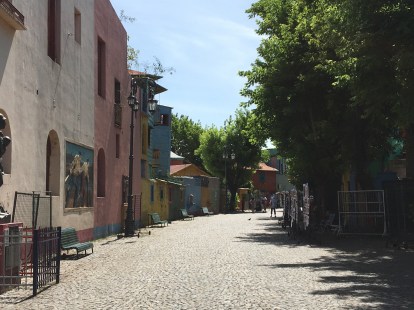
There’s not anything in particular to see in La Boca; you just arrive in this small area called Caminito where there are all of these brightly colored buildings (many made out of corrugated metal; this area is right next to the river, so many of its materials came from the shipping industry). There were various outdoor restaurants that each had their own duo dancing tango for the entertainment of the customers; we meant to eat, but we prioritized shopping first. I, having read mostly just that La Boca was a pretty shady place if you strayed out of this small touristy area, had left my wallet and most of my cash back at home, so I was unprepared for shopping, which was a shame – we encountered some really lovely leather and fur pieces in various shops as well as a lot of great art being sold on the street. Mary was kind enough to loan me money to buy a really well-designed purse that I loved, from a woman who sold it very well and gave me a kiss as we left (such a nice gesture and one that wouldn’t happen anywhere in the US or even in most of Europe, I venture!). We also each got a print of a street scene – as it turned out, I had taken a picture of exactly the same scene before I bought the painting (which is now getting framed, so I don’t have a picture of it):

IMG_5650.jpg

A Brief History Lesson…

Our plan after La Boca was to observe the Madres de la Plaza de Mayo, who gather in the plaza each Thursday at 3:30 p.m. to continue protesting against the military junta’s disappearances of their children during the Dirty War from 1976-1983.

This is a subject I read quite a lot about in college as well. I’m pretty familiar now, after working on and observing a few genocide trials in law school, with the intimate details of some of the worst atrocities committed since World War II. Those cases all involved a lot of killing, and that happened in Argentina too (many of the disappearances involved drugging enemies of the regime and then dropping them out of planes into the ocean), but what happened in Argentina is bone-chilling in a different way. The military set up torture centers right in the middle of Buenos Aires. A gruesome but fascinating book I read recounted the experiences of survivors who described how, completely aside from horrifying acts like being strapped to mattress coils and electrocuted, it was torture to be in the basement of these torture centers and to see the shadows of pedestrians passing by on the sidewalks above them, to hear the sounds of cars on the streets – normal life going on mere feet from the hell into which they’d been thrown.

The Madres began protesting even before the end of the war. Many of the victims of the dictatorship were young people in their 20’s and 30’s, which also explains the existence today of a second group called the Grandmothers of the Plaza de Mayo: they seek the grandchildren who were stolen as infants at the time of their parents’ abduction, or taken away from mothers who gave birth while in custody, and given to families loyal to the junta. Those grandchildren are now in their 30’s.

Knowledge of all of this stayed subtly in back of my mind throughout my time in Buenos Aires. It’s always – I lack a better word here – interesting to be in a place with such heavy memories in its recent past. In most such places I’ve visited, there are still visible signs of the past in the present (shell holes in walls, etc.), but Buenos Aires isn’t like that – perhaps in part due to the fact that the Dirty War didn’t involve an actual war, so there were never physical signs of it. The only real physical reminder, as far as I can tell, is the weekly appearance of the Madres.

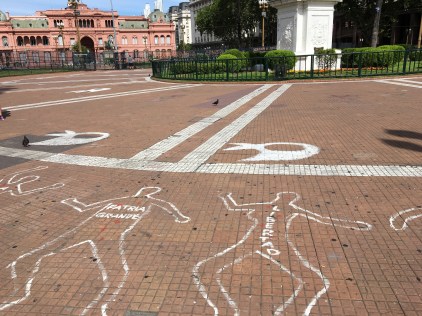
Unfortunately, we didn’t arrive until closer to 4:30, and perhaps because it was New Year’s Eve, there were no longer any Madres to see – though a group was dismantling a tent that had been set up with their logo, so they must have been there. Their logo is the white symbol in the picture below; it’s a headscarf:

IMG_5662.jpg

The message above says “governments pass; repression stays – the fight too. 4644 kids killed by the state apparatus.”

IMG_5660.jpg

(That’s the Casa Rosada – the presidential palace – in the background.)

I’ll try to catch the Madres the next time I’m in Argentina. (I know I’ll be back.) At least we had the benefit of a talkative taxi driver on the way to the plaza; he pointed out to us the site of one of the torture centers (whose name I remembered), now a crater in the ground but surrounded by various remembrances in honor of those who were killed there. I was a little surprised that he was so willing to broach the subject (though it was Mary who first brought it up by asking if he thought the Madres would still be in the plaza).

Back to the NYE Narrative…

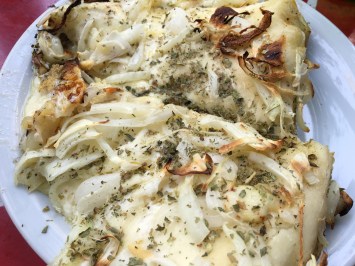
Before getting ready for our night out, and because we’d never managed to have lunch, we grabbed a snack at the Kentucky pizzeria one block down from our apartment. This strangely named chain is all over Buenos Aires and has been around since the 50’s, so I think it’s pretty legit, but we still couldn’t help but chuckle at the name! We decided to try an Argentine specialty called fuggazzetta -a sort of double-layered pizza with cheese in between and a mixture of cheese, onions, and oregano on top. It doesn’t look like pizza at all, but damn is it good:

IMG_5663.jpg

And now, it’s finally time to recount our New Year’s Eve in Buenos Aires!

One of the experiences on my Buenos Aires list was to eat at a “puerta cerrada” – a secret, “closed door” restaurant, of which there are many across the city. They’re not secret in the sense of being unknown, but they are not restaurants that you can just happen by on the street. Many are simply the homes of the chefs, so they’re very small and intimate. They have websites that tell you how to make a reservation, and once you do that you’ll receive the address and other necessary information. It’s pretty cool!

A New York Times article led me to one with a more robust website that happened to be advertising a New Year’s Eve menu. The Almacén Secreto Club is in a neighborhood called Colegiales, west of Palermo. It wasn’t ideal from a location point of view in the sense that we’d been strongly warned about the fact that the Subte would close and there would be no taxis, so most people were planning their evenings within walking distance of their homes. We were able to take the Subte west and then walk another 20 minutes to get there, and as we’d learned from doing this the evening before to pay our deposit, it was only a 20-minute walk over to the part of Palermo with all of the bars and clubs, so it ended up working out just fine.

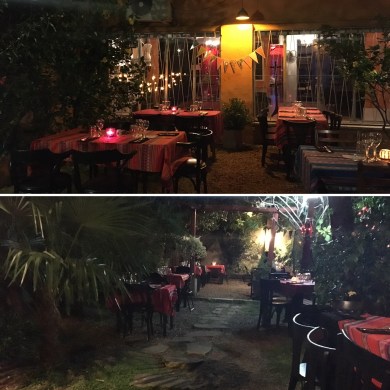
The club is located in a house on a perfectly normal residential street, and the house doubles as an art gallery of sorts – though we never got around to exploring it. Upon arrival, the only thing that tips you off to the presence of a restaurant is the wonderful aroma of roasting meat wafting out of a hallway leading to the kitchen. We rang a bell, provided our names via intercom, and were ushered down a long hallway and into the back garden, which couldn’t have been lovelier.

56FB3E8E-B603-48B2-B662-A49E08224ADE.jpg

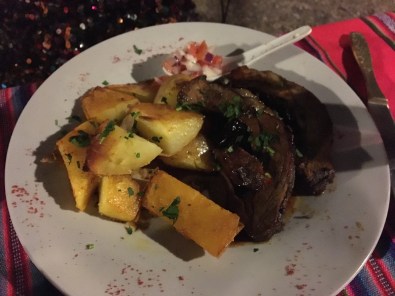
There were probably about 30 of us out in the garden for dinner. The evening was like an intimately sized wedding reception where you know no one else. There were a few families (one with kids our age dining with their parents; one with grandparents, parents, and little kids dining together; a mother and daughter) as well as a handful of couples. We arrived at 9:00 and were the first there, but the garden filled up quickly. We ordered a bottle of malbec and then one of each of the options for the set menu:

IMG_5673

What a neat trick with the cork!

IMG_5669.jpg

IMG_5670.jpg

IMG_5671.jpg

This beef was SO good – it had clearly been cooking all day.

IMG_5672.jpg

Possibly the best pork I’ve ever had…

And then, as if all that weren’t enough to stuff us silly, we had a round of desserts (including a brownie topped with delectable ice cream and sort of a walnut and ice cream cake) and then a BONUS round of desserts – they wheeled out a huge table laden with various cakes, breads, and candies and shouted for us to help ourselves. Mary and I could only marvel at how everyone else seemed to have plenty of room to continue eating – we couldn’t!

Just after midnight (we didn’t do any sort of countdown, but nonetheless everyone on cue got up and started hugging and kissing their table mates) the wait staff brought out glasses of champagne, followed by party favors (masks, noise makers, headbands, necklaces). As fireworks started going off around us (though we couldn’t see ANY of them!), a DJ inside the house turned on some music, and a waiter encouraged us to dance, saying “hoy, se puede!” (“Today, you can!” New life motto. #HoySePuede) Mary and I calmly sipped our champagne and continued searching for the fireworks that sounded as though they were exploding right over our heads; eventually we went in to start dancing and had a great time – it felt even more like a wedding reception then! My favorite memory is of two women our mothers’ ages dancing next to/with us during a remix of “Ob-La-Di, Ob-La-Da”; they shouted all the words! The waiters and cooks danced with us in between their clearing up duties. It was such a great way to spend the evening, and it was only 800 pesos per person – $57, which included everything! (This is in stark contrast to other places where we had originally made reservations – one was 2000 pesos per person or $150, and I bet there wouldn’t have been party favors or dancing!)

Things wound down around 1:00, and we exited from the calm of the garden to the relative chaos of the streets, where people were still firing off plenty of fireworks, resulting in scenes like this:

IMG_5693.jpg

Yes friends, that is an actual fire in the middle of the street – and cars were continuing to drive past! One firework exploded just a few yards away from us as we were passing by this intersection; needless to say, we hastened away in favor of a slightly safer locale. Aside from the explosions though, it was a very nice time in the street; we exchanged greetings of “feliz año!” with people as we passed by.

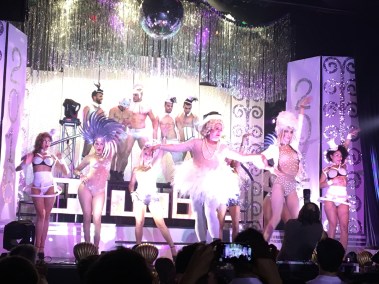
We eventually made our way to Club 69, which we’d heard was having a NYE party. I am never excited to go clubbing but generally don’t regret it, and this was no exception. We were greeted inside by drag queens and very muscular men wearing minimal amounts of clothing – yes please! We pushed through the crowd to get near the bar, and the fact that we were still wearing our party favors (the masks were now serving as headbands) worked in our favor because a guy started talking to Mary pretty quickly. She discovered that he was French and said “talk to my friend! She speaks French!” and the poor guy was so thrilled to find another francophone that he just couldn’t help but kiss me ten minutes later. 🙂 It wasn’t a midnight kiss, but still – I think being kissed by an attractive French guy only hours into 2016 suggests good things to come for me this year! So does the fact that I managed to get out of that club an hour later with absolutely nothing on my white dress.

IMG_5755.JPG

My new French friend, borrowing Mary’s mask

We talked to the French group for a little while but eventually separated; we stayed long enough to try another local drink, a fermet and Coke. Fermet is kind of like Jagermeister; it’s very herbal and not a flavor I particularly enjoy. We probably had significantly more Coke in our drinks than the usual ratio would be for an Argentine! While we sipped, we enjoyed the burlesque show, complete with pole dancing!

IMG_5697.jpg

We left the club just after 3 and managed to get a taxi within five minutes – it wasn’t nearly the impossibility we’d expected. We’d had a great night, but I was thrilled to get home a little “early” in advance of our trip to Uruguay the next day! More on that in the next post…

Buenos Aires days 1 and 2: steak, cocktails, and Evita

Monday, December 28 was our first full day in Buenos Aires. After having plotted out a rough plan for the week the night before and getting some much-needed sleep, we woke up mid-morning and started walking west down the Avenida Santa Fe with the aim of checking out a few things in Palermo. A lot of things are closed on Monday, so this was our day of more casual exploring. Our first order of business, however, was to find me a pair of more suitable shoes. I did a really aggressive purge of my possessions about two months ago and failed to think ahead to this trip, which resulted in my disposing of almost all of my summery sandals because I either didn’t wear them enough or they’d reached a point of being worn beyond repair. I literally didn’t own a pair of flip flops to bring with me; I spent Sunday afternoon walking around in strappy, low-heeled sandals which are fine fashion-wise but not the best in terms of long-distance comfort. Anyway, we thankfully found a store selling [real] Havaianas flip flops a few doors down, and I gratefully removed my loafers. Alas, Havaianas (as I remembered too late) usually need to be broken in, and pretty soon we were stopping to buy band-aids for my blistering feet. Take note, fellow travelers, that it’s always a good idea to have anti-blister ointment in your purse! I’m never traveling without it (or throwing away all of my flip flops) again.

But I digress. Aside from my injured feet, we had a lovely several hours wandering in the western part of the city. The expression in Spanish is “dar un paseo” – it’s hard to translate literally, but it’s the equivalent of “taking a stroll” – and Palermo is the perfect place to do so. There is a cluster of parks and green, leafy plazas filled with tropical foliage, and these are one of my favorite features of South American countries. (Don’t get me wrong – I absolutely adore the style of the Parisian parks and the gardens at Versailles, but the difference in the types of trees and plants in this part of the world makes you feel like you’ve truly escaped to some sort of urban oasis.)

IMG_5580

We particularly enjoyed the Japenese Garden, which was established by the Japanese community here. There’s a very large koi pond in the center, and the usual features of Asian gardens surround it. I always love looking at the fish!

IMG_5581.jpg

Next we went in search of a store called the Casa de las Botas (House of Boots), which specializes in equestrian boots of all types and colors. We were expecting to find a store selling all the genuine leather boots our wallets could handle, but instead it turned out to be a workshop where they really do make all the boots that they had in the showroom – all custom made. I had forgotten that polo remains a big thing in Argentina, and from what I can tell this place outfits all of the polo players in the country – with boots in all sorts of colors, including yellow, purple, and turquoise!

At this point it was about 3:00, so it was definitely time for some lunch. We wandered through an area home to many bars that we will visit at a later time and ended up at a restaurant we’d heard about called Miranda, which had outdoor tables on the shaded sidewalk. Our cold Quilmes beers provided a quick relief from the heat, and our steaks arrived in short order thereafter. My first bite of my “ojo de bife” (ribeye) was overwhelming even in the face of the fact that the meat was thoroughly cooked – not pink at all! There were so many flavors, and supplementing with the little pot of oil and onions made it absolutely incredible. (I can only imagine how good it would have been if it had been medium, which is what we thought we ordered!)

IMG_5594

Following lunch, which was filling but not stuffing, we made our way back to the Subte and traded the heat of the streets to the refreshing cool of the pool. 15 minutes was plenty to leave us feeling cooler and ready to take on the evening, which promised to be an entertaining one. We had heard about a Monday-night-only drumming concert at a rather hipster event space about a mile south of our neighborhood and figured it would be a good way to meet locals. It turned out to be what I decided was the Argentine equivalent of going to a baseball game: no one was there for the music; it was just an excuse for being outside and drinking beer in a crowd. We ended up meeting one other group of tourists at the end of the night, but otherwise this was a locals-only affair. Mary and I bought a couple of beers (the second of which was, by a rule imposed on the particular line we were in, a one-liter bottle poured into a larger-than-usual Solo cup – needless to say, we didn’t drink beer the rest of the trip). We didn’t end up meeting many locals; two guys approached us towards the end of the event and were extremely persistent at trying to get us to come to a different part of town to have dinner with them, but we weren’t quite interested enough to be adventurous.

There’s a video of the drumming on my Instagram page if you’re interested!

Tuesday brought two things I’d been very excited to see: Evita’s grave in the famous Recoleta cemetery and the Museo Evita afterwards. As I mentioned in my last post, I’ve always been fascinated by Evita, even aside from loving the musical. I read a lot about her in college; did you know that her body was embalmed and then stolen by the political enemies of Peron so that it was secretly buried in Italy for a while? She was that powerful of a figure and symbol that she posed a threat even in death. Because she’d been embalmed, when they finally got her body back, she looked almost exactly the same as she had the day she died, other than some damage apparently due to rough handling by her kidnappers. If you delve into things she wrote or records of people who interacted often with her, you can’t help but be convinced that this was a woman who could have written a book about the art of propaganda… and at the same time, you won’t know if she was a brilliant, scheming political mastermind or if she just did genuinely think and feel all these things she expressed… or both! I won’t say more here, but I suggest you do some research for yourself. She’s still such a big figure – I saw her book on sale at a few bookstands in the San Telmo market, and postcards of her are everywhere too.

Evita’s grave is in the Duarte plot in Recoleta. (If I recall, there’s a story there too – of course her family was neither rich nor from Buenos Aires, so a lot must have happened to secure them such a prestigious burial spot.) Recoleta is the Buenos Aires equivalent of Père Lachaise in Paris; all the famous people are buried there. Here it is from the vantage point of a mall across the street:

IMG_5612.jpg

Mary and I, not being particularly familiar with any of those other famous people, made a beeline for Evita and then did a casual loop through the rest of the place. Here’s what Evita’s grave looks like:

IMG_5601

IMG_5602

IMG_5606.jpg

IMG_5608.jpg

The Museo Evita is over in Palermo, in the building that used to house women and children receiving aid from her charitable foundation. They have a number of her outfits on display, which was cool to see because as much as I am aware that she was a real person, sometimes her story takes on such epic proportions that it’s hard to believe that she existed in real (and relatively recent) life, so seeing something that she actually wore was a step closer to believing she was real. There are also a lot of pictures of her and excerpts from her writing, both formal and informal. The way she and Peron wrote to each other is fascinating – despite the gap in their ages and their completely disparate backgrounds, they wrote incredibly flowery things to each other about their undying love. And, as I mentioned before, you get a real sense of how much Evita lived and breathed her work. I’m reading a biography of her now, and apparently in the time leading up to her illness, she routinely worked 20-hour days. Pretty incredible.

IMG_5591.jpg

Tuesday night proved to be my favorite of our nights out in Buenos Aires. We set off for Palermo with plans to go to a wine bar called Trova but arrived to find it, and another wine bar nearby, both closed despite the fact that they are usually open at that time. We decided this was just a sign that we were meant to do something else that night, and sure enough not five minutes later we happened to walk past a restaurant called Olsen that we’d both heard about. It’s a Scandinavian restaurant (random I know) famous for both its food and its vodka selection. It should also be famous for its beautiful outdoor garden – they had soft lanterns hanging from trees, making for a very romantic effect in the summer evening! We scored two seats at the bar (right in front of the bartender, my favorite spot), and after much perusal of the cocktail menu and patiently waiting for the young man in front of us to make a bunch of drinks (he was the only one making cocktails in the whole place, and because he was making them well, it took a while), we ended up with our drinks. I got a dill martini out of curiosity and loved it:

IMG_5625

We also couldn’t help but take advantage of the vodka flights and canapés; they just looked too cool. We got a “3 + 3”, which meant three shots of vodka (three different types) and then three canapés (two of each for us to share). We weren’t entirely sure what all the food was, but it was absolutely delicious, and the vodka was a lot of fun too!

IMG_5623.jpg

It’s a good thing we got that little bit of food because we never ended up having dinner. One of my chief anxieties about coming to Buenos Aires was about the timing of evening activities: as someone who can’t drink caffeine and is generally more of an early to bed, early to rise type, I feel a bit intimidated by places where going out before 1 a.m. is “early” and where dinner is supposedly not until 11 or so. Mary and I were determined to be on BA time, which is how we fell into the routine of eating lunch between 3 and 4 and then not having dinner until at least 10. That night, though, we waited too long to have dinner and learned that, most bizarrely for a place with such a nightlife (on weekends you might not get home until 7 a.m.), there are no options for late-night eating (like the kebab shops of London or the pizza joints of DC). We left Olsen still not feeling hungry for a full meal even though at that point it was about 11, so we followed the recommendation of the bartender and went in search of a bar called Rey de Copas that had not been in our guidebooks.

Rey de Copas means “king of cups”, and the place is aptly named. We bypassed the people sitting at tables in the patio areas of the old house in which it is located and went straight to the bar, which we had to ourselves – along with the five (five!) bartenders. Their cocktail list was full of mysterious ingredients, but fortunately they immediately presented us with a tasty and free cocktail to help us make a decision. We both ended up with unique and very well-crafted drinks, and we started chatting up the bartenders while we sipped them. I am not sure to what extent I have really conveyed in prior posts how much I appreciate really good cocktails and bartenders who are true artists and take real pride in their craft; in fact I am thinking of starting a separate blog just to review cocktail bars in different cities I visit. At any rate, we really enjoyed talking to these guys, and one in particular whose name we sadly never learned – to us he will always just be that cute bartender in the red shirt (la camisa roja). In my experience, the best bartenders will always respond favorably to being invited to craft something unique, and he was no exception. I told him that we’d decided to give him the honor of creating our last drink of the night, something we’d never have had before. He gave us a wicked grin and put the team to work, and five minutes later we had two exquisite cocktails. I have no idea what was in mine other than that it was something herbal and native to Argentina.

IMG_5630

We got a few other samples of local drinks along the way, so needless to say, these guys took great care of us. Our only regret of the night is that they never asked us for our numbers! Other than that, I can’t recommend Rey de Copas enough – it’s the Buenos Aires version of my favorite bar in Paris/the world, Le Calbar.

By the time we left Rey de Copas, it was after 2, and dinner was no longer an option… so we got in a taxi and came home to eat a Luna bar before falling asleep. As you can perhaps guess, Wednesday wasn’t the easiest start for us…

Country #30: Argentina! – an introduction

Dear readers,

As related in previous posts, I turned 30 this year, and I’ve been trying to travel as much as possible in honor of my new decade. I realized a couple days after my birthday that I should have tried to visit 30 countries before I turned 30 (at that time I had been to 27), but I decided that visiting 30 countries by the end of the year in which I turned 30 was almost as good. I went to Morocco and Turkey in the summertime (I will eventually put up a post about Istanbul, which was amazing), which got me to 28 and 29 (along with a new continent!), and I decided that my 30th country should be a special one. In recent years I’ve taken to asking people what one country they would go to if they could only go to one more, and for me that answer was always and immediately Argentina. I’ve wanted to come here pretty much since I started learning Spanish. I can even remember being in 3rd grade and having my teacher, who I guess probably studied abroad here, teach us about the Argentine flag, the gauchos in the pampas, etc. In college as a Hispanic Studies and International Relations major, I spent a lot of time studying Latin American history and politics, and Argentina was always the country that most interested me in terms of both of those areas. I also learned quite a lot about Eva Peron, which makes me slightly less embarrassed to disclose that I know the words to every song from “Evita”, which I own (I used to show it to my Spanish students) and which I’ve also seen on the stage in London.

The only reason I haven’t been to Argentina before is, in all honesty, because I’ve been afraid of coming and never wanting to leave. I felt that way about Rio when I went in 2011, but given how much I already knew and loved about Argentina, I thought there was a significant chance that I’d feel that so strongly that I would actually have to uproot my life and move down here.

I arrived in Buenos Aires on Sunday morning after spending Christmas with family in Indiana, where it was cold. Let me tell you friends, if you, like me, have never traveled to the southern hemisphere during our winter months, you’ve been living wrong. I cannot tell you how my heart soared the moment I stepped off the plane into the 90-degree heat with the sun brightly shining down on everything. (This is especially welcome after spending the last few months in London, where it has been sunny for no more than 15 minutes at a time.) I immediately forgot that it was the end of December and felt like I had been transported to the end of June, suspended in time and far away from every source of stress.

The woman who checked my passport is the first person ever to make me feel genuinely welcome in the process. She asked me if I spoke Spanish (to which I was delighted to reply “Si!”) and then made a point of calling me by name as we worked through the rest of the procedures, as if I were a new friend she was welcoming into her home.

I also had a hilarious and unexpected welcome in a different form. Back in May when I went to Barcelona, I met an extraordinarily attractive man (who is now saved in my phone as “Hot Paolo”) who turned out to be an Argentine model/actor/singer living in Miami. I’ve kept in touch with him a bit (and hope to see him while here) and couldn’t help but start laughing out loud when I saw his face plastered on one of the sliding doors leading out of the customs area into the main lobby of the airport. I texted him as soon as I got a wifi connection and said “is it possible that your face is on an ad in the Buenos Aires airport?!”, to which he replied “yes that’s me! I’m glad I welcomed you to Argentina!”

I talked to my taxi driver for the duration of my trip into the city center; he said I spoke “excellent” Spanish, which made me very pleased, and I think it is a sign that I am meant to have a great time here that I, for once, am having no trouble mixing French with Spanish. I’m doing very well with retrieval of words I’ve had no occasion to use in recent years and speaking very fluidly indeed!

My best friend and #1 running and travel buddy Mary is also with me on this trip – together we’ve now been on five continents (North America, Europe, Africa, Asia, and South America) this year! We are staying in Recoleta, a neighborhood in the central-west part of the city. Our apartment happens to have a rooftop pool, which again I can’t recommend enough in terms of planning future travel. Since Mary was arriving about 12 hours after me, I allowed myself a lazy start to my first day in Buenos Aires and immediately went up to the pool, where I soaked up more Vitamin D in an hour than I’d gotten from the last several months in London.

IMG_5544.jpg

Later in the afternoon I rallied and went over to San Telmo, a neighborhood on the southern edge of the city, to see its Sunday market. I navigated the Subte (subway) and had no trouble getting there, though I was troubled by the fact that I had packed a wardrobe suitable for European fashion when, based on what I observed among the Argentines on the Subte and the tourists in the market, everyone here dresses much more casually. (In my defense, everyone always talks about Buenos Aires being the physical and cultural Paris of South America, so I just assumed that I’d find people relatively dressed up!) I wandered through the market streets wearing a cute black dress and strappy sandals, feeling entirely overdressed next to locals and tourists wearing the universal tourist uniform: shorts and sneakers. Who knew! Anyway, in the market I caught my first tango performance – more on tango later, I’m sure – and saw lots of antiques and leather goods for sale. Nothing in particular caught my eye, but it felt great and entirely appropriate for Sunday afternoon to wander up the street seeing everything.

IMG_5570.jpg

black & white somehow seems more appropriate…

After about a 20-minute walk I found myself in none other than the famous Plaza de Mayo, home to the Casa Rosada (presidential palace, still in use as the president’s offices) and, on Thursdays, the Madres de la Plaza de Mayo, who still protest the disappearances of their children during the Dirty War. If I’m being honest, the Plaza was a bit underwhelming – maybe it will look different when we go back later in the week, but it was very quiet and just didn’t give off any sense of having been the site of major historical events (including Evita’s famous speech from the balcony of the Casa Rosada). I nonetheless took a few pictures, and then because I was pretty tired, I hopped back on the Subte and went back to the apartment for a little more pool time.

IMG_5569.jpg

La Casa Rosada

I’ll write more later today about what we’ve done so far (we are about to go see Evita’s grave!). Stay tuned to our adventures, which will include descriptions of delicious steak and wine, outdoor drumming concerts, and who knows what else!

Why I Chose a 7-Hour Layover En Route to Croatia

I’n sitting in the Hilton at Chicago’s O’Hare International Airport waiting for Rachel and counting down the hours of my lengthy layover – seven hours – between my flight from Richmond and our flight to Munich. You might be asking: why did you fly to Chicago first? This is a good time to share my prior experiences with traveling to and from Croatia. Despite being a country I love so much, it’s given me my top three travel tales of woe!

I first visited Croatia in August 2006. My mom, brother, and I flew from Washington Dulles to Frankfurt, where we were supposed to be on a flight to Dubrovnik with my aunt and grandmother, who were flying from Chicago. As often happens in summer, a wall of thunderstorms surrounded the airport, and we were about two hours late in leaving DC – the exact length of our layover in Frankfurt. Unfortunately, we didn’t make up any time in the air, and we missed the flight to Dubrovnik. But this was no ordinary miss. We could literally see the Croatia Air plane, not more than one or two gates away from us, when we pulled into the gate. If Frankfurt didn’t require an extra round of security (because clearly we all acquired forbidden items mid-flight), we would have probably squeaked on. Instead, we joined about 300 people from ours and other delayed flights who were trying to get rebooked.

We ended up “lucking out” and being rebooked on a flight to Paris and then another from there to Dubrovnik. I didn’t mind the chance to speak some French, but I had no idea what awaited us at Charles De Gaulle. Our flight to Croatia was to leave from a tiny satellite terminal with only a few gates and hardly any amenities – maybe one place to get food. The time when our plane should have begun to board arrived, but there was no plane. We waited about two hours (at this point it was around 5 pm) for the delayed plane, and then just as we were about to board, everyone in this tiny terminal was suddenly forced to leave the gate area.

It’s fortunate that I speak French because none of what ensued was explained in English. There was some sort of bomb threat, so while all the travelers watched, police came in with dogs and spent about 45 minutes checking the area. When they finished, it was time for the 200 or so of us to go back through security – which in that terminal had a total of two metal detectors, so this took at least another hour. We finally got underway around 9:00 and landed in Dubrovnik around 11:30.

Of course, despite all these delays, our luggage didn’t arrive with us. At that point we just had to laugh. We left the airport, took literally the last taxi, and finally arrived at our hotel about 12 hours behind the rest of our family. My mom and brother got their luggage 24 hours later, but mine took a full 48.

Do you see now why I was willing to fly to Chicago so that Rachel and I would be on the same flight and why I brought several days worth of clothes in a carry-on?!

The other two stories are quicker to tell. On that same 2006 trip, we managed to make it onto our connecting flight in Frankfurt to go back to DC, but just barely, so we were sure there was no way our luggage had made it on. I wish we had been so lucky. My beautiful, newly purchased suitcase appeared on the conveyor belt, and my brother said “why does it look wet?” I quickly thought of what might have broken inside (I had a few small bottles of kruškovac, pear brandy), but nothing was large enough to have made the entire suitcase wet.

When the suitcase reached us, our noses explained the source of the wetness. Suffice it to say that it was as though my poor suitcase had been under a toilet the whole flight. Lufthansa gave us cash on the spot, without getting more than a few feet from the suitcase. This is why I always pack my clothes in plastic bags (which fortunately I had done)!

Then this past February, my flight from Zagreb to Paris was cancelled at the last minute (ie while we were on the runway), leaving me standing at the end of the long line of everyone on that flight who was waiting for rebooking from the ONE agent available to do that. I stood in that line, holding expensive Croatian cheese I’d just purchased from duty free, for a solid three hours! I was just thankful there was still a way to get me home. I ended up with a voucher for a beer and a flight to Frankfurt and then Paris. At least there was a beer…

So hopefully Rach and I will not have any such trouble! We’ll be in Split less than 24 hours before we head to an island, so if our luggage isn’t there tomorrow, we’re not likely to see it again until we’re back 8 days later. I packed my carry-on accordingly. And at least we’ll be together from the start!

As a final note: the 2006 trip was worth every ounce of patience required to get there. Once you see the gorgeous Adriatic coast, you immediately stop caring about everything else!

The Art of Travel

I finally find myself in the position of being an American who lives abroad and can now observe my fellow American travelers more from the perspective of the locals. I’ve always aimed to be a model ambassador of America, and because I’ve traveled to South America, Europe, and Asia, I’ve had a lot of opportunities to practice the art of travel in different situations. Here are my suggestions for being an expert traveler.

  1. Do your research and plan ahead.

I’m not saying you have to plot out an hour-by-hour agenda for your trip (you shouldn’t), but you should read up on your forthcoming destination(s) and have a good idea of what you want to see, do, and eat while there. (Yes, eat – food is absolutely one of my motivations for traveling, and in my opinion if you’re not trying the local cuisine then there’s just no point in being there at all.) This is important even if you are visiting or staying with someone who lives in that place – it puts a lot of pressure on the host to have to come up with everything, and it’s much better for you as the traveler if you have your own ideas of what seems most interesting! Ideally, your pre-travel research should extend beyond guidebooks; for instance, if you’re going to Paris, watch a few movies set in Paris, and read some of the many memoirs written by Americans or other expats in Paris. Their perspectives on the culture, and inclusion of all sorts of random details about everyday life, will both enrich your own observations and help to minimize the number of surprises you encounter when you arrive. They can also help you to conform with important standards of politeness, such as knowing that in Paris you greet the owners of shops when you enter.

  1. Pack light, but with useful accessories.

You shouldn’t travel without an umbrella, period, unless you’re going to the desert. There are a few other items that I always bring, because you never know when they’ll come in handy:

  • earplugs (there is always street noise, even in a five-star hotel)
  • eye mask (I can sleep under a bright light, but if you’re sensitive to light, this is invaluable)
  • a small sleep sack or even a sleeping bag (my sleep sack folds up into a pouch that’s about 3×5”; my sleeping bag is also very compact and makes a great pillow when in its sack. It has served me well during two nights camping out at London’s Heathrow airport.)
  • travel towels (again, compact, and always useful – I like to have one in my carry-on so I can wash my face before and after long flights)
  • corkscrew (I have one of those combos that also has a little knife; great for wine and cheese picnics in Paris)
  • fold-up water bottle (I have one by Vapur that is completely flat when empty)
  • combination lock (this is a must if you’re staying in a hostel)
  • a Sharpie (you’d be surprised how often it can be helpful to have a permanent marker)
  • eye drops (great for long overnight flights to help you instantly feel less tired upon arrival)
  1. Leave your native expectations and habits behind.

Travel is about broadening your perspectives and experiences. This means eating the local food, attempting to speak the local language, and generally engaging with locals as much as possible. If you’re on a long trip and are dying for a taste of home one night, fine, but don’t be that person who orders only familiar food at the expense of trying new (and likely incredible) things.

It is also important to be aware of differences in culture so that you are better about blending in. For example, Americans are almost always the loudest people in the room when they’re outside the United States. You don’t realize how loudly we talk until you are suddenly sitting with French people next to a table of Americans and realize that you can hear every single word of their conversation because the French all speak relatively softly in comparison. Small linguistic differences can be useful to know, too: saying “pants” in the UK means something very different from “trousers.”

Other things that are likely to surprise less-traveled Americans:

  • Hotel rooms and bathrooms are TINY in comparison to the ones in any standard American hotel. This is because, particularly in Europe, each square foot of real estate is much more expensive, and thus space is at a premium. Don’t expect a full bathtub, and know that a double occupancy room is likely to have two twin beds pushed together rather than a double or queen-sized bed.
  • Some Europeans tend to be less dependent on shower curtains (in my experience, Spain, Italy, and France). In such cases, the shower head most likely detaches from the wall, and with some care you should be able to avoid getting water all over the room. Think of it as a fun challenge!
  • In many countries, you can’t flush paper or anything else down the toilet. You’ve just got to get over that. In some places, you may not even have an actual toilet. Again, try to see it as a fun challenge (and take a deep breath of fresh air before you go in).
  • Standards of service vary from country to country. Accepting that fact is essential for the benefit of all concerned. You can’t get angry at your Parisian waiter for not coming to check on you every five minutes; that’s just now how it’s done in Paris, and lack of attention does not mean that you have a bad waiter.
  • Waiting in line can be a verrrrrrry different experience in some countries. You may encounter lines that are are more wide than they are long or where people are constantly cutting or where everyone is yelling or where there is only one person dealing with the line despite its absolutely massive length. This is why it is essential to pack your patience (and maybe a flask).

It’s easy to become anxious in countries that are less developed, where for instance you can’t drink the water. Act cautiously (I’m paranoid about digestive illnesses when I travel) but don’t let this become the entire focus of your trip.

  1. Choose Your Travel Companions Carefully

I’ve been extraordinarily fortunate in the people with whom I’ve done all of my big trips, and that’s largely down to luck because I’ve never actually evaluated potential travel partners or thought “so-and-so would be really great to see _____ with; I should see if she’s interested!” My trips have come together pretty organically. Nearly all of my international travel before the end of college was with school groups (three weeks in Italy during high school, summer in Spain during college, various Model UN trips), so not only did I have friends with me; I had a lot of friends with me. In big groups, the dynamics aren’t so important – if you don’t jive with someone, you don’t have to spend time with them. Where your companions really matter is when there’s a smaller group or just the two of you – anytime that you’re expected to spend the majority of your time exclusively with those people.

I don’t think there’s a particular rule to follow when considering whether to travel with someone. My trips to Venezuela, Colombia, Panama, and Romania were with a male friend of mine who is in many ways my polar opposite, and all were awesome. In such situations, it’s important to be aware before the trip of any potential sources of conflict. (I am not averse to taking risks while traveling, but I am nowhere near adopting Greg’s mantra of “live by 30 or die trying.” I adjusted the boundaries of my comfort zone, and he exercised a little more caution. Compromise is key.) Personality is a major factor, but other things matter too. Know how much money you’re willing/able to spend during the trip and how that compares to your companions. Do you like the same kind of food? How willing are you to try local cuisine? (It’s a bummer to arrive somewhere and learn that your companion has no interest whatsoever in eating like a local.) How much physical activity are you up for? (Will you want to rely on public transportation, or are you willing to walk everywhere?) Are you more interested in working from a checklist of tourist activities or just wandering around? Are you an active tourist, or are you more interested in just relaxing? Do you need some alone time every day? If you’re part of a group, are you willing to do things on your own, or do you need the reassuring presence of the others at every moment? There are no wrong answers to any of these questions, but you should know your own answers and those of your travel companion(s) before you leave, or preferably even before you book.

Having a conversation ahead of time can save some frustration during the trip. Try to get on the same page about everything so that you can manage expectations and minimize situations of diplomatic indecision. You might consider establishing a codeword for use in situations of tension. (My mom and aunt would say “bananas” to each other while in Paris if they were getting frustrated with each other.) You should not have to be someone other than who you are while you’re traveling. You should be willing to compromise, but if you think you’re going to miss out on a significant number of things because of your travel companion(s), you should rethink your trip. In all likelihood, you’ll only go to a particular place one time in your life. Make sure you can make the most of it!

Last Spring Break Ever, Part 2: Budapest

The bulk of my last spring break ever (since I’m graduating from law school in May, and at the moment at least, have no plans to seek further higher education) took place in Budapest with my Croatian friend Iva.

The Journey to Budapest

Iva and I reunited after 19 months of separation at the train station in Zagreb early on Friday afternoon. After lots of hugs and some staring at each other (in that “wow I can’t believe you’re actually here!” way), we wheeled our bags into an adjacent underground mall to kill time before our train at a cafe. I whipped out my two Croatian books and read aloud, which served the dual purpose of practicing my pronunciation and making Iva laugh.

Our seven-hour trip began at 2:30. This was my first train trip outside western Europe, and Iva seemed to think we’d end up getting delayed, but it went really smoothly. The train was fairly full as we left Zagreb, but a lot of those people were just traveling elsewhere in Croatia and got off at various points along our route. I was excited to see a different part of the country as I had never been east of Zagreb before. We passed through a lot of “villages,” which prompted a discussion about the use of that word instead of “towns.” I consistently hear people from the Balkans refer to “villages,” and I explained to Iva that, at least in the US, villages imply something so small (and perhaps an element of age, or even backwardness) that I’ve never heard anyone call a modern-day establishment in the US a “village.” Nonetheless, “village” is definitely the appropriate word in the former Yugoslavia, and trust me, there are some tiny ones. Six houses in the middle of nowhere might constitute a village. We saw some larger ones, including a couple with a church that I said I would probably have called “towns.” I told Iva that I always think it’s really interesting to travel through the Balkans because the land looks SO different to me – while we obviously have countryside in the US (and in other European countries that I’ve traveled in), there are not these random sprinklings of inhabitants – you’re either in a town (I would say with at least 100 people) or you’re nowhere. Much of the land in the Balkans seems to fall somewhere in between, and I find that fascinating and timeless.

Anyway, it took us close to three hours to get to the Hungarian border. The train stopped on the Croatian side first, and Croatian border patrol officers came through the train to inspect our passports. As always in the EU, my American passport required significantly more attention; everyone else can just get a quick glance at their documentation, but they had to scan my passport, wait for the information to load on their little handheld device, and then finally give me a stamp. The two Croatian guys seemed to take great interest in mine while they waited for my information to load; I swear it looked like they scrutinized each stamp in my passport as if to say “let’s see where this American girl has been!” After that it was about 10 minutes before we stopped again on the Hungarian side. (We knew we were in Hungary because suddenly the signs were completely unintelligible to us.) The Hungarian border patrol agents (who were very cute) repeated the procedure, and eventually we got underway again.

Rural Hungary on a wet day at dusk is more than a little creepy. We were quickly chugging our way through a forest where mist crawled between the trees, and I half expected to see wolves running around. The light soon disappeared entirely, and we went at least an hour without seeing anything out the windows. On top of this, we were now almost alone in our train car – there were only three other people in there with us, including an older Romanian woman (who spoke Croatian and reminded me a lot of my grandmother) and then two other people sitting at the other end. If we’d been entirely alone, I would absolutely have turned up the music on my phone and just had a private dance party in the train. As it was, I settled for wandering to the cafe car and buying a beer to bring back to the seat.

We eventually found civilization again, and some Hungarians got on the train. There was still plenty of space, and we retained control over our little square of four seats. Iva and I each put in an earbud and went through songs on my phone that reminded us of our time together in The Hague – an exercise we repeated frequently over the next several days.

We rolled into Budapest’s Keleti train station around 9:45, stepped out into the rain, hailed a cab, and arrived at our hotel about 15 minutes later. I could tell from the drive that I was going to like Budapest and that it was not what I had been expecting – in a good way.

Buda + Pest = Budapest

We didn’t stray far from our hotel on Friday night; we walked about ten minutes away and ended up getting a late dinner at an Italian restaurant. Iva had taken a five-hour bus ride from her hometown that morning, so it had been an especially long day for her, and we went to bed pretty much as soon as we got back.

Saturday morning dawned chilly and wet, but fortunately it was misting more than raining. We figured we might as well start with the main point of interest: the Hungarian Parliament building. Like our hotel, it is on the Pest side of the Danube and was a 15-20 minute walk northwest from us.

I took a TON of pictures of Parliament from various vantage points around the city over the course of our time there. Here is a sample from Saturday, when the weather was the worst (so they get better from here!):

IMG_3342

IMG_3347

IMG_3351

Anyway, the Parliament building is just stunning from all angles, inside and out. We went on a tour and learned that it took 17 years to construct. My other favorite factoid from the tour was that the stained glass windows inside the main entrance hall had been taken out and stored before the World War II bombings, so the originals were preserved! Pretty cool (and what good foresight).

part of the ceiling of the great entrance hall

part of the ceiling of the great entrance hall

IMG_3353

We walked a huge loop around the Danube that morning – from Parliament down to the famous Chain Bridge, across the river to Buda, and then back north to the other bridge that connects to Margaret Island in the middle. The Buda side has a lovely, paved promenade along the river where lots of people were running, and it made for easy walking. (On the Pest side they’re doing some sort of construction in the blocks south of Parliament, and this disrupts pedestrian traffic.) I’ll wait and post pictures of these same things, which we saw every subsequent day, for later on when we had better weather.

We ended up doing some further wandering back on the Pest side in the afternoon and found a mall with a lot of the stores we had shopped at together one day in Rotterdam. We spent a couple of hours in there and eventually had a very late lunch at a restaurant there, but I didn’t buy anything from the stores.

In the evening we ended up at Saint Stephen’s Basilica in the center of Pest. It’s a lovely church, inside and out.

IMG_3360

IMG_3368

That evening we dressed up (Saturday night!) and set off planning to go to an Irish pub (Iva loves all things Irish) and then another bar called Morrison’s that had rave reviews on TripAdvisor. The Irish Pub turned out to be closed, so we continued on to Morrison’s. As seems to be the trend in Budapest, this bar was built in the courtyard of a building (though it had a dancefloor and other areas inside the buildings). There was some sort of ceiling, so it was plenty warm, and the less observant would not have been aware they were actually outside. We secured a table in the main open area, and I got us drinks from the bar.

Now, we had generally been admiring the Hungarian men over the past 24 hours. For me at least, Hungary (and Croatia!) are great places because almost all the men fit the physical description of my type: dark haired, olive skinned, and handsome. I had had many occasions during the day to think to myself “mmm, Magyars.” There were, as always, SOME attractive men in this place, but on the whole we were a little underwhelmed, especially when a young, drunk kid (Iva and I are both 28, and at this point anyone more than a year or two younger than us just seems like a teenager) planted himself at our table and started talking to us. I will give him points for his persistence despite his very much less than perfect English, but he persevered FAR beyond the acceptable point, and eventually his friend joined us too, making things even more awkward. Iva and I were not there to find lovers, but we would much rather have preferred each other’s company to that of some random guys whose conversation was awkward more than anything else. We finally managed to excuse ourselves after about half an hour and headed to the dance floor, where things were much better. Still, this bar was closing at midnight (I have no idea why), so we didn’t stay that much longer. We walked home thinking that if we passed another bar we’d check it out, but we didn’t really see anything.

On Sunday morning I went out for a run (I am running the Paris half marathon in three days, agh!) and came back feeling cautiously optimistic about the weather: I had seen patches of brighter cloudiness that hinted at the forthcoming appearance of the sun, something I haven’t seen much of lately in Paris. We left the hotel at just the right time and enjoyed about 40 minutes of actual sunshine, which helped us capture these pictures:

the Chain Bridge

the Chain Bridge

view of Parliament from the Chain Bridge

view of Parliament from the Chain Bridge

Parliament from Castle Hill in Buda

Parliament from Castle Hill in Buda

There is a funicular that goes up the steep hill to Buda Castle, but we opted for the winding pathway instead (which didn’t actually take that much time or energy). Buda Castle is a bit of a misnomer – there’s not a castle there now; some of the wall built into the hill might have been part of a castle at some point, but now there’s just a large palace housing some sort of art museum. We were there for the views, which were great.

IMG_3397

We witnessed a fun sort of changing of the guards, which involved about a dozen Hungarian men in uniform twirling their long guns and marching around while someone else played a typical drum selection. From there, we worked our way north through the Castle District to Saint Matthias Church and Fishermen’s Bastion (I have no idea why it’s called that).

The church is lovely on the outside, and though I was a bit affronted at having to buy an entry ticket, it was amazing on the inside too.

IMG_3400

IMG_3403

IMG_3417

IMG_3420

Fishermen’s Bastion is sort of like the front wall of a castle, with some turrets. It’s fun to walk through, and if we’d had more time, I would have enjoyed sipping a coffee in the cafe at the top of one of the turrets.

IMG_3408

IMG_3411

Later in the day, after additional walking and sightseeing (none of which I found remarkable enough to merit pictures or further description here), we discovered that Budapest at night is a real rival to Paris at night in terms of beauty. It was stunning, and I really wish I had a camera that took good night photos.

the Chain Bridge, with Castle Hill on the left

the Chain Bridge, with Castle Hill on the left

Chain Bridge and Buda Castle

Chain Bridge and Buda Castle

Buda

Buda

Saint Matthias lit up - it looks like something out a fairy tale in real life

Saint Matthias lit up – it looks like something out a fairy tale in real life

On Monday morning, having completed our sightseeing in Buda, we stuck to the Pest side of the river and walked to the southern end of the city. We stopped first at the second largest synagogue in the world and spent about an hour walking around its various areas and exhibitions. I think I had only been in one synagogue before (though I have no idea where), so this was an interesting change from the usual routine of seeing churches. I thought the interior of the synagogue was lovely (and in most ways exactly like a Christian church), but the real treasure was the rest of the grounds that dealt with the experience of the Hungarian Jews during World War II. The synagogue is in the middle of the Jewish neighborhood which became the Jewish ghetto during Nazi occupation, and thousands of Jews starved or froze to death within its walls. Several thousand of those victims are now buried in a garden within the walls of the synagogue, and there are various other memorials within the grounds.

the interior of the synagogue

the interior of the synagogue

the Memorial Garden, home to 24 mass graves of over 2000 Jews

the Memorial Garden, home to 24 mass graves of over 2000 Jews

each leaf has the name of a Holocaust victim on it.

each leaf has the name of a Holocaust victim on it.

After this sobering experience, we shifted gears and walked further south to go to the Central Market. If Anthony Bourdain has ever done an episode of No Reservations in Budapest (hmm, should check that out), he MUST have come here. It’s a huge building filled with beautiful piles of colorful vegetables, butchers selling all sorts of sausages and meat that was not immediately identifiable to me, bottles of palinka (the Hungarian version of rakija), and a few restaurants serving traditional Hungarian food (which smelled INCREDIBLE, and unfortunately I didn’t get to have any).

100% coming back here the next time I go to Budapest.

100% coming back here the next time I go to Budapest.

The most highly anticipated moment of the trip, at least for me, finally came on Monday afternoon when we went to a thermal bath. There are a bunch of these in Budapest, and I want to go back to experience all of them. We went to the Szechenyi baths in the northeastern part of the city (getting there was a whole other adventure that isn’t worth recounting here, but suffice it to say that my dead-tired legs were so happy to soak in that warm water). We arrived around 5:30 and spent the next 80 minutes or so rotating through the various thermal pools. Some were actually really cold (which would have been fine in the summer), so we stuck to the ones that were between 34 and 38 degrees celsius. It was  strange to be in something that looked like a pool or hot tub that was not chlorinated! The signs weren’t in English, so I’m not sure what differentiated each one other than the temperature, but there were definitely differences in the color and smell of the water. Some were more green and had an almost menthol-like scent wafting off the top. It was LOVELY, and if I lived in Budapest, I would go at least once a week.

On our way home we passed an ACTUAL castle and then went through Heroes Square, both of which were, per the city standard, beautifully lit up:

the color of the Budapest sign changes every few seconds!

the color of the Budapest sign changes every few seconds!


Heroes Square

Heroes Square

Our final act of tourism in Budapest was to go to a ruin pub on Monday night. I’d read about these ruin pubs but still wasn’t really sure what they were. This is a good opportunity to discuss how my expectations of Budapest compared to what I actually saw in Budapest. Having seen a solid amount of formerly (or, in the case of China, currently) communist countries, I was expecting the city’s appearance to reflect a lot more of that history. Instead, Budapest could just as easily be a city in western Europe; it is chock full of grand architecture and is one of the most aesthetically pleasing cities I’ve ever seen. Thus, I’d expected the ruin pubs to tie in the visual element of post-communism that I had anticipated in the rest of the city.

The ruin pub we visited was, in a word, awesome. Like the bar we went to on Saturday night, this place was build into the exterior space between a set of buildings. It was a huge amount of area – there were at least six separate rooms, some of them larger than entire distinct bars. Iva’s assessment of the decoration was very accurate: “it’s like all the stuff that no one wanted anymore ended up here.” The “ceilings”, walls, and other surfaces of this ruin pub were decorated with all sorts of random stuff – disco balls, buckets, netting, toys, old radios, shovels, fake flowers, dolls, etc. This is another situation where a video would be a lot better at conveying the overall atmosphere. There were plenty of people there despite it being Monday night.

IMG_3486

IMG_3488

…and that about sums up Budapest! We took an afternoon train on Tuesday, but we didn’t do anything else of note on Tuesday morning. The journey back to Zagreb was much the same as the journey to Budapest, though with fewer people on the train.

My last spring break ever may not have been spent on a tropical beach somewhere, but it was still great! (It was my first and only European spring break!)