
We had designated Friday morning as the time to go to Pão de Açucar (Sugarloaf Mountain) after hearing that its views were best in the morning light, so that was our first order of business once we got up. After waiting more than 20 minutes at the bus stop and almost giving up on the bus, #511 finally arrived and took us (and the many other people packed on board) to the base of the Urca mountain (the smaller of the two in all the images of Sugarloaf). We were wholly unprepared for the line that we found there. I volunteered to scout ahead and figure out just how long it was; it may well be the longest line I’ve ever seen. It stretched about three city blocks and was sometimes as many as ten people wide. We debated for a few minutes about what to do… it seemed like waiting in line would cost us the whole rest of the day, but we also didn’t know if we’d be any better off trying to show up first thing on Saturday.
Fortunately, luck was on our side. Stacey and Mary went to do some scouting of their own and ended up meeting an Irish couple who were much further up in line. They invited us to join them in line, allowing us to cut over two hours of wait time! We soon found ourselves boarding the first of the cable cars and heading up to Urca.
The first thing we saw on that summit was the launching pad for the helicopter tours of the city. Every few minutes, a helicopter would take off for Cristo or other points around the city; we learned that the shortest journey offered – a total of ten minutes, just round-trip to Cristo, was about R$150; the most expensive was over R$1000! They seemed to have plenty of business despite the high prices.
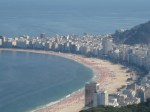
We did a loop to take pictures from the various vantage points there; it was the opposite of our experience on Corcovado. Everything was completely visible and gorgeous. We could see many different beaches, each with its own distinct coloring, and mountains off in the distance that were half hidden by the haze and seemed not to be quite real. It’s no use trying to use words here; you’re just going to have to look at pictures.
After a quick bite to eat, we boarded the second cable car to the top of Sugarloaf. We took another round of even more spectacular photos before setting off in search of the monkeys advertised on the signs asking visitors not to feed the wildlife. We followed a set of short trails that led a through the foliage downhill and even made monkey-like sounds, but we didn’t find any… perhaps on my next trip!
After descending back to the ground level, we caught a more prompt bus back to Copacabana and grabbed about two hours on the beach. I finally joined Mary and Stacey in wearing a tanga; I was very glad to purchase a bikini with the same pattern as the famous Copacabana sidewalk, and I went into the water to put it on as soon as I had it! I must say I felt quite liberated. J
Back at Cabana Copa, we rinsed off, grabbed our stuff, and set off with mixed feelings for the hostel we had booked for our last night. Lonely Planet had recommended it, and we all thought it sounded like it would be an interesting experience. The hostel was located in another favela near the Santa Teresa neighborhood of the city; Lonely Planet described it as a guesthouse with lovely views from its porch. There weren’t too many options left in Rio by the time we realized we needed a place on Friday night, and we figured it couldn’t be that bad if Lonely Planet (a source I’ve always trusted) recommended it. Here is a description of the place on HostelWorld.com:
“The greatest view and the quietest environment you can imagine! The Hostel ‘Pousada Favelinha’ is located on a small mountain in the heart of Rio de Janeiro , between the district of Laranjeiras and the hip Santa Teresa. It is situated inside a small ‘Favela’, one of the many ‘poor’ districts that Rio has got. However, it is not ‘poor’ in cultural terms, and it is absolutely secure! You are only a five minute walk from either the metro station at ‘Largo do Machado’ which will take you to the Copacabana beach in only another 7 minutes, or from the ‘bondinho’, the old little cable car which runs through the beautiful artist´s district in Santa Teresa and right down to the center of Rio and the nightlife district ‘Lapa’.
Since there are no roads in front of our hostel, the only thing you will have to put up with is walking a small hill up (or down, wherever you come from) to reach home. This paths leads you through so many beautiful houses and trees, playing children, and old women chatting, that you would wish your stay was longer…”
Well, dear readers, let me tell you about our second adventure in a favela.
We got into a cab with a nice young driver who, together with Mary, the Lonely Planet book, and his GPS finally figured out where to take us and gamely did his best despite having no real idea where we were going. We stopped multiple times to ask for directions, and at once point we had to go in reverse about 200 yards down a very narrow street on a hill (we think we may have hit some things in the process). Finally, after about 40 minutes, we found the school that Lonely Planet had mentioned as the entrance to the hostel (something along the lines of “enter through the school” – nothing too detailed.) By this time it was dark, and although we weren’t in a favela at all like Rocinha (it was more like an older part of the city), we didn’t much like the idea of getting out of the cab and wandering around. Two men at the gate to the school pointed us in the general direction we needed to go, and we started off.
Now at this point, given the description Lonely Planet, we assumed the hostel would be just on the other side of the school or something simple like that. This was not the case. Instead, we went up and down some stairs and inclines for about 10 minutes before I popped into a little bar and asked for directions. The two men there looked flabbergasted to see me but seemed to know what I was asking for, so we set off again down another hill and bore left as they directed. Here we once again had to find someone to help us, and fortunately a young woman offered to lead us part of the rest of the way. It was at least 10 minutes before we finally found the building that multiple people seemed to think was the hostel.
Taking a deep breath (as by now we were completely out of breath from hiking around with our heavy backpacks), I knocked on the door. There was no answer, so I knocked again, and then we started calling out. (We knew someone was in the building because we’d seen people on the back porch from a distance). Finally, a man opened the door a crack and looked at us with a somewhat bewildered yet sneaky look on his face. I explained that we were looking for the hostel, and he gave us no indication for a moment that we had in fact arrived at the place in question. Instead, he asked us to hold on and shut the door.
By this time, we’d pretty much decided we couldn’t stay here even if we did find it. We wanted to go to the famous Lapa street party that night, and there was no way in hell we could have left that place and returned later in the night. We also felt 100% sketched out. This did not improve when the man opened the door again and invited us in while communicating in broken English that since we had arrived after we’d said we would that he’d given our room away. (WTF?) It was clear that something nefarious was going on; this dude definitely struck me as being high out of his mind, and we think that him closing the door the first time was to stop whatever obvious drug use or exchanges had been going on in the living room prior to our arrival.
Fortunately, he was quite nice and called us a cab to take us back to town. He left us alone for about two minutes, during which we composed ourselves (thank God we’re each good at being calm in a crisis!), came up with a quick plan, and braced ourselves for going back the way we’d just come. By the grace of God (or in this case, Cristo), we managed to figure out our way back to the school, and the cab was waiting for us when we got there.
The above narration does not do this story justice AT ALL. This was one of many instances over the trip when I really just needed to have a video camera on. It’s impossible to communicate the extent to which this place sketched us out or how angry we were at Lonely Planet – we have NO IDEA how they could have thought to recommend this place and so grossly misrepresented its location. It says a lot that the people we met inside the favela were friendlier and more helpful than the people at the hostel! Here is what I found on a Lonely Planet forum just now about the same place:
“I am urgently compelled to make this post … due to my experience on my departure after an 11 night stay. After being awoken by the owner returning at 5am with a gang of friends and playing music at maximum volume (to the point of the walls vibrating) somebody burst into my room and switched on the light. Irritating to say the least at which point from my bed I yelled several expletives. That is all I did. A few hours later, I was about to check out and I wrote a note of complaint to the male receptionist who was a gentle and extremely helpful young guy called Jorge who had only been working there a short time. I owe this guy a lot. I explained what had happened and communicated my disappointment and requested that after an 11 night stay I was entitled to a discount at least for such a terrible night. Minutes later I was then met by the female part owner who was smashing my door with a 75cm wooden club in a rage of unparalleled intensity. On opening the door she wielded the club at me and screamed and yelled what I assume to be the filthiest words the Portuguese language has to offer. In the following moments I had the bat raised to my head, I was spat at and later pelted with rocks as I left the building. …. As a practising clinical psychologist, there is no doubt that this ‘woman’ would have been sedated or restrained in any other environment and is in dire need of immediate psychological assessment. For this reason, I urge you to give serious thought to staying here. Had she indeed hit my skull with the bat I cannot imagine what would have happened. The fact that there is a pitbull on the premises that responds to her commands and the fact that the police will not enter the favela only compounds the danger here.
After travelling in over 50 countries in the past 15 years including all of S America, this is my worst experience.”
Anyway, we had the cab take us back to Cabana Copa, where we got on a computer and managed to find a room at a hotel a few blocks away. Because we’d technically booked a room for two, we had to devise a plan to sneak the third person in. Mary volunteered to go and find food for us while Stacey and I checked in. I must say, it was a relief to check into a legitimate hotel after the adventure of the past two hours, and we felt so reassured by the assistance of the bellhop in getting our bags upstairs. We turned on the tv, found that “Erin Brockovich” was playing, and chilled out for another few minutes before Stacey went down to get Mary.
I have to give Mary major props for the food she managed to acquire in 20 minutes: she came back with an entire pizza (Brazilian style has sausage and onion on it), a burger with fried egg on top, and a grilled banana and cheese sandwhich along with some beers. We had quite a little party in our room as we celebrated being alive, having all of our belongings, and having been able to work through the situation.
Somewhat later, after showering and resting a bit, we headed out for our last evening in Rio. Every Friday night, the Lapa neighborhood has a big street party. We didn’t know much about it other than that it existed, so we were curious to see what we’d find.
The street party isn’t quite like anything I’ve ever seen in the US. Lapa is the samba district, and several blocks were closed off to traffic. The streets were filled with stands selling beer, cocktails, and all sorts of food, and the various samba clubs and restaurants were all alive with people. There were hundreds of people there ranging from age 8 to age 88. Some were in casual attire; others were in costumes. It was crazy; it’s probably the closest thing to Carnaval that anyone can experience in Rio when it’s not that time of the year. We had a blast just strolling around taking in everything and everyone. We even encountered Michael Jackson and took a few pictures with him!
Most of the samba clubs sounded amazing but had pretty long lines, so we opted to sit outside at a bar and just watch people go by while we sipped caipirinhas. Again, this was a situation that called for a video camera; words just can’t explain. It was just too cool. We all agreed that it was a great way to spend our last night; we felt like true cariocas.

 Travel With Wergs