Rome… in 2002 and 2016

I spent my four-day Easter weekend in Rome. This trip had special significance for me because Rome is the very first city that I visited outside the United States – and I hadn’t been back there since 2002.

I wish blogs had been a thing back then. It’s so strange now to think about how much things have evolved even within this millennium. The last time I was in Rome, none of my friends had cell phones; we took pictures on non-digital cameras with actual film inside and called home occasionally using a calling card at a pay phone. I scanned some of those photos but have long since discarded the original prints. However, I do still have the journal I kept during the trip.

I was last in Rome as part of a high school trip with about 30 other kids, including a fair number of my closest friends. My high school’s theme of government and international studies meant that we all studied multiple languages and that we had our choice of a few international trips to help us apply our studies. The Italy trip was the longest running and most popular of the trips, partially because, well, Italy, and partially because the three teachers who ran it couldn’t have been more qualified to do so. We had with us a Latin teacher who knows everything there is to know about the Roman empire, an Italian teacher (who also happened to be my French teacher), and an art history teacher – all of whom, in addition to being exceptionally knowledgeable about their respective areas of expertise, are amazing people who treated us with a degree of trust and equanimity not often bestowed on high school students.

That trip was a major turning point in my life. We can all identify experiences that changed us and set us on different paths, and in some ways the Italy trip is the most formative experience I’ve had in my nearly 31 years of life. It’s easy to see why. I had my first (limited) exposure to foreign languages in elementary school, when my principal used to give us a few Spanish lessons on random afternoons. I loved the idea of learning how to say things in a different language, so when I had the good fortune to go to a middle school with a French teacher renowned throughout the city, I dug a deeper foundation for a love of foreign languages. During that time one of my friends pointed out to me that I should be a lawyer because I always win my arguments, and when I related that to my mother, she said “you should be an international lawyer!” And then what did I do? I went to my internationally-focused high school, where I studied French, Spanish, and Italian, and then went to college, where I majored in International Relations and Hispanic Studies and spent most of my free time doing Model UN and planning my future career as a lawyer working abroad. What am I doing now? Working as a lawyer in London (and getting to use Spanish and French upon occasion at work). Pretty cool.

But I probably wouldn’t have had nearly the same drive to pursue a career abroad were it not for that trip to Italy when I was 17. It’s hard now to know to what extent I was really conscious of this during and immediately after the trip, but certainly when I think back now I think of that trip as the origin of my desire to live outside the United States. Speaking another language was just as enjoyable in real life as it had been in the classroom. I marveled at how delicious the food was, how much older everything was and looked, the history that oozed out of every stone, the fashionable dress of the Italians, the completely different approach to city planning, and the innumerable other differences, large and small, between the United States and everywhere we went in Italy.

Because we received academic credit for the trip (and it really did involve quite a lot of formal learning; we had to give presentations), we had to keep journals, for which we were also graded. When I read mine now, I have to laugh. It sounds exactly like the journal of a 17-year-old American who is abroad for the first time. My next major experience in Europe was when I spent the summer studying in Spain in 2005, and at that time I had very firm opinions about the right and wrong attitudes to have when being abroad, first and foremost appreciating the distinction between “different” and “weird”. I have always assumed that I had that attitude in 2002 as well, but judging solely by my journal, I’m not sure I did. I loved many things that were different about Italy, but I was more likely to note the things that were different in a not-so-good way, with or without a judgmental tone. Like my decision to live abroad, I think my “how to be a good traveler” inclinations can be attributed to the Italy trip, but they perhaps took root just afterward rather than in the midst of the experience.

At any rate, I have no idea why it took me so long to get back to Rome; it was my favorite place that we visited on that trip and remained at the top of my list of favorite cities for quite a long time, perhaps until I went to Rio. I’d never had an experience of going back to a place I had been once before after such a long lapse of time, and I was curious to see what I would remember.

Two things about Rome stand out very clearly in my mind from my 2002 trip: it gets blazingly hot in the summer, and the fact that we walked everywhere only made the memory of the heat more pronounced. Rome was our first (and last) stop on the three-week trip, so naturally it was there that my specially bought walking sandals gave me horrible blisters that made the walking – for which we, as Americans, were not naturally prepared – all the more unpleasantly memorable. There’s a point in my journal where I complain (or brag?) “Mr. Ross walked us across half of Rome today!”

I don’t doubt the veracity of that statement, but it’s funny how perspectives change. Of course my 17-year-old self was astonished by the idea of walking across half of a city; we drive everywhere in the US, and the bulk of my physical activity came from swim practice. Walking to a place that was a five-minute drive away had never occurred to me; why would you walk instead of drive, even such a short distance? So you can imagine how mind-blowing it was that we were walking distances that would have taken as much as 20 minutes to drive.

It took me about 10 minutes of being in Rome this time around to realize how skewed my perception had been. Now that I’ve been living in Europe for nearly three years, I’ve grown quite accustomed to walking and actively embrace the opportunity. In Paris I often spent 70-90 minutes a day walking to and from school, and now I have a 20-minute walk between my house and my office (and I live where I do precisely because I want to be able to walk). Once I had dropped my suitcase at my hotel on the northeastern edge of the city center (near the Termini train station), I needed to get over to the Vatican for a 1:30 entrance time to the Musei Vaticani. If you look at a map, it’s not a short distance, and I was a little concerned about time, but I went for it anyway, and pretty soon I realized a few things.

First, Rome (or at least the center) is not nearly as large as I thought. The journey from my hotel to the Vatican only took me about 45 minutes, and I was essentially walking from one edge of the center to the other. Second, I hadn’t learned much about the geography of the city last time because our teachers led us everywhere. We got to go off for lunches on our own, but we never ventured beyond the confines of the neighborhood in which we were, so I never had the opportunity to independently connect the dots between, say, the Pantheon and the Trevi Fountain. (Our teachers also often didn’t tell us where we were going while we were on the move, so we weren’t usually in a position to make those connections. I distinctly remember that on our first morning in Rome we set off from Termini without any idea of where we were going and that after walking through a bunch of smaller streets we turned a corner and suddenly the Colosseum was in front of us. I’ve sometimes wondered if Mr. Ross did that on purpose for dramatic effect.) Third and finally, Rome’s not as confusing to navigate as I thought. I remembered a tangled web of narrow streets without much visibility about where things led, but I found it remarkably easy this time around to rely on my sense of direction in order to get from one point to another.

Aside from the big realization about the size and navigability of the city, my other big take-away from the 2016 trip was that I remembered almost nothing of what I’d seen in 2002. Yes, I vaguely remembered being inside the Colosseum (enough to know that it was different this time) and Saint Peter’s and the Sistine Chapel and the Forum… but in terms of small details within museums and churches (or churches generally), I might as well have never been there before. My first day (Friday) was my “take a trip down memory lane” day, so I went to the Musei Vaticani and the Musei Capitolini – the two museums that stick out in my mind as being the most significant on our 2002 trip.  I tell you, a grand total of two things were familiar to me about the Musei Vaticani: the Sistine Chapel (specifically, that everyone takes pictures despite the staff interspersed throughout the crowd) and the spiral staircase at the exit. That is literally it. The room with Raphael’s “School of Athens” was such an unfamiliar space to me that I actually passed through without realizing it was there (which is really sad because that painting was something I had really wanted to see again, and once you go through it’s hard to turn around).

The Capitoline Museums were slightly more familiar to me, but only from the outside. I remembered that they overlooked the Forum, that there was an equestrian statue of Marcus Aurelius in the center of the courtyard, that a grand staircase led down to the street, and that we often used to reassemble after lunch in the shade of the portico on one side of the courtyard. I definitely had a moment of looking at that spot in the shade and remembering us drinking our water in a futile attempt to beat the heat. Inside the museum, however, I was just as clueless as I’d been at the Vatican. I feel like we spent a LOT of time in that museum and that it contained a LOT of stuff that was really important, but nothing looked familiar to me… and without Mr. Ross to explain everything in detail, it was a pretty empty experience, except for the following.

It had become tradition for each Italy trip to take THE group photo of the trip with Constantine’s head at the Capitoline Museum. Finally seeing that head was an exciting moment for me in 2002; I’d seen it in pictures from trips past and couldn’t wait for us to have our own shot with it. I still have the (scanned!) picture from 2002:

1930399_533660263467_8052_n

The GSGIS 2002 Italy Trip

(I’m the third from the left in the back row.) Obviously, one of my first thoughts in approaching this return trip was “I have to take a new picture with Constantine.” So here we are, me with Constantine in 2016:
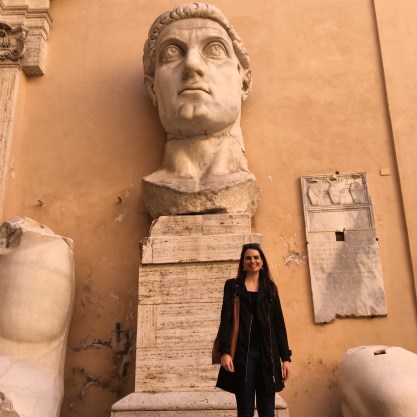
IMG_6054.jpg

I feel lonely in this picture!

To close out the nostalgia, I’ll just note that I didn’t feel particularly sad to find that so much had become unfamiliar to me. It actually almost seems appropriate. As much as the 2002 Italy trip was a bridge into the future that has become my present, it was also the end of another era of my life. I’m glad that forgetting so much allowed me to have an almost entirely new experience this time.

(One final thing for the record. Many people, in discussing how my trip to Rome in 2016 would be different from the one in 2002, commented about how I’d probably drink the same amount of alcohol. I just want to note that although wine was sometimes inevitably served at our dinners – our teachers often knew the proprietors of the restaurants where we’d go as a large group, and Italians are obviously completely used to teenagers drinking wine at meals – I was essentially a goody-two-shoes back then and also had no appreciation for wine, so my consumption was very minimal.)

Which is why it’s appropriate that my first evening in Rome began at a wine bar. I met up with an Australian friend of mine from London (we became friends thanks to a book event about Paris, which just goes to show that the magic of Paris extends beyond the French border) and her boyfriend, and we accomplished the truly remarkable feat of finding a place that seemed to be crowded with Italians rather than tourists. We got there just as it opened at 6:30, which was lucky because by the time we left the place was completely full. Isn’t this exactly how a wine bar should look?
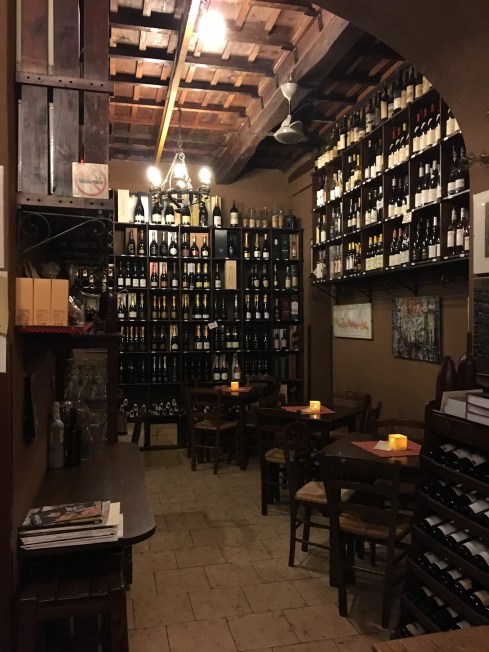
IMG_6072.jpg

We had a lovely bottle of Italian red and, of course, some bruschetta and anchovies. (It was Good Friday, so we were trying to be good and avoid meat – which was surprisingly difficult to do in the city that has been home to the Catholic church all these years.) After the wine bar we moved on in search of a restaurant just north of the Piazza Navona that had been recommended to them, and although we didn’t find it, we ended up in a place that suited us just as well. We got what was marketed to us as ONE appetizer, a collection of Roman antipasti. Look at what that one appetizer included:

IMG_6075.jpg

artichokes, green beans, mushrooms, zucchini, cauliflower, buffalo mozzarella, prosciutto (whoops), and of course bread

Next we enjoyed what was essentially a flight of pastas. We ended up with only two, which I think is only because we communicated that we really couldn’t have possibly each had a third plate of pasta. Both were delicious; the second boasted a sauce made entirely of a reduction of two types of cheese. YES PLEASE. And, obviously, they gave us some limoncello “on the house” at the end of the meal to aid our digestion of their food as well as the gelatto that we felt was our cultural imperative to have as dessert.

Not that I would have felt guilty about all of this food in the first place (that’s just a losing battle if you’re in Italy and completely misses the point of being there), but I walked about 30,000 steps – almost four trips across the center of the city – that day, so I totally earned it.

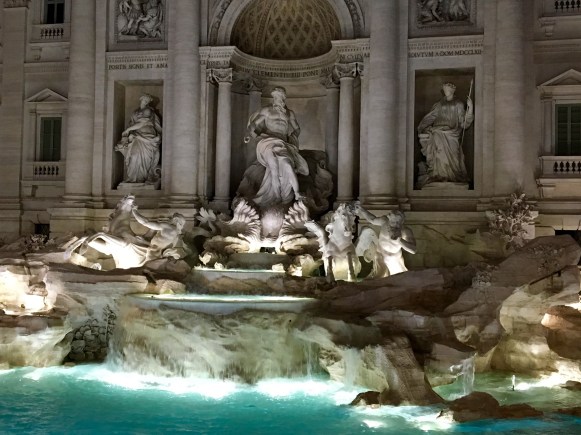
My last stop of the day was at the Trevi Fountain. This picture (for whatever reason) now holds the record of the most likes I’ve received for any picture I’ve posted on Instagram:
IMG_6079.jpg

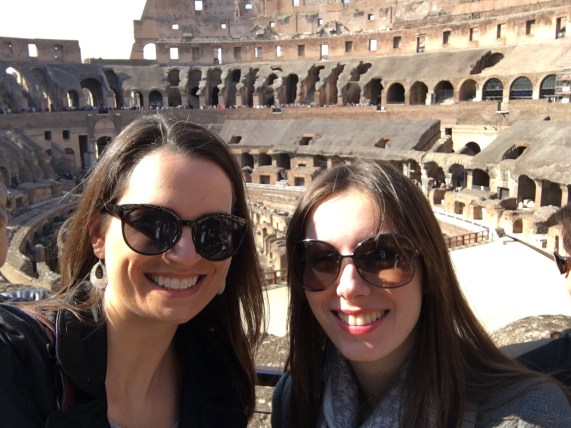
My Croatian friend Iva joined me on Saturday; it was her first time in Rome, and by then I’d familiarized myself enough that I could lead us around pretty easily. The weather was gorgeous – completely clear blue sky and warm enough in the sun that I took off my jacket (for the first time in months). We spent the afternoon at the Colosseum (including a rather long wait in a confusing line, but whatever) and the Forum. I once again missed having Mr. Ross as my tour guide; I remember him having so much to say while we were in the Forum.
IMG_6087

me and Iva inside the Colosseum

IMG_6067

the still awe-inspiring Roman Forum

Easter Sunday was just as lovely in terms of weather. Now, I should note that I hadn’t chosen to come to Rome that weekend because it was Easter specifically; I came because I had a four-day weekend, and I felt that I needed four days in order to do Rome properly (which was true). The fact that I am a Catholic [who doesn’t go to mass] was just icing on the cake. Iva is more of a practicing Catholic than I am, but I think we were ultimately equally excited about the prospect of being in Saint Peter’s Square on Easter Sunday.

We decided to approach things casually. Because the Brussels terrorist attacks had taken place earlier that week, we weren’t sure how many people would actually turn up in the square (we’d heard that a lot of pilgrims had cancelled their trips). Iva is from a major city in Croatia, but any city in Croatia is small compared to other major European capitals, so she was feeling nervous about being in a place that was naturally more of a target. We figured as long as we could see the Pope’s balcony and hear the noon blessing, we’d be happy.

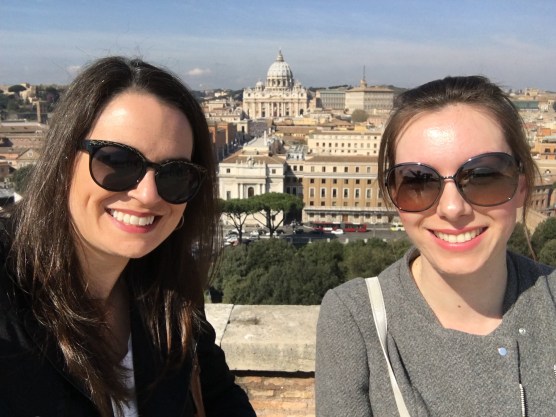
We started the day nearby at the Castel Sant’Angelo. I actually didn’t go here in 2002, so it was cool to do something entirely new! It’s well worth a visit; the views of the Vatican are great, and the views of the rest of the city are arguably better than those from the dome of Saint Peter’s (not to mention exponentially easier to achieve).
IMG_6164.jpg

We had a pretty clear vantage point of the way leading into Saint Peter’s Square and didn’t feel particularly pressed to get over there – from what we could tell, people hadn’t extended much beyond the square itself. We arrived at the security checkpoint on that street (about four blocks back from the square) around 11:30. There were barricades to control the flow of people, and policemen were checking bags, but otherwise it wasn’t a particularly complicated procedure.

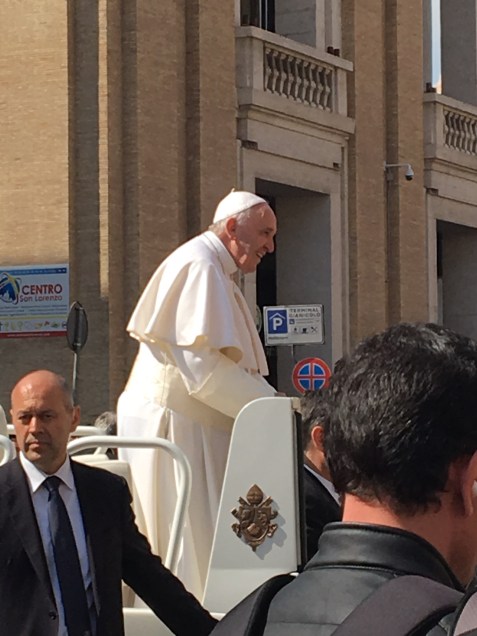
We had made it to what seemed like a final barricade in the middle of the street and were prepared to stand there the rest of the time when suddenly I looked a little further ahead and realized that the Pope was in the Popemobile and driving straight at us! Neither of us had any idea that this would happen, and it was pure good luck that we happened to be in the right place at the right time. We were in the front of the barricade and ultimately weren’t more than five meters away from him!
IMG_6183.jpg

Pope Francis!

We spent the rest of the day (and the rest of the trip) periodically commenting to each other, “we saw the Pope!” It was such a cool surprise, especially given that as it turns out you can barely see him when he’s on the balcony. We had a clear vantage point (from just outside the square) by the time he came out at noon to give the blessing, and although we could distinguish individual people, that was the greatest detail we could see. I’m so glad that I got the chance to see someone whom I admire so much and who is doing so much to lead the Church towards a more liberal approach to the modern world. And it was great to be part of that crowd of the faithful on Easter Sunday.

After the blessing, we joined the throng filing out of Vatican City and walked for a while along the south side of the Tiber until we got to Trastavere. We ate some pizza on the steps of a fountain (mine had truffles on it; amazing) and then got gelatto to celebrate Iva’s post-Lent ability to eat sweets.

IMG_6197.jpg

Tiramisu and dulce de leche. Sinfully delicious.

After walking quite a bit further through the south side, we crossed back over to the north side and into an area of the city that I vaguely remembered as being a little seedier. (I noted in my journal that while walking to see a church we passed a man who was wanking off on the side of the street, which needless to say was somewhat traumatizing for me.) We walked to see Rome’s random Egyptian pyramid and then backtracked a bit to rest in a rather dirty park where some Italians were lying in the grass or having Easter picnics. Finally we had a nice little uphill hike to see something else I hadn’t seen before, the famous keyhole of the Knights of Malta. Until we reached the square with the keyhole, I think we had spent nearly an hour without seeing any tourists.

The keyhole was underwhelming, and I do not recommend seeking it out. It’s cool in that yes, you look through a keyhole in a large door and see Saint Peter’s with trees on either side, but you can’t take a picture of that image, and you have to wait in line for about 15 minutes for that five-second experience. Not worth it! However, the immediate area is lovely. We continued down the road and looked inside two very old churches, then we sat in the lovely orange and rose garden with a great view:
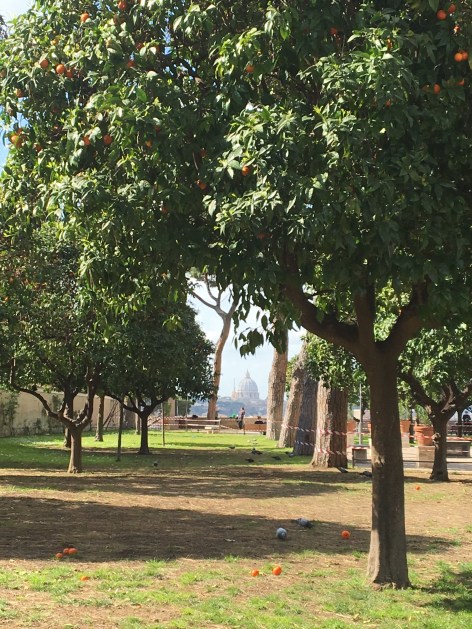
IMG_6206.jpg

That’s Saint Peter’s beyond the trees.

We decided to find the Spanish Steps before calling it quits for the day, so we walked about 30 minutes north from there. Part of the steps are covered with scaffolding now, so I didn’t take a picture, but we had a good time seeing where all of the good shopping in Rome is. (Gucci, Prada, etc. are all around there.)

On Sunday night we managed to score seats in the famous Pizzeria da Baffetto just down the street from our apartment. The previous night there had been a continuous and very long line to get in, so we hadn’t been optimistic, but on Easter it went from being completely closed (no one inside) at 6 p.m. to being open at 6:30, and we got there around 6:45. Neither of us thought it was the best pizza we’d had; mine looked great, but I couldn’t really taste any of the tomato, and that’s a pretty important part! I did, however, spark the interest of our waiter, who whispered to me on our way out, “I love you!”
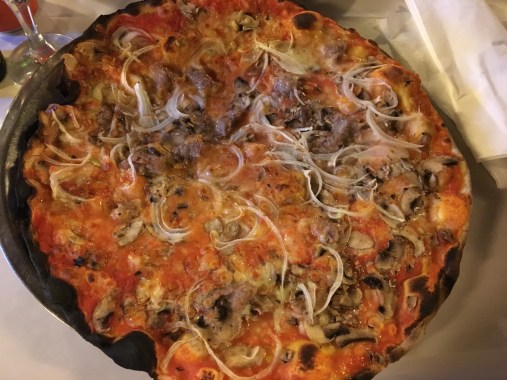
IMG_6219.jpg

Iva had her heart set on getting some chocolate cake to make up for the sweets she hadn’t eaten during Lent, so we ended up at a cute restaurant a little further away with a very effective guy in the role of front of the house – he saw us pass on the street, told us to come back in two minutes, and had us seated three minutes later. This place was just off the southern end of the Piazza Navona, so there was great people watching, and that guy and one of his waiter colleagues proved very entertaining as well. The waiter took a fancy to Iva, while the other guy seemed most interested in me. At the end of the night, Iva received a handwritten note from the waiter with his name, phone number, and “see you later! kiss!” on it. We were chuckling over that when the other guy came over and commented “I’m more efficient”, proceeding to hand me a small piece of paper on which was typed his name, his number, and the tagline “Love in Rome.” I’m 100% serious, and if I were skilled enough with photo editing to blur out his name and phone number, I’d put a picture of the note here. They weren’t keen to let us leave and tried very hard to extract from us a promise that we’d come back in 45 minutes when they’d be off work and ready to share a glass of wine with us. We weren’t interested in doing anything physical with them, and we couldn’t think of anything we’d have to talk about, so we didn’t take them up on the offer… but it was flattering and amusing nonetheless!

On Monday we got up earlier and spent my last few hours in Rome at Saint Peter’s. The interior was moderately familiar to me; I was glad to re-touch Saint Peter’s foot. The outdoor display from the day before was also lovely:
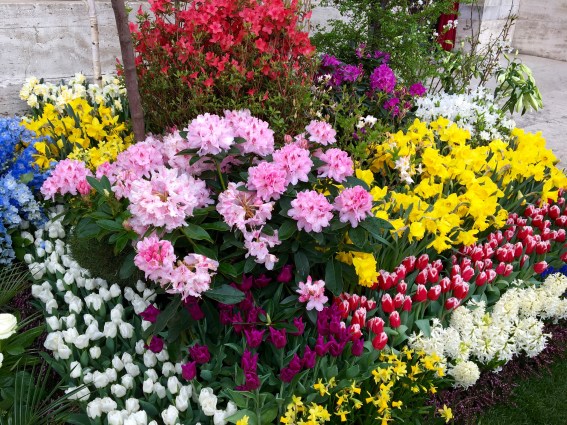
IMG_6228.jpg

one of several large floral displays on the steps of St. Peter’s, just under the crucifix
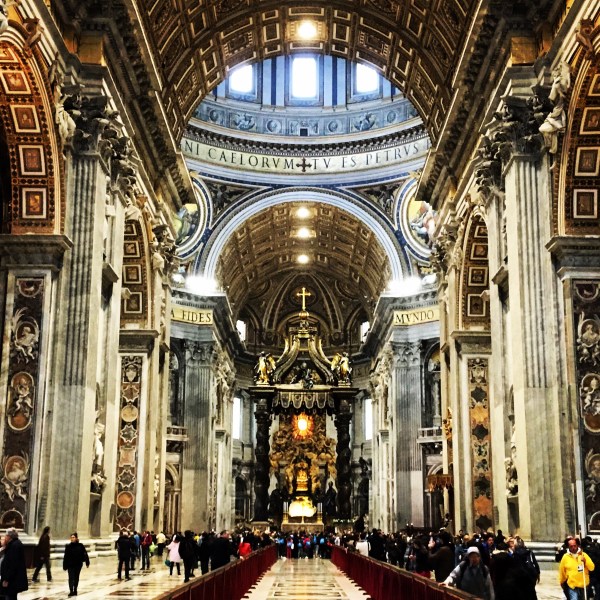
IMG_6229.jpg

We climbed to the top of the dome (which was actually a bit more arduous than I remembered) and, perhaps because it was cloudy and perhaps because it was just extremely crowded, we weren’t at all sure it was worth the energy or the time. I saw a teenage Italian girl blatantly add her name to the graffiti on the wall and wanted to smack both her and her mother, who handed her the pencil. The nerve! I also saw that a student from Boston College had inscribed her full name along with her school affiliation and was seized by indignation and the desire to contact the [Catholic] school and tell them that their students clearly don’t think much of the Church if they’re willing to deface Saint Peter’s. It’s one thing to write your name in a random bathroom stall, but I found it utterly appalling how many people had written something (or stuck their gum!) on the walls on the top of the dome. I’m sorry to end it on that angry note, but that was the last thing we did before I had to go to the airport!
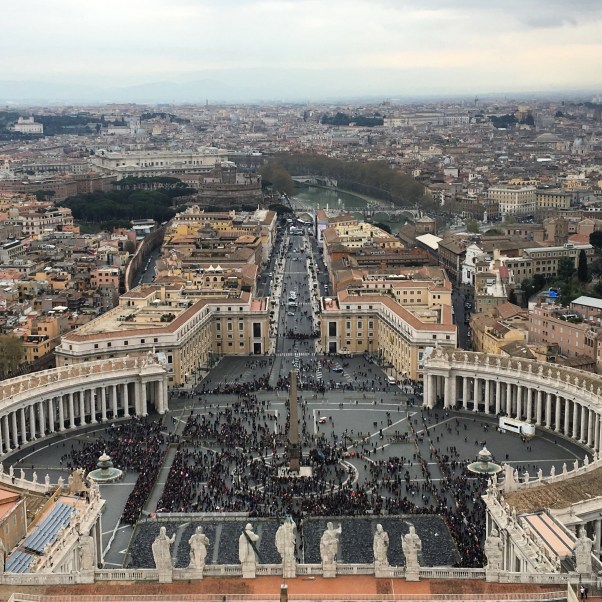
IMG_6242.jpg

In sum, it was wonderful to go back to Rome – to see things that were familiar yet new, and in the comfort of 65-degree rather than 95-degree weather. Now is the perfect time of year to see the city, and despite it being Easter weekend, I actually thought there were fewer tourists than I’d been expecting. I definitely think I could live in Rome, and it’s now more firmly back towards the top of my list of favorite cities.

New Year, New Country: Uruguay

My last full day in Argentina was actually spent mostly in Uruguay!

The old town of Colonia del Sacramento (now a World Heritage site) is a mere 75-minute boat ride from Buenos Aires, and since Uruguay has the misfortune to just be Argentina’s forgotten neighbor without any individual claims to fame*, we figured we’d better go see it while we had the opportunity… when in doubt, get another stamp in the passport! Uruguay brings my country count to 31 and my Spanish-speaking country count to 9, if you include Puerto Rico. Not bad!

*Note that our favorite red-shirted bartender from Rey de Copas essentially agreed with this assessment; after all, he was an Uruguayan living in Argentina!

Given the utter chaos we’d witnessed at the boat terminal on Wednesday, we were more than a little anxious about whether we’d even make it to Uruguay. As it turned out, we had absolutely no reason to be worried. We arrived a bit over an hour ahead of the boat’s scheduled departure and found the hallway that had previously been jammed with people to be practically deserted in comparison; we got our boarding passes easily and then went through customs, just like you do if taking the Eurostar from London to Paris.

The only problem was that it was raining. It had been cloudy when we woke up, and then about 10 minutes before we left the apartment, despite absolutely no forecast for rain, it started pouring. I looked out the window and remarked “well, at least the street isn’t flooding like it did when I was in Caracas and it rained like this,” but five minutes later I changed my mind – there was a river of water about three feet wide extending into the street from the sidewalk! It wasn’t supposed to be raining in Colonia either, so we weren’t sure what to make of the fact that it was raining in Buenos Aires.

I snoozed the entire trip over, and when we pulled into port, the rain had stopped. We didn’t have any kind of plan for the day, especially since we had no way of knowing what would be open since it was New Year’s Day. (Buenos Aires had been a ghost town – NOTHING was open, and only a few cars were on the roads.) I had a map from my guidebook, and we ultimately just walked out of the terminal and turned left to follow the coastline.

We had made it a block or two into the old town when it started raining again. Mary had an umbrella, but this wasn’t the tranquil kind of rain for which an umbrella will suffice; we rushed into the nearest place with an open door, which turned out to be a nice hotel, and took advantage of their wifi for about 15 minutes before, thankfully, the rain stopped and the sun began to peek out.

IMG_5712.jpg

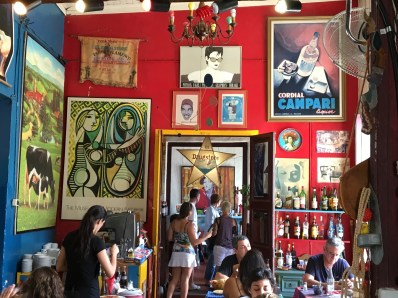
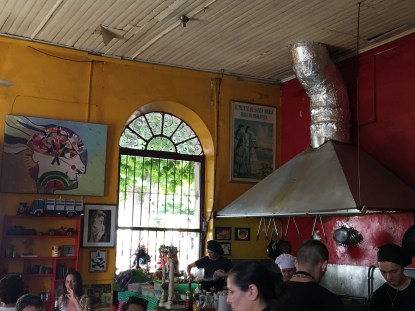
From that point on, it was a lovely day. The old town reminded me of Old San Juan or the walled part of Cartagena, except smaller and more quaint. We wandered a bit and then found a restaurant recommended by both our guidebooks called The Drugstore. I have no idea why it was called that, but it was a fantastic place to spend a few hours of the afternoon. All of the doors and windows were open to let in the warm breeze, and a woman was singing to set the mood.

IMG_5723.jpg

The right half of this picture was one of the restaurant’s kitchens – just a few yards from our table!

IMG_5724.jpg

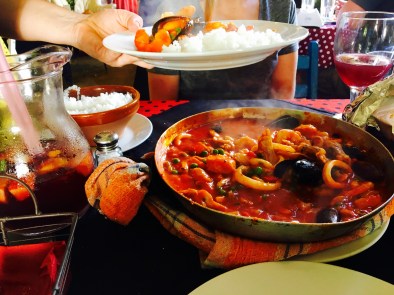
We had a horrible time trying to decide what to eat (there were too many good options), but we eventually went with the recommendation of our waitress and got a seafood stew which was incredible:

IMG_5732.jpg

Fish, squid, mussels, shrimp, and some other creature I couldn’t identify…

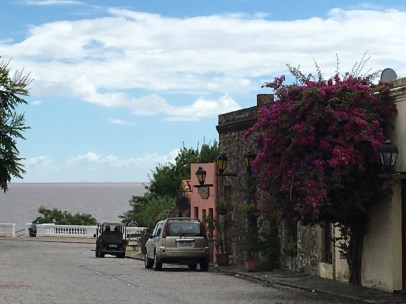
We lingered there, eating the stew and drinking sangria, until about 4:00, at which point we figured we’d better keep exploring. Here are a few pictures of the rest of the town:

IMG_5714.jpg

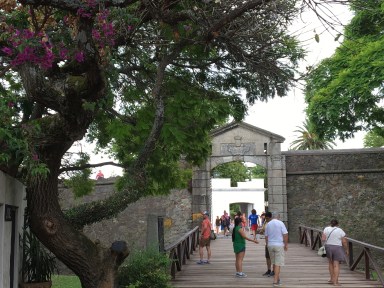
The gate to the old town

IMG_5720.jpg

IMG_5721

We eventually found a beach and spent a pleasant half hour catching some late afternoon sun in the sand! The surrounding area was really beautiful too.

IMG_5736.jpg

IMG_5734.jpg

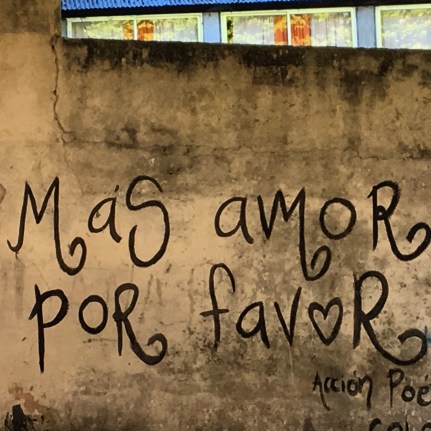
I also loved this message on the wall:

IMG_5745.jpg

“More love, please!”

We had an 8 p.m. ferry back to Buenos Aires, during which we both napped again. Because there still wasn’t anything open, we ended up just spending our last night at home, which was fine. We did a little research on Uruguay because we realized we both knew very little about it and learned that it has a few claims to fame that seem not to have become popular knowledge:

  • It’s the second smallest country in South America after Suriname and is home to only 3.3 million people. (I didn’t think it was nearly that small!)
  • According to Wikipedia, Uruguay is ranked first in South America for all of the following: democracy, peace, lack of corruption, and e-government; it shares first place for press freedom, size of the middle class, and prosperity.

WHO KNEW!

Uruguay’s beach town of Punta del Este is supposed to be the Hamptons of South America… perhaps maybe one day I’ll make it there. At any rate, I’m glad to have seen Colonia and definitely recommend it as a day trip for anyone going to Buenos Aires!

New Year’s in Buenos Aires

Mary and I allowed ourselves to sleep until 11 on New Year’s Eve – after several nights in a row of going to bed past 3, it was necessary, especially given the fact that we wouldn’t be able to sleep late the next morning due to our trip to Uruguay. We had a lazy start after that, taking an hour to lay in the sun by the rooftop pool before really getting started with the day.

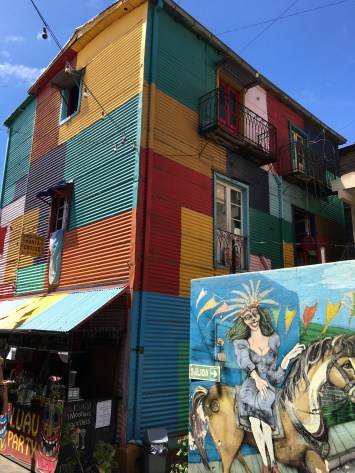
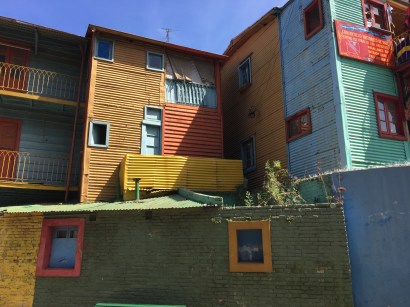
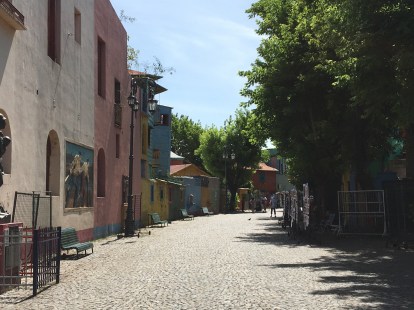
We spent a couple hours in La Boca, a rougher neighborhood south of the city center that happens to be the home of another staple of Argentine culture: tango. My guidebook utterly failed to convey what I’d find in La Boca; it mentioned neither the brightly colored buildings nor the art and textile shopping that awaited us there. It was actually my favorite part of the city!

IMG_5648.jpg

IMG_5654.jpg

There’s not anything in particular to see in La Boca; you just arrive in this small area called Caminito where there are all of these brightly colored buildings (many made out of corrugated metal; this area is right next to the river, so many of its materials came from the shipping industry). There were various outdoor restaurants that each had their own duo dancing tango for the entertainment of the customers; we meant to eat, but we prioritized shopping first. I, having read mostly just that La Boca was a pretty shady place if you strayed out of this small touristy area, had left my wallet and most of my cash back at home, so I was unprepared for shopping, which was a shame – we encountered some really lovely leather and fur pieces in various shops as well as a lot of great art being sold on the street. Mary was kind enough to loan me money to buy a really well-designed purse that I loved, from a woman who sold it very well and gave me a kiss as we left (such a nice gesture and one that wouldn’t happen anywhere in the US or even in most of Europe, I venture!). We also each got a print of a street scene – as it turned out, I had taken a picture of exactly the same scene before I bought the painting (which is now getting framed, so I don’t have a picture of it):

IMG_5650.jpg

A Brief History Lesson…

Our plan after La Boca was to observe the Madres de la Plaza de Mayo, who gather in the plaza each Thursday at 3:30 p.m. to continue protesting against the military junta’s disappearances of their children during the Dirty War from 1976-1983.

This is a subject I read quite a lot about in college as well. I’m pretty familiar now, after working on and observing a few genocide trials in law school, with the intimate details of some of the worst atrocities committed since World War II. Those cases all involved a lot of killing, and that happened in Argentina too (many of the disappearances involved drugging enemies of the regime and then dropping them out of planes into the ocean), but what happened in Argentina is bone-chilling in a different way. The military set up torture centers right in the middle of Buenos Aires. A gruesome but fascinating book I read recounted the experiences of survivors who described how, completely aside from horrifying acts like being strapped to mattress coils and electrocuted, it was torture to be in the basement of these torture centers and to see the shadows of pedestrians passing by on the sidewalks above them, to hear the sounds of cars on the streets – normal life going on mere feet from the hell into which they’d been thrown.

The Madres began protesting even before the end of the war. Many of the victims of the dictatorship were young people in their 20’s and 30’s, which also explains the existence today of a second group called the Grandmothers of the Plaza de Mayo: they seek the grandchildren who were stolen as infants at the time of their parents’ abduction, or taken away from mothers who gave birth while in custody, and given to families loyal to the junta. Those grandchildren are now in their 30’s.

Knowledge of all of this stayed subtly in back of my mind throughout my time in Buenos Aires. It’s always – I lack a better word here – interesting to be in a place with such heavy memories in its recent past. In most such places I’ve visited, there are still visible signs of the past in the present (shell holes in walls, etc.), but Buenos Aires isn’t like that – perhaps in part due to the fact that the Dirty War didn’t involve an actual war, so there were never physical signs of it. The only real physical reminder, as far as I can tell, is the weekly appearance of the Madres.

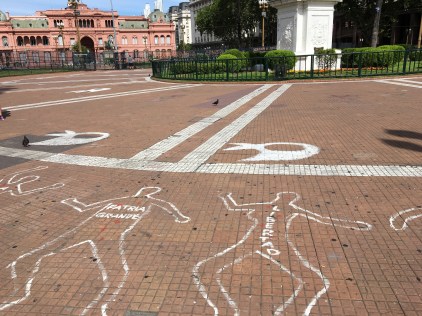
Unfortunately, we didn’t arrive until closer to 4:30, and perhaps because it was New Year’s Eve, there were no longer any Madres to see – though a group was dismantling a tent that had been set up with their logo, so they must have been there. Their logo is the white symbol in the picture below; it’s a headscarf:

IMG_5662.jpg

The message above says “governments pass; repression stays – the fight too. 4644 kids killed by the state apparatus.”

IMG_5660.jpg

(That’s the Casa Rosada – the presidential palace – in the background.)

I’ll try to catch the Madres the next time I’m in Argentina. (I know I’ll be back.) At least we had the benefit of a talkative taxi driver on the way to the plaza; he pointed out to us the site of one of the torture centers (whose name I remembered), now a crater in the ground but surrounded by various remembrances in honor of those who were killed there. I was a little surprised that he was so willing to broach the subject (though it was Mary who first brought it up by asking if he thought the Madres would still be in the plaza).

Back to the NYE Narrative…

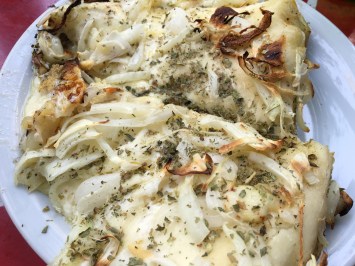
Before getting ready for our night out, and because we’d never managed to have lunch, we grabbed a snack at the Kentucky pizzeria one block down from our apartment. This strangely named chain is all over Buenos Aires and has been around since the 50’s, so I think it’s pretty legit, but we still couldn’t help but chuckle at the name! We decided to try an Argentine specialty called fuggazzetta -a sort of double-layered pizza with cheese in between and a mixture of cheese, onions, and oregano on top. It doesn’t look like pizza at all, but damn is it good:

IMG_5663.jpg

And now, it’s finally time to recount our New Year’s Eve in Buenos Aires!

One of the experiences on my Buenos Aires list was to eat at a “puerta cerrada” – a secret, “closed door” restaurant, of which there are many across the city. They’re not secret in the sense of being unknown, but they are not restaurants that you can just happen by on the street. Many are simply the homes of the chefs, so they’re very small and intimate. They have websites that tell you how to make a reservation, and once you do that you’ll receive the address and other necessary information. It’s pretty cool!

A New York Times article led me to one with a more robust website that happened to be advertising a New Year’s Eve menu. The Almacén Secreto Club is in a neighborhood called Colegiales, west of Palermo. It wasn’t ideal from a location point of view in the sense that we’d been strongly warned about the fact that the Subte would close and there would be no taxis, so most people were planning their evenings within walking distance of their homes. We were able to take the Subte west and then walk another 20 minutes to get there, and as we’d learned from doing this the evening before to pay our deposit, it was only a 20-minute walk over to the part of Palermo with all of the bars and clubs, so it ended up working out just fine.

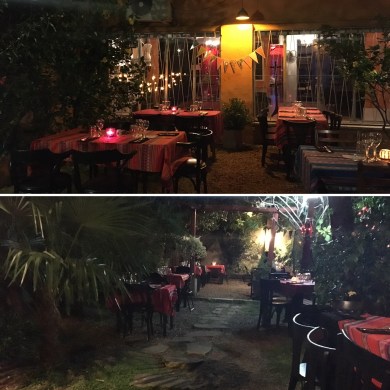
The club is located in a house on a perfectly normal residential street, and the house doubles as an art gallery of sorts – though we never got around to exploring it. Upon arrival, the only thing that tips you off to the presence of a restaurant is the wonderful aroma of roasting meat wafting out of a hallway leading to the kitchen. We rang a bell, provided our names via intercom, and were ushered down a long hallway and into the back garden, which couldn’t have been lovelier.

56FB3E8E-B603-48B2-B662-A49E08224ADE.jpg

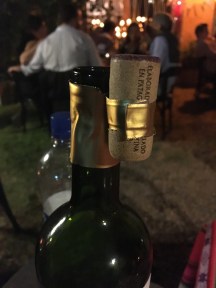
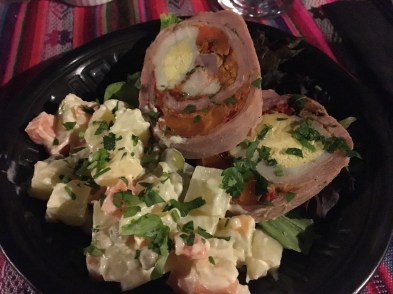
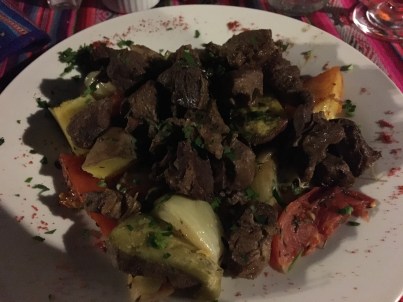
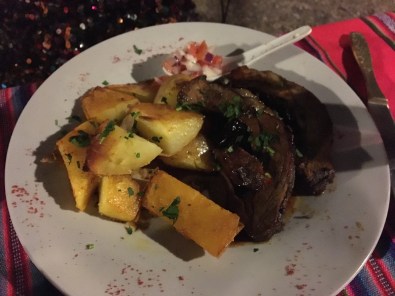
There were probably about 30 of us out in the garden for dinner. The evening was like an intimately sized wedding reception where you know no one else. There were a few families (one with kids our age dining with their parents; one with grandparents, parents, and little kids dining together; a mother and daughter) as well as a handful of couples. We arrived at 9:00 and were the first there, but the garden filled up quickly. We ordered a bottle of malbec and then one of each of the options for the set menu:

IMG_5673

What a neat trick with the cork!

IMG_5669.jpg

IMG_5670.jpg

IMG_5671.jpg

This beef was SO good – it had clearly been cooking all day.

IMG_5672.jpg

Possibly the best pork I’ve ever had…

And then, as if all that weren’t enough to stuff us silly, we had a round of desserts (including a brownie topped with delectable ice cream and sort of a walnut and ice cream cake) and then a BONUS round of desserts – they wheeled out a huge table laden with various cakes, breads, and candies and shouted for us to help ourselves. Mary and I could only marvel at how everyone else seemed to have plenty of room to continue eating – we couldn’t!

Just after midnight (we didn’t do any sort of countdown, but nonetheless everyone on cue got up and started hugging and kissing their table mates) the wait staff brought out glasses of champagne, followed by party favors (masks, noise makers, headbands, necklaces). As fireworks started going off around us (though we couldn’t see ANY of them!), a DJ inside the house turned on some music, and a waiter encouraged us to dance, saying “hoy, se puede!” (“Today, you can!” New life motto. #HoySePuede) Mary and I calmly sipped our champagne and continued searching for the fireworks that sounded as though they were exploding right over our heads; eventually we went in to start dancing and had a great time – it felt even more like a wedding reception then! My favorite memory is of two women our mothers’ ages dancing next to/with us during a remix of “Ob-La-Di, Ob-La-Da”; they shouted all the words! The waiters and cooks danced with us in between their clearing up duties. It was such a great way to spend the evening, and it was only 800 pesos per person – $57, which included everything! (This is in stark contrast to other places where we had originally made reservations – one was 2000 pesos per person or $150, and I bet there wouldn’t have been party favors or dancing!)

Things wound down around 1:00, and we exited from the calm of the garden to the relative chaos of the streets, where people were still firing off plenty of fireworks, resulting in scenes like this:

IMG_5693.jpg

Yes friends, that is an actual fire in the middle of the street – and cars were continuing to drive past! One firework exploded just a few yards away from us as we were passing by this intersection; needless to say, we hastened away in favor of a slightly safer locale. Aside from the explosions though, it was a very nice time in the street; we exchanged greetings of “feliz año!” with people as we passed by.

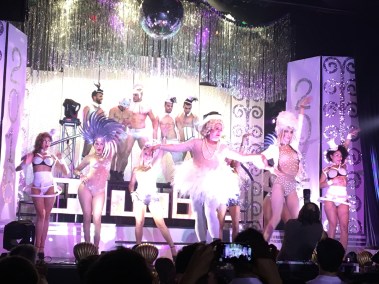
We eventually made our way to Club 69, which we’d heard was having a NYE party. I am never excited to go clubbing but generally don’t regret it, and this was no exception. We were greeted inside by drag queens and very muscular men wearing minimal amounts of clothing – yes please! We pushed through the crowd to get near the bar, and the fact that we were still wearing our party favors (the masks were now serving as headbands) worked in our favor because a guy started talking to Mary pretty quickly. She discovered that he was French and said “talk to my friend! She speaks French!” and the poor guy was so thrilled to find another francophone that he just couldn’t help but kiss me ten minutes later. 🙂 It wasn’t a midnight kiss, but still – I think being kissed by an attractive French guy only hours into 2016 suggests good things to come for me this year! So does the fact that I managed to get out of that club an hour later with absolutely nothing on my white dress.

IMG_5755.JPG

My new French friend, borrowing Mary’s mask

We talked to the French group for a little while but eventually separated; we stayed long enough to try another local drink, a fermet and Coke. Fermet is kind of like Jagermeister; it’s very herbal and not a flavor I particularly enjoy. We probably had significantly more Coke in our drinks than the usual ratio would be for an Argentine! While we sipped, we enjoyed the burlesque show, complete with pole dancing!

IMG_5697.jpg

We left the club just after 3 and managed to get a taxi within five minutes – it wasn’t nearly the impossibility we’d expected. We’d had a great night, but I was thrilled to get home a little “early” in advance of our trip to Uruguay the next day! More on that in the next post…

Buenos Aires: art, empanadas, and (less impressive) cocktails

Picking up from the end of my last post, our third day in Buenos Aires did not start particularly well. The effects of excellent cocktails without a proper dinner took their toll, and we spent a large portion of the day trying to get our groove back. This was partially just a matter of luck – it was like we had to pay a bit for how good a time we’d had the night before.

We were planning to go to Uruguay that day, but when I checked the website of Buquebus (the company that ferries people to Uruguay), it looked like there were no longer any tickets available. We decided our best bet was to go to the port regardless, if for no other reason than to buy tickets.

The only word I can use to describe the scene at the port is “chaos”. Imagine an airport departures hall with no lines for check in and a lot of delayed flights. People were EVERYWHERE, in lines that seemed to wind, intersect, and lead nowhere at all. It took us more than 10 minutes just to figure out where we could buy tickets – and even then it was a fairly bizarre experience because we had to go into what is essentially a travel agency and wait to speak to an agent rather than just walking up to a ticket window. Anyway, eventually we were seated across the desk from a nice young woman our age, who informed us that the first day with tickets available was Friday – New Year’s Day. We weren’t wild about the prospect of having to get up earlier to get on a boat after what would surely be a long night out, but our desire to add another stamp to our passports won out, and we bought the tickets.

At this point we were desperate for food – preferably greasy food. We were just five minutes from Puerto Madero, a waterfront area with lots of outdoor dining. I’ll spare you a description of the horrible meal that awaited us – suffice it to say that if you are in a country that is famous for foods like steaks and pasta, you should never just order a sandwich from the cheap daily specials list.

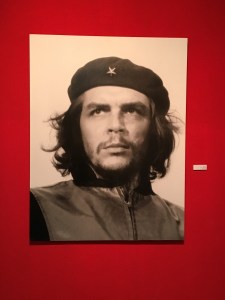
We struggled onwards to the Centro Cultural Jorge Luis Borges, a museum of sorts located on the top two floors of a fancy mall downtown. We weren’t really sure what we’d find there, but we’d read that they might have interesting exhibits. We saw some modern art that we didn’t understand and a very nice photography exhibition by the guy who took that picture of Che Guevarra that you see everywhere.

IMG_5631

What saved the afternoon was our visit to the mall’s food court, where we got ice cream. Because Argentina had a huge wave of Italian immigrants, it has great Italian food, and that includes ice cream. I got a dulce de leche ice cream that was di-vine. Now, I didn’t know this – dulce de leche is an Argentine thing. I wasn’t really aware of the history of that flavor, and calling it a flavor is the first problem – it’s actually a product sold in jars everywhere; it’s like the Nutella of Argentina, except that instead of chocolate and hazelnut it’s more of a salted caramel. A dangerously delicious salted caramel. I didn’t take a picture because I was too busy consuming it with abandon.

Our final stop of the afternoon was MALBA, the Museo de Arte Latinoamericano de Buenos Aires. This is the most famous of the many art museums in Buenos Aires; it’s in northern Palermo in a big, modern building that suggests a much larger collection than they actually have (not complaining). There is one main gallery with works spanning about a hundred years; it includes paintings (one of Frida’s self portraits!) and other more modern installations. Like my favorite art museum in Paris (the Orangerie), MALBA provided just the right amount of art to give us a good dose without overwhelming us.

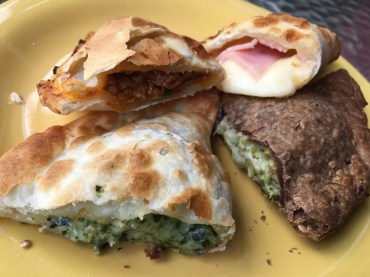
When we got home in the late afternoon, we were still in desperate need of satisfying food. We found it in the form of empanadas from a nearby empanadería: we got one with spiced meat, one with ham and cheese, one with spinach, and one with broccoli and cheese. They were all delicious and just what we needed.

IMG_5633.jpg

Following a restorative nap up by the pool, we prepared for another night of cocktail bar exploration and finally made plans for dinner the next evening (New Year’s Eve). I’ll explain more about that in my next post. After going to pay a cash deposit for dinner, we walked east back towards the part of Palermo we’d been in the previous night and happened upon a restaurant that looked like it would give us everything we’d been missing all day.

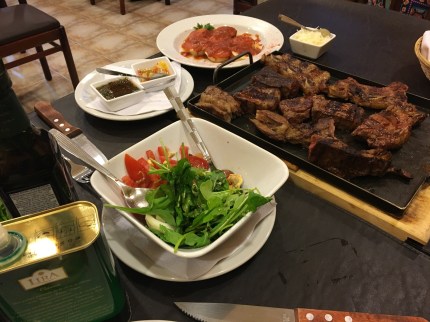
La Dorrega was clearly a family-run neighborhood haunt; everyone in there seemed to know the owners, and we were definitely a bit of a novelty as the only tourists. We ordered half a bottle of Malbec, a salad, a three-meat mixed grill, and Sorrentinos, which are an Argentine type of ravioli stuffed with ham and cheese. Our waitress attempted to impress upon us the ambitious quantity of the food we’d ordered, but we simply smiled and said “we’re from the United States. We can handle it.” Hilariously, two minutes before the main courses arrived, our waitress informed us that our table would not hold all the food, so they had to bring us a second one! Here’s what we ended up with:

IMG_5638.jpg

(Please observe the huge quantity of meat as well as the size of the steak knives. Those blades are about the width of two fingers.)

We ate almost everything and weren’t at all sorry about it. Everything about that restaurant experience was perfect, and we felt like the frustrations of the first half of the day had been cleansed away.

From there we set off for the bar we’d heard most about – Frank’s. Frank’s is a speakeasy in Palermo, and though there’s a sign on the wall for it, it’s quite difficult to get into. When we first arrived, we could see no door to open to let us in – and we were so confused that we decided we should keep looking and took a full walk around the block. Fortunately, when we came back, we saw the door open and immediately pounced upon the couple exiting to ask if this was Frank’s. Step one complete. Step two is harder. A bouncer met us at the door and asked us for the password. Frank’s posts the “password” (I use that term loosely) on their Facebook page each day. That day, the “password” was a quote: “you return in every cocktail that I drink.” We fumbled to remember the right words, but eventually the bouncer let us into a dimly lit entryway with a phone booth on the opposite wall. Step three is to enter the phone booth and figure out which button to press to open the secret false wall that lets you into the actual bar. It’s quite a process!

I give Frank’s full marks for creativity and atmosphere based on all of that. Unfortunately, that’s the end of my praise. This is a bar that, aside from the whole password/phone booth thing, is actually supposed to have really good cocktails. Bolstered by my success at sweet-talking the guys at Rey de Copas, I approached the bar (following a greeting by a very attractive bartender on the other side) and said that I needed recommendations about what to order. Now, to contextualize this interaction: there is a board behind the bar that lists about five drinks, but (here’s a sign that I’m no longer in my 20’s) I didn’t have my contacts in and couldn’t read the very small text particularly well, so there was a practical reason for asking for a recommendation aside from the fact that it’s just  more fun and a good way to make friends with bartenders. This guy was having none of it. One would think I’d asked the most trite question possible. He asked what I liked; I hedged a bit and said I like things that are semi-sweet or bitter, with a particular preference for vodka or whiskey-based drinks. He seemed put out by this and said nothing further; he proceeded to make me a cocktail with a darkly colored Martini liquor in it and… wait for it… beer. BEER! There was something fruity too so that the final effect was something pinkish. This bartender was a total snob, not friendly at all, and didn’t even bother to make me something with either of my two preferred base liquors! Mary more wisely ordered from the menu and ended up with a very pretty drink. But here’s the clincher: our two drinks together were 400 Argentine pesos – which is 30 American dollars. To put this in perspective, most of our meals up to this point (other than the feast preceding this drink) ran about 350 pesos for the two of us. I’m talking about meals with steak and wine costing less than these two drinks. Mary’s drink was delicious but gone in a second because it was small, and mine wasn’t worth finishing. We didn’t stay for another round and left feeling affronted on a number of levels. Don’t go to Frank’s!!!

We went to one more bar before calling it a night. This one was thankfully a lot better. It was called 878 and was much closer to Rey de Copas. There were a number of bartenders behind the very long bar (that was the downside – too big a place, and too busy, so not as intimate), and they were all clearly very good at what they did. Their cocktail list is extensive, and from our vantage points at the bar, everything was very well put together. We learned that they use yerba buena in a lot of drinks; it smells a lot like basil but tastes quite different, as we discovered. We didn’t get to talk too much to the bartenders, but it was at least a way to take away the sting of disappointment from Frank’s! (Even six days later as I write this, I am still upset about Frank’s!)

Thus ended our third day/night in Buenos Aires… next stop, 2016!

Buenos Aires days 1 and 2: steak, cocktails, and Evita

Monday, December 28 was our first full day in Buenos Aires. After having plotted out a rough plan for the week the night before and getting some much-needed sleep, we woke up mid-morning and started walking west down the Avenida Santa Fe with the aim of checking out a few things in Palermo. A lot of things are closed on Monday, so this was our day of more casual exploring. Our first order of business, however, was to find me a pair of more suitable shoes. I did a really aggressive purge of my possessions about two months ago and failed to think ahead to this trip, which resulted in my disposing of almost all of my summery sandals because I either didn’t wear them enough or they’d reached a point of being worn beyond repair. I literally didn’t own a pair of flip flops to bring with me; I spent Sunday afternoon walking around in strappy, low-heeled sandals which are fine fashion-wise but not the best in terms of long-distance comfort. Anyway, we thankfully found a store selling [real] Havaianas flip flops a few doors down, and I gratefully removed my loafers. Alas, Havaianas (as I remembered too late) usually need to be broken in, and pretty soon we were stopping to buy band-aids for my blistering feet. Take note, fellow travelers, that it’s always a good idea to have anti-blister ointment in your purse! I’m never traveling without it (or throwing away all of my flip flops) again.

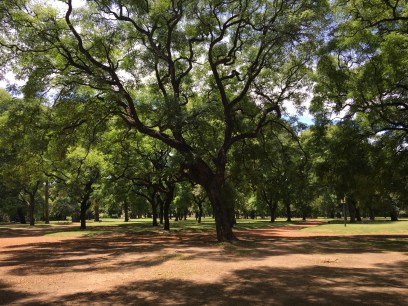
But I digress. Aside from my injured feet, we had a lovely several hours wandering in the western part of the city. The expression in Spanish is “dar un paseo” – it’s hard to translate literally, but it’s the equivalent of “taking a stroll” – and Palermo is the perfect place to do so. There is a cluster of parks and green, leafy plazas filled with tropical foliage, and these are one of my favorite features of South American countries. (Don’t get me wrong – I absolutely adore the style of the Parisian parks and the gardens at Versailles, but the difference in the types of trees and plants in this part of the world makes you feel like you’ve truly escaped to some sort of urban oasis.)
IMG_5580

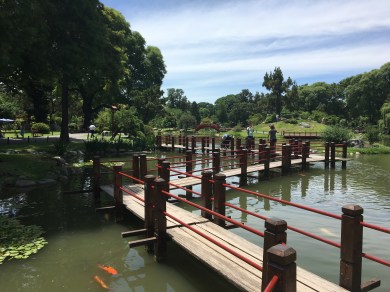
We particularly enjoyed the Japenese Garden, which was established by the Japanese community here. There’s a very large koi pond in the center, and the usual features of Asian gardens surround it. I always love looking at the fish!

IMG_5581.jpg

Next we went in search of a store called the Casa de las Botas (House of Boots), which specializes in equestrian boots of all types and colors. We were expecting to find a store selling all the genuine leather boots our wallets could handle, but instead it turned out to be a workshop where they really do make all the boots that they had in the showroom – all custom made. I had forgotten that polo remains a big thing in Argentina, and from what I can tell this place outfits all of the polo players in the country – with boots in all sorts of colors, including yellow, purple, and turquoise!

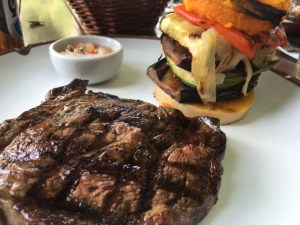
At this point it was about 3:00, so it was definitely time for some lunch. We wandered through an area home to many bars that we will visit at a later time and ended up at a restaurant we’d heard about called Miranda, which had outdoor tables on the shaded sidewalk. Our cold Quilmes beers provided a quick relief from the heat, and our steaks arrived in short order thereafter. My first bite of my “ojo de bife” (ribeye) was overwhelming even in the face of the fact that the meat was thoroughly cooked – not pink at all! There were so many flavors, and supplementing with the little pot of oil and onions made it absolutely incredible. (I can only imagine how good it would have been if it had been medium, which is what we thought we ordered!)

IMG_5594

Following lunch, which was filling but not stuffing, we made our way back to the Subte and traded the heat of the streets to the refreshing cool of the pool. 15 minutes was plenty to leave us feeling cooler and ready to take on the evening, which promised to be an entertaining one. We had heard about a Monday-night-only drumming concert at a rather hipster event space about a mile south of our neighborhood and figured it would be a good way to meet locals. It turned out to be what I decided was the Argentine equivalent of going to a baseball game: no one was there for the music; it was just an excuse for being outside and drinking beer in a crowd. We ended up meeting one other group of tourists at the end of the night, but otherwise this was a locals-only affair. Mary and I bought a couple of beers (the second of which was, by a rule imposed on the particular line we were in, a one-liter bottle poured into a larger-than-usual Solo cup – needless to say, we didn’t drink beer the rest of the trip). We didn’t end up meeting many locals; two guys approached us towards the end of the event and were extremely persistent at trying to get us to come to a different part of town to have dinner with them, but we weren’t quite interested enough to be adventurous.

There’s a video of the drumming on my Instagram page if you’re interested!

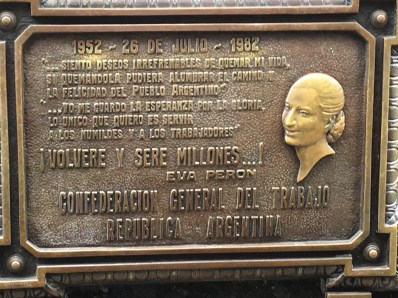
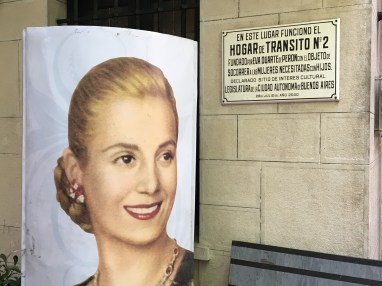
Tuesday brought two things I’d been very excited to see: Evita’s grave in the famous Recoleta cemetery and the Museo Evita afterwards. As I mentioned in my last post, I’ve always been fascinated by Evita, even aside from loving the musical. I read a lot about her in college; did you know that her body was embalmed and then stolen by the political enemies of Peron so that it was secretly buried in Italy for a while? She was that powerful of a figure and symbol that she posed a threat even in death. Because she’d been embalmed, when they finally got her body back, she looked almost exactly the same as she had the day she died, other than some damage apparently due to rough handling by her kidnappers. If you delve into things she wrote or records of people who interacted often with her, you can’t help but be convinced that this was a woman who could have written a book about the art of propaganda… and at the same time, you won’t know if she was a brilliant, scheming political mastermind or if she just did genuinely think and feel all these things she expressed… or both! I won’t say more here, but I suggest you do some research for yourself. She’s still such a big figure – I saw her book on sale at a few bookstands in the San Telmo market, and postcards of her are everywhere too.

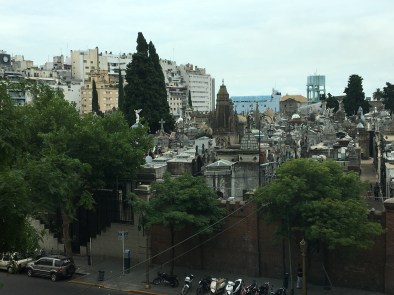
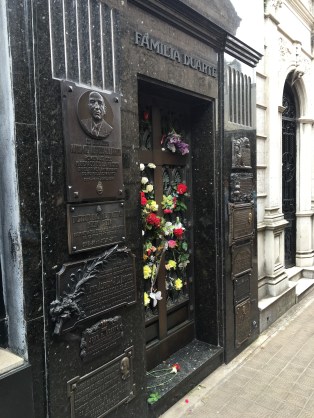
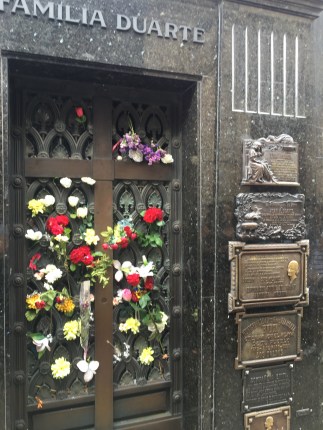
Evita’s grave is in the Duarte plot in Recoleta. (If I recall, there’s a story there too – of course her family was neither rich nor from Buenos Aires, so a lot must have happened to secure them such a prestigious burial spot.) Recoleta is the Buenos Aires equivalent of Père Lachaise in Paris; all the famous people are buried there. Here it is from the vantage point of a mall across the street:

IMG_5612.jpg

Mary and I, not being particularly familiar with any of those other famous people, made a beeline for Evita and then did a casual loop through the rest of the place. Here’s what Evita’s grave looks like:

IMG_5601

IMG_5602

IMG_5606.jpg

IMG_5608.jpg

The Museo Evita is over in Palermo, in the building that used to house women and children receiving aid from her charitable foundation. They have a number of her outfits on display, which was cool to see because as much as I am aware that she was a real person, sometimes her story takes on such epic proportions that it’s hard to believe that she existed in real (and relatively recent) life, so seeing something that she actually wore was a step closer to believing she was real. There are also a lot of pictures of her and excerpts from her writing, both formal and informal. The way she and Peron wrote to each other is fascinating – despite the gap in their ages and their completely disparate backgrounds, they wrote incredibly flowery things to each other about their undying love. And, as I mentioned before, you get a real sense of how much Evita lived and breathed her work. I’m reading a biography of her now, and apparently in the time leading up to her illness, she routinely worked 20-hour days. Pretty incredible.

IMG_5591.jpg

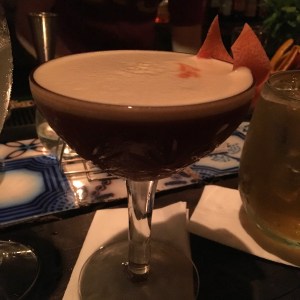
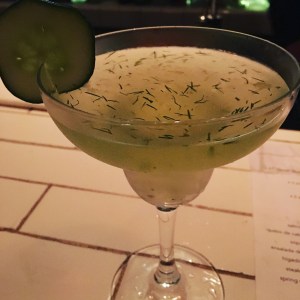
Tuesday night proved to be my favorite of our nights out in Buenos Aires. We set off for Palermo with plans to go to a wine bar called Trova but arrived to find it, and another wine bar nearby, both closed despite the fact that they are usually open at that time. We decided this was just a sign that we were meant to do something else that night, and sure enough not five minutes later we happened to walk past a restaurant called Olsen that we’d both heard about. It’s a Scandinavian restaurant (random I know) famous for both its food and its vodka selection. It should also be famous for its beautiful outdoor garden – they had soft lanterns hanging from trees, making for a very romantic effect in the summer evening! We scored two seats at the bar (right in front of the bartender, my favorite spot), and after much perusal of the cocktail menu and patiently waiting for the young man in front of us to make a bunch of drinks (he was the only one making cocktails in the whole place, and because he was making them well, it took a while), we ended up with our drinks. I got a dill martini out of curiosity and loved it:
IMG_5625

We also couldn’t help but take advantage of the vodka flights and canapés; they just looked too cool. We got a “3 + 3”, which meant three shots of vodka (three different types) and then three canapés (two of each for us to share). We weren’t entirely sure what all the food was, but it was absolutely delicious, and the vodka was a lot of fun too!

IMG_5623.jpg

It’s a good thing we got that little bit of food because we never ended up having dinner. One of my chief anxieties about coming to Buenos Aires was about the timing of evening activities: as someone who can’t drink caffeine and is generally more of an early to bed, early to rise type, I feel a bit intimidated by places where going out before 1 a.m. is “early” and where dinner is supposedly not until 11 or so. Mary and I were determined to be on BA time, which is how we fell into the routine of eating lunch between 3 and 4 and then not having dinner until at least 10. That night, though, we waited too long to have dinner and learned that, most bizarrely for a place with such a nightlife (on weekends you might not get home until 7 a.m.), there are no options for late-night eating (like the kebab shops of London or the pizza joints of DC). We left Olsen still not feeling hungry for a full meal even though at that point it was about 11, so we followed the recommendation of the bartender and went in search of a bar called Rey de Copas that had not been in our guidebooks.

Rey de Copas means “king of cups”, and the place is aptly named. We bypassed the people sitting at tables in the patio areas of the old house in which it is located and went straight to the bar, which we had to ourselves – along with the five (five!) bartenders. Their cocktail list was full of mysterious ingredients, but fortunately they immediately presented us with a tasty and free cocktail to help us make a decision. We both ended up with unique and very well-crafted drinks, and we started chatting up the bartenders while we sipped them. I am not sure to what extent I have really conveyed in prior posts how much I appreciate really good cocktails and bartenders who are true artists and take real pride in their craft; in fact I am thinking of starting a separate blog just to review cocktail bars in different cities I visit. At any rate, we really enjoyed talking to these guys, and one in particular whose name we sadly never learned – to us he will always just be that cute bartender in the red shirt (la camisa roja). In my experience, the best bartenders will always respond favorably to being invited to craft something unique, and he was no exception. I told him that we’d decided to give him the honor of creating our last drink of the night, something we’d never have had before. He gave us a wicked grin and put the team to work, and five minutes later we had two exquisite cocktails. I have no idea what was in mine other than that it was something herbal and native to Argentina.

IMG_5630

We got a few other samples of local drinks along the way, so needless to say, these guys took great care of us. Our only regret of the night is that they never asked us for our numbers! Other than that, I can’t recommend Rey de Copas enough – it’s the Buenos Aires version of my favorite bar in Paris/the world, Le Calbar.

By the time we left Rey de Copas, it was after 2, and dinner was no longer an option… so we got in a taxi and came home to eat a Luna bar before falling asleep. As you can perhaps guess, Wednesday wasn’t the easiest start for us…

Country #30: Argentina! – an introduction

Dear readers,

As related in previous posts, I turned 30 this year, and I’ve been trying to travel as much as possible in honor of my new decade. I realized a couple days after my birthday that I should have tried to visit 30 countries before I turned 30 (at that time I had been to 27), but I decided that visiting 30 countries by the end of the year in which I turned 30 was almost as good. I went to Morocco and Turkey in the summertime (I will eventually put up a post about Istanbul, which was amazing), which got me to 28 and 29 (along with a new continent!), and I decided that my 30th country should be a special one. In recent years I’ve taken to asking people what one country they would go to if they could only go to one more, and for me that answer was always and immediately Argentina. I’ve wanted to come here pretty much since I started learning Spanish. I can even remember being in 3rd grade and having my teacher, who I guess probably studied abroad here, teach us about the Argentine flag, the gauchos in the pampas, etc. In college as a Hispanic Studies and International Relations major, I spent a lot of time studying Latin American history and politics, and Argentina was always the country that most interested me in terms of both of those areas. I also learned quite a lot about Eva Peron, which makes me slightly less embarrassed to disclose that I know the words to every song from “Evita”, which I own (I used to show it to my Spanish students) and which I’ve also seen on the stage in London.

The only reason I haven’t been to Argentina before is, in all honesty, because I’ve been afraid of coming and never wanting to leave. I felt that way about Rio when I went in 2011, but given how much I already knew and loved about Argentina, I thought there was a significant chance that I’d feel that so strongly that I would actually have to uproot my life and move down here.

I arrived in Buenos Aires on Sunday morning after spending Christmas with family in Indiana, where it was cold. Let me tell you friends, if you, like me, have never traveled to the southern hemisphere during our winter months, you’ve been living wrong. I cannot tell you how my heart soared the moment I stepped off the plane into the 90-degree heat with the sun brightly shining down on everything. (This is especially welcome after spending the last few months in London, where it has been sunny for no more than 15 minutes at a time.) I immediately forgot that it was the end of December and felt like I had been transported to the end of June, suspended in time and far away from every source of stress.

The woman who checked my passport is the first person ever to make me feel genuinely welcome in the process. She asked me if I spoke Spanish (to which I was delighted to reply “Si!”) and then made a point of calling me by name as we worked through the rest of the procedures, as if I were a new friend she was welcoming into her home.

I also had a hilarious and unexpected welcome in a different form. Back in May when I went to Barcelona, I met an extraordinarily attractive man (who is now saved in my phone as “Hot Paolo”) who turned out to be an Argentine model/actor/singer living in Miami. I’ve kept in touch with him a bit (and hope to see him while here) and couldn’t help but start laughing out loud when I saw his face plastered on one of the sliding doors leading out of the customs area into the main lobby of the airport. I texted him as soon as I got a wifi connection and said “is it possible that your face is on an ad in the Buenos Aires airport?!”, to which he replied “yes that’s me! I’m glad I welcomed you to Argentina!”

I talked to my taxi driver for the duration of my trip into the city center; he said I spoke “excellent” Spanish, which made me very pleased, and I think it is a sign that I am meant to have a great time here that I, for once, am having no trouble mixing French with Spanish. I’m doing very well with retrieval of words I’ve had no occasion to use in recent years and speaking very fluidly indeed!

My best friend and #1 running and travel buddy Mary is also with me on this trip – together we’ve now been on five continents (North America, Europe, Africa, Asia, and South America) this year! We are staying in Recoleta, a neighborhood in the central-west part of the city. Our apartment happens to have a rooftop pool, which again I can’t recommend enough in terms of planning future travel. Since Mary was arriving about 12 hours after me, I allowed myself a lazy start to my first day in Buenos Aires and immediately went up to the pool, where I soaked up more Vitamin D in an hour than I’d gotten from the last several months in London.

IMG_5544.jpg

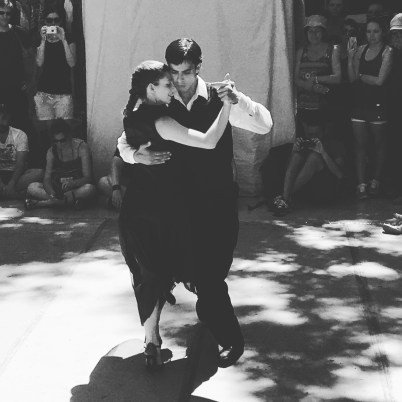
Later in the afternoon I rallied and went over to San Telmo, a neighborhood on the southern edge of the city, to see its Sunday market. I navigated the Subte (subway) and had no trouble getting there, though I was troubled by the fact that I had packed a wardrobe suitable for European fashion when, based on what I observed among the Argentines on the Subte and the tourists in the market, everyone here dresses much more casually. (In my defense, everyone always talks about Buenos Aires being the physical and cultural Paris of South America, so I just assumed that I’d find people relatively dressed up!) I wandered through the market streets wearing a cute black dress and strappy sandals, feeling entirely overdressed next to locals and tourists wearing the universal tourist uniform: shorts and sneakers. Who knew! Anyway, in the market I caught my first tango performance – more on tango later, I’m sure – and saw lots of antiques and leather goods for sale. Nothing in particular caught my eye, but it felt great and entirely appropriate for Sunday afternoon to wander up the street seeing everything.

IMG_5570.jpg

black & white somehow seems more appropriate…

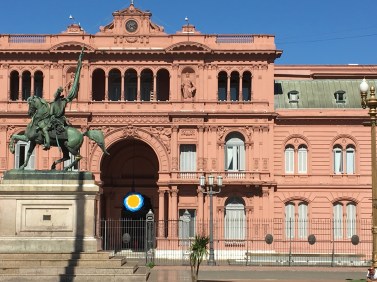
After about a 20-minute walk I found myself in none other than the famous Plaza de Mayo, home to the Casa Rosada (presidential palace, still in use as the president’s offices) and, on Thursdays, the Madres de la Plaza de Mayo, who still protest the disappearances of their children during the Dirty War. If I’m being honest, the Plaza was a bit underwhelming – maybe it will look different when we go back later in the week, but it was very quiet and just didn’t give off any sense of having been the site of major historical events (including Evita’s famous speech from the balcony of the Casa Rosada). I nonetheless took a few pictures, and then because I was pretty tired, I hopped back on the Subte and went back to the apartment for a little more pool time.

IMG_5569.jpg

La Casa Rosada

I’ll write more later today about what we’ve done so far (we are about to go see Evita’s grave!). Stay tuned to our adventures, which will include descriptions of delicious steak and wine, outdoor drumming concerts, and who knows what else!

Morocco: the “essay”

Note: I’m trying my hand at more “sophisticated” travel writing, so this piece does not provide the play-by-play or pictures typical of my other posts. 

“You’re going to Morocco… and Turkey?”

Yes, I know those aren’t exactly next to each other; that was never the point. I’ve just started a new decade of my life, so I wanted to aim for places that were entirely different from any I have previously visited. Morocco and Turkey may be on separate continents, but they have one core feature in common: both are predominantly Muslim countries. That wasn’t why I chose them – I had heard a lot about both – but it ended up being the unifying theme of the trip and the thing that most stands out to me about my experience in Morocco particularly.

I used to be pretty passionate about international relations, so I’m not totally without exposure to Islam, but the 10 days my friend Mary and I spent in these two Muslim countries showed us a very humbling amount of things we did not know. From the moment I first heard the call to prayer in Morocco, I had a steady flow of questions about the practices that are a core part of life in these societies, for example about the call to prayer (why five times a day? why at those specific times? how does one qualify to be a muezzin calling everyone to prayer? do they choose from a hymnal-type selection of pieces to sing/call? does the same person do all five calls to prayer each day?) and wearing headscarves (what does the Koran say about this? how tight do they need to be? when do women start wearing them, since almost almost all the young girls had their hair freely exposed?).

Morocco looks and feels more Muslim than the one part of Turkey I saw (Istanbul), and that penetration varied within Morocco as well. Marrakesh was undoubtedly the most Muslim-feeling destination of the whole trip. We saw almost no Moroccan women there with uncovered heads, and we saw significantly more women there than in other places wearing additional coverage, usually just in the form of long sleeves on the arms, but there were also a significant number of women wearing the full veils so that only their eyes were visible. Mary and I, being travelers who care deeply about blending in and showing respect for local culture, had of course packed more conservative clothing in order to be more covered throughout the trip: we spent the entire time wearing long maxi dresses with shrugs, sweaters, or scarves around our shoulders. We also brought scarves that we could wear on our heads, and Marrakesh made us feel this was necessary – not because anyone seemed to care that we hadn’t covered our heads, but because, to the extent it was not already obvious, walking around with uncovered heads was the equivalent of wearing a neon sign saying “I am a tourist!” We had not realized that most women also covered their arms and often their feet, so even after we started wearing the hijab we still had a bit of a give-away in the form of our short sleeves and sandals.

I can only think of one other country I’ve visited where I really wanted to blend in for reasons of security as much as respect, and that was Venezuela. (I went in 2010, two weeks before the New York Times published an article indicating that Caracas – where I had been – was more deadly than Baghdad. I was in no rush to call attention to the fact that I was foreign, let alone American, and the fact that we never encountered a single other foreign tourist should tell you a lot.) The past few days since my return from this trip have been a little funny because so many people have said “yeah, I would have advised you not to go to Morocco with another woman.” I have no idea why we were so unprepared for the challenge of traveling as two (smart, independent, street-savvy) women in Morocco. British people fly down to Morocco all the time for long weekends (we saw plenty of them), and given that the British are just as bad as the stereotypical Americans abroad (I saw plenty of women with tons of exposed skin), I had just taken this to mean that we would be totally fine. Why would so many people visit a place that was uncomfortable or dangerous?

Most of what made our time in Morocco, and particularly in Marrakesh, more challenging was not actually overt danger, though a man did follow us down the alley to our riad one night before turning around when we reached the door, and I don’t think I’ve ever clutched my purse so tightly to my body while walking around. What grated on our nerves, and made us very thankful indeed for the freedoms we enjoy, were the subtleties of navigating daily life as women. We came to feel, and again this is mostly in Marrakesh, that someone was almost always taking advantage of us in some way because we were women. I find it difficult to write about this in a balanced, diplomatic way because I remain unsure about to what extent what we experienced was typical and whether it was more to do with what would happen to any foreigners in Morocco or whether there was in fact some exacerbation of the existing practice (or we were less able to deal with the existing practice) because we were women. There are many countries around the world where, for example, you have to bargain for purchases in order not to be totally ripped off; I’m talking about something more subtle. I think we were shouted at by street vendors more than the men, but that’s not a big deal. More to my point is this example: our riad hired a tour guide to lead us around the medina during the first half of our one full day in Marrakesh. While I loved Abdullah in certain respects – he was very open, provided a lot of great one-liners that I wrote down, and answered every question we asked – we ended up paying him a not insubstantial amount of money for a tour that ultimately did not show us any of the “must-sees” in Marrakesh and instead included quite a bit of what I will call “performance shopping”. We spent half an hour in a carpet shop, where the owner and his assistants gave us tea and laid out at least 30 rugs for us to admire, touch, and evaluate for potential purchase. I’m not saying I did not appreciate the opportunity to see these rugs; they were undoubtedly beautiful, and I might well have bought one if I had a space big enough, but we had not asked for this, and it felt wrong having to pay him for time that was not in fact spent guiding us (he wasn’t even in the room). We stopped at a few other shops as well, and though we did buy some products at a women’s cooperative selling argan oil and other Moroccan beauty products, on the whole this was not something we had anticipated or desired when we arranged the tour. We found it difficult to be assertive because we did not want to be rude to Abdullah or to any of these other people (who, even if it was only because they were hoping to make money, were all very welcoming and polite) – is that reluctance to offend perhaps more typical of women than men? You see why I find it difficult to assess whether our experience was common to everyone or whether it was exacerbated by our gender. And back at our riad that afternoon, the taxi booked to take us to and from our hammam cost much more than the ride the riad had also arranged from the airport, which is significantly further away. We began to wonder if the young man who was managing the riad in the absence of the owner was getting some sort of kickback, and his by then overly familiar attitude with us – which culminated in him being more touchy-feely than appropriate when helping me put on my hijab – started to make us distinctly uncomfortable and glad that we were leaving Marrakesh early the following morning.

Now, don’t get me wrong – Marrakesh is a beautiful and fascinating place, and one to which I’d return in the company of a man. We had a much more comfortable experience in Rabat, which is both more progressive and more polished as a result of being the capital (and one that doesn’t happen to be a major tourist destination). Whereas 99% of the women in Marrakesh had covered their heads, in Rabat I’d estimate that this was more like 50-60%, though there still wasn’t a single woman on the beach wearing anything less than a full set of clothes. Mary and I stayed covered elsewhere but dispensed with the hijab, which in that setting would have almost seemed like too much effort on our part. Rabat also holds the distinction of being the only place on the trip where we managed to have all our dinners uninterrupted by unwanted and uninvited attention from our male waiters. And there aren’t nearly as many tourists in Rabat; I think it reflects very well on a city when tourists are treated more or less like locals. The vendors in the medina did not call out to us or otherwise try to trap us in their stalls; they were content to greet us if we showed interest, to answer questions that we had, and then to let us be on our way. On the whole, we felt much more at ease in Rabat, which is part of the reason we decided to stay there an extra day rather than seeing Fez, which we expected to be a repeat of Marrakesh and thus just not worth the trouble.

So to tie everything together: Morocco was my first foray into the Muslim world. I remain fascinated (and inspired) by much of what I saw and experienced in that context and plan to acquire some reading materials so that I am significantly better informed about Islam. That being said, the biggest questions I have stem from the tangled web of cause and effect relating to the religion and to the status of women. I hope that I can avoid relying on stereotypes as I write this as that is not at all my intention; however, I think it is fair to say that one thing most people associate with the Muslim world is the secondary status of women, at least by Western standards. I was privileged to grow up in a country where, in most essential ways, women are equal to men in theory if not yet in practice, and I personally have never been denied any opportunity or in any way restricted because of my gender, so naturally I believe that this is how it should be elsewhere. That’s not to say that men do not routinely take advantage of women, in various ways, in the US and elsewhere – far from it – but in my experience that feels more like the exception to the rule than it did in Morocco. I have a lot more reading to do before I can offer any educated remarks on the extent to which the teachings of Islam have shaped the role of women in Morocco. All I can offer based on my observations over five days (and I am happy to receive comments on this), is that I do think there is a link between the extent to which women are protected (I am choosing to see it that way rather than something more intentionally prejudicial) and the effect this has on how they are perceived and treated by men. I remain very interested in visiting other Muslim countries, but I think this is the last time I will do so without a man accompanying me. This trip was humbling not only for its reminders of how little we knew about Islam but also for the limitations it has shown us as seasoned travelers. I would not have described myself as conceited, but I did used to think that I was a pretty savvy traveler, that there was not a place or situation (within the bounds of common sense and reason) that I could not adapt myself to or enjoy as a female traveler, at least not if I had another person with me. This is the first time I’ve really come up against something that made me reconsider that assessment and admit some form of defeat. Could I go back to Morocco as a solo woman? No, not even if I pretended to be married. Could I go back to Morocco with another woman? Yes, but the stresses of doing so would likely outweigh the benefits (though I would like to think that knowing what to expect would be half the battle).

All in all, I can’t say I was in any way sorry to leave Morocco. I do hope I will go back another time, with a man, to see the things I missed in Marrakesh and to see Fez. Morocco is a large and richly diverse country with a lot to offer visitors, and in that sense we only scratched the surface. Next time, I’ll be more prepared and hopefully better poised to continue these observations in a more sheltered way.

Barcelona: Day 3

Monday morning started out cloudy, which made me glad I had gotten in a little bit of beach time the day before. I pulled my things together, dropped off my suitcase in the lobby, and took the metro (large and clean but otherwise unremarkable) to the north of the city to see the much recommended Parc Güell, home to still more of Gaudí’s work. The park is located on a hill far above the city, and it’s a bit of a hike to get up there. I wove my way around not a few people with selfie sticks who were trying to capture shots of themselves over nondescript views of the city!

There’s a lot to see inside the park, but I was content once again to forego the cost of a ticket and just see what I could. The most famous part of the park is the overlook with the mosaic balconies; it costs money to go out on them, and I would have paid, but the ticket booth was curiously in a different part of the park! I still got a pretty good look though:

FullSizeRender

IMG_6285

The clouds disappeared while I was at the park, so I didn’t linger longer than necessary to see most of it. I took the metro back to La Rambla so that I could grab lunch at a famous tapas bar inside the market. Luckily, a stool was open, and I spent a minute just trying to figure out the system – there’s not really a menu; you can look at what other people are eating, or, in the case of two separate groups of Asian tourists, pull up Instagram on your phone and point to a picture of what some random other person ate and ask if they’re serving that today! The couple next to me were eating octopus and a sort of vegetable scrambled egg, both of which looked excellent, so I went with those. The man behind the bar was just as much a part of the bar’s fame as the food, I think; he’s probably about 70, speaks Catalan, wears a vest that seems more appropriate to the Ritz Carlton than to a stall inside a touristy market, and has a killer smile. (He gamely took the phones extended by the Asian tourists and indicated whether or not the food pictured thereon was available.)

IMG_6291

IMG_6293

After that delightful break, I ventured once again into the Barri Gotic to look for last-minute purchases, and then I made my way to the beach for the remainder of my afternoon. I parked myself on an 8€ chair, pulled out my Kindle, and spent the next two hours enjoying this view and listening to the music of bands playing on the boardwalk:

IMG_6297

J came to meet me there, so we got to see each other one more time before I left. I am so glad we found each other on Saturday night! I still spent a good chunk of time alone this weekend, but it was just the right amount – not so much that I felt lonely; it was nice to be able to look forward to seeing someone at some point in the day. If all my future solo trips can go as well as this one, I’ll be well pleased.

There was a great deal of Barcelona that I did not see this weekend, so I will definitely have to go back. I loved the city. I have been saying for the last year that if Paris had a beach, it would be the perfect city. Barcelona isn’t quite as beautiful as Paris, but it’s got plenty of very stately buildings (not to mention all the interesting Modernisme influences), a great underlying energy, and… a beach. Food for thought.

Barcelona: Day 2

I woke up on Sunday feeling a little tired but generally very excited for the day ahead. I was so happy to be back in a Spanish-speaking country after spending all of last year in Paris – I speak French, but my level of confidence and comfort in French is still drastically below what I feel in Spanish. I’ve still been trying to improve my French in the year since I left Paris, so it was actually a little hard for me to switch gears and get back to Spanish. (I actually happened to be in Madrid recently just for a day, and someone there told me I was speaking with a French accent – whoops.) I am happy to report that I spoke a LOT of Spanish with people with different accents, and I didn’t have any trouble at all (and I lost the French accent and reverted back to my more neutral Spanish one). Spain is always a little bit of an adventure linguistically because a) Spanish people speak with a deliberate lisp which is pretty hard to replicate and b) in Spain there is a separate verb form used that does not exist elsewhere in the Spanish-speaking world, and we don’t really learn it in the US, so it’s always kind of funny for me when I hear people using it or when I have to fake-it-til-I-make-it myself.

Anyway, I grabbed a quick breakfast and then set off in search of the beach. The sun was shining, and now that I live in London, it’s even harder to pass up a chance to sit outside in the sun. Especially when this is the view you end up with:

IMG_6193

IMG_6195

Not bad, right?! I settled down onto the sand around 11, and already there were men walking around calling out “mojitos!” I have to give them credit for presentation – those drinks looked lovely on their tray, and the guys carried a bottle of rum in their other hand so you could see them spike it for you. Also on offer (by people who sometimes got quite in your face about it) were coconuts, dresses, henna tattoos, and massages.

After an hour, I walked back to my hotel, changed my clothes, and set off for a Gaudí-filled afternoon. I grabbed a ham and cheese sandwich (queso manchego and jamón serrano… so good) and made my way up to see the three most famous Gaudí buildings, starting with the Casa Amatller and the Casa Batlló, which are right next to each other.

IMG_6205

Maybe someday I will be willing to shell out the admission price to see the inside of the Casa Batlló (on the right), but for now it was cool enough just to see them from the outside. I love the colors on the Casa Batlló; it strikes me as very beachy.

Just a bit further north along the same boulevard is the even more famous La Pedrera:

IMG_6211

This also has quite a steep admission fee, but I’d probably be willing to pay it just to walk on the roof, which looks really cool.

Eventually I made it to Avenida Diagonal and stopped for a glass of cava at a cafe on a quiet corner. I perused through a copy of Spanish Vanity Fair and just savored the ability to sit in the sun, which was warm but not uncomfortable, and enjoy the feeling of being in a foreign city.

From there it was time for the big event: La Sagrada Familia, Gaudí’s still-unfinished cathedral. It will truly be a marvel when finished. Right now I didn’t find the outside much to look at; a lot of it is still covered in scaffolding (though it is unclear to me why this is because there are pictures of it without scaffolding – so it’s like they’re already restoring some parts of it when other parts have yet to be constructed!). The following pictures do not even come closing to doing justice to the beauty inside the cathedral. Apparently Gaudí envisioned “a church of heavenly light”, and I think the people who have continued making his vision a reality have really created that effect.

IMG_6216
IMG_6230

IMG_6233

IMG_6237

IMG_6251

IMG_6253

(This last is the view we had coming down from the tower… a bit dizzying!)

All the colored light inside the church brought to mind my reaction to the statue of Christ the Redeemer in Rio. I love that statue because to me it reinforces the idea that God is about love. While I appreciate the stately beauty and grandeur of much older cathedrals (such as Notre Dame), they are often dark and cold on the inside and bring to mind the more guilt and punishment side of the Catholic church, which for me is not particularly conducive to worship. I can really see myself enjoying the Sagrada Familia as a place of worship and reflection.

After all my walking and then the descent from the tower on those spiral stairs, I was ready for a more extended break, so J and I settled into a plaza nearby and ordered a liter of sangria, which was of course very refreshing. J noted that it seemed a bit stronger than usual, and when we had finished, our waiter (who up until then had not been particularly friendly or attentive) asked us if we were feeling “happier” now. I said “yes, it was strong!” and he grinned and said “well, I made it myself, and I made it stronger because you’re both so pretty.” We popped into the restaurant to use the bathroom, and he made a serious attempt to get us to stick around. I told him we were heading back to Tapas 24, and he was like “bah, that place is so commercial; we have great food here.” (I will just note that we were one block from the Sagrada Familia, which is unquestionably the biggest tourist destination in Barcelona. Do with that what you will.) Anyway, when we finally left he made a big display of pretending his heart was breaking, etc. etc., which amused me greatly. See why I love Spain?!

Back at Tapas 24, we assumed our spot at the bar from the night before, had our friend Sam make us another of his special gin and tonics, and gradually ordered the tapas we’d been looking forward to all day. First (and later) we had some patatas bravas, which usually look more like chunks of potato or potato wedges but at Tapas 24 look more like regular fries, covered in the delicious aioli and bravas sauce.

IMG_6260

Next we had the bikini (apparently a Barcelona term for a ham and cheese sandwhich). This was no ordinary ham and cheese, though: this was Spanish ham with buffalo mozzarella and truffle oil. Oh, my God.

IMG_6261

We got two orders of these and could easily have eaten more!

Finally, the grand finale was the dessert we’d seen other people eating the previous night. Folks, in terms of presentation, it doesn’t get much better than this:

IMG_6271

That is a baked pineapple with coconut whipped cream… otherwise known as a piña colada in solid form. It was every bit as good as it looks.

In the midst of enjoying all this food, we were having some fun with the men who’d come into our lives over the last 24 hours. I should note that J has a boyfriend, so this was all just in good fun for her. First, I texted Hot Paolo while we were waiting to get into the Sagrada Familia and learned that he was getting on a flight to Rome at 9:00 that night, so we weren’t able to meet up with him again, which of course made me very sad. He was kind enough, however, to send me a message later while he was at the airport that included both a picture of him looking pensively sad about his impending departure and a video of him singing in front of the Sagrada Familia earlier that afternoon. (It turns out he is a singer, and that video is never coming off my phone.) Closer at hand, we decided to try to connect with Rafa, the cute chef working just on the other side of the glass from us. J eventually decided that a note was the best strategy, so she grabbed a napkin and (with some translation assistance from me) scrawled “would you like to make us breakfast tomorrow?”. Rafa’s face when he finally noticed her pressing this against the glass was priceless; we could hear him say “of course; give me your phone number!!!” He even came over for a quick moment to introduce himself and ask our names. We followed up later with messages like “J has a boyfriend, but K doesn’t, and she speaks Spanish!”, but his interest was clearly for J (which was okay with me; I was still reveling in my messages from Hot Paolo).

We ended up being the last to leave the bar that night. Sam and Rafa told us that they were all going out at the Bar Obama (yes, that Obama) a couple blocks away and that we should meet them there, so we agreed and headed over to wait for them. We were immediately cornered by a group of Cubans who now lived in Barcelona, and I spent the next 20 minutes trying to have simultaneous conversations with one who was trying to get me to go on a date with him the next day and another who was telling me that it was my obligation as an educated American to help his people in Cuba. (Both were interesting conversations but also made me slightly uncomfortable.) J stepped out to make a call, and I eventually disengaged to try to find her. It turned out she had gone home, and given the late hour and my lack of certainty about when the Tapas 24 staff would appear, I followed suit. It was a rather anticlimactic end to the night, but if I have learned one thing in my travels, it is that great nights (such as the one I had the night before) rarely repeat themselves immediately, and there is no sense getting upset about it! J and I still had a really fun evening.

Barcelona: Day 1

After eight months of living in London during which I have been horrible about traveling (only making return trips to Paris and The Hague), I finally got my adventurous travel spirit back and took off this past bank holiday weekend for a much-needed vacation in Barcelona.

Spain is a country near and dear to my heart. I studied abroad in Cádiz, a town on the southern coast, during the summer of 2005 and got to see a number of other cities (Madrid, Segovia, Toledo, Sevilla, Jerez de la Frontera, and Granada) while I was there. I loved every moment of that time in Spain, and I cannot account for the fact that it took me an entire decade to go back except to say that I was more focused on accumulating new stamps in my passport rather than becoming more familiar with countries I’d already visited. I also think my continued study of Spain (through my Hispanic Studies major, for which I ultimately wrote a thesis about Spanish film) and my subsequent years as a Spanish teacher helped me feel connected to the country even when I was far away. That being said, the things that make Spain so magical can only be experienced in Spain – the food, the music, the dancing, and the supremely attractive men. (It was true 10 years ago, and it is true today: out of the 27 countries I’ve visited, Spain has by far the most attractive men.)

I have heard so many good things about Barcelona over the years (plus I’ve watched “L’auberge espagnole” and “Vicky Cristina Barcelona” countless times), so it’s been at the top of my travel priority list for a while and was a natural choice when I thought about where to go for my first SOLO trip. I turned 30 two weeks ago, and for that as well as for the practical reason that I am still single, I am moving forward into this next decade of life ready to experience more of the world as a solo traveler. I’ll write a separate post about my thoughts on solo travel, but for now, I can say I am very encouraged about it!

I arrived in Barcelona around 5:00 on Saturday evening, and after dropping my things at my hotel near the Barceloneta metro station, I set off on foot for the most famous street in Barcelona, La Rambla. (I think it is also called Las Ramblas because although it’s a continuous street, its name changes a few times along the way, each with “La Rambla” in the title.) It was bustling with tourists and locals alike. There’s a wide pedestrian strip in the center of the road, which makes it easy to amble along, ignoring souvenir stands and perhaps not ignoring the gelato stands. I was quite hungry and made straight for the Mercat de la Boqueria, which is a feast for all the senses. It is comparable in size to the market I went to in Budapest, and inside are people selling every type of fruit and vegetable known to man (along with a wide range of fresh juices and smoothies), fish, baked goods, and of course: ham, ham, and more ham. You can grab a paper cone filled with freshly shaved ham for about 1.50€. I opted for a wrap with two types of chorizo, a quail egg, and a few patatas bravas to tide me over until dinner time:

IMG_6171

I planned to spend more time at the market on Monday, so I was soon continuing north along La Rambla. I made a brief detour into the Corte Ingles, Spain’s department store, and then I turned back southeast to wander through the Barri Gotic, which is the old part of the city and made up of narrow, winding streets filled with shops and restaurants. I eventually came out into the plaza where the Cathedral is located and passed a trio giving an outstanding impromptu concert along one of its walls. One man played Spanish guitar, and a man and a woman sang along. Their rendition of “Ave Maria”, with opera-quality voices, brought tears to my eyes. Five minutes further along, I encountered a completely different musical performance in the form of a troupe of 20 or so people playing different types of drums. They filled up the whole street, and the sound of all their drums reverberating off the stone walls made a pretty terrific sound.

I eventually turned north again and made my way to a tapas place that had been recommended to me for its great food and its convivial atmosphere. Since this would be my first experience dining out alone, I wanted a place where I could sit at a bar and at least watch people putting food together. There were a few people standing along the wall inside waiting for seats to open up, and that waiting period gave me time to look at some of the dishes being served, all of which looked incredible. I eventually ended up perched on a bar stool and sipping a glass of white wine while perusing the menu, which was in Catalan. (For those who may not know, Barcelona is in Catalunya, which is one of the provinces of Spain with its own official language and aspirations of independence.) Catalan is pretty similar to Spanish, but that menu was an exercise in guessing! After extensive deliberation, I ended up ordering a Bomba de la Barceloneta, spicy lamb skewers, and one of the daily specials, white asparagus with caviar and edible flowers.

This is the Bomba – it’s the Spanish equivalent of a Scotch egg, minus the egg. There’s a ball of meat at the core, which is surrounded with the potatoey substance found in Spanish croquettes.

Bomba de la Barceloneta

The asparagus was incredible, as you can tell:

IMG_6181

I was never bored while sitting there alone. I was perched next to a window looking into a part of the kitchen where a number of delicious things were being prepared, so I enjoyed watching one of the cute chefs (whose name turned out to be Rafa, as will be revealed in the next post), and directly in front of me I could watch the man whose job it was to prepare the most simple dish in the place: two slices of toasted bread rubbed with tomato and sprinkled with olive oil. That’s literally all there was to it – I am not talking about bruschetta with chopped tomatoes on top of the bread; I mean literally cutting a tomato in half, rubbing it against the bread, and then topping it with olive oil. I did not order this, but everyone around me seemed to want some, and when I asked a neighbor if it was one of those things that was really delicious because of its simplicity, they said yes. I also really enjoyed watching the restaurant staff: people dashed back and forth from one side of the bar to the other, variously taking orders, getting drinks, serving tapas, or darting out from behind the bar to find a seat for somebody. They would shout certain orders as they were made, and one or more people would acknowledge the order by calling out “oído” (literally, “heard”). They had to be constantly on their toes, but no one lacked for energy or enthusiasm.

I was midway through my dishes when the stool next to me opened up, and an American girl named J sat down with sangria in hand. We started talking immediately, and I ended up spending a lot of time with her over the course of the weekend. The fun in traveling alone is that you never know who you are going to meet! She had been sitting in a different part of this restaurant eating with a mother and daughter she had also just met, and when they left, someone thought to move her to be next to me so we could talk!

We ended up staying at Tapas 24 for another couple of hours, working our way through a glass of sangria and then a gin and tonic that one of our friends behind the counter offered to us with the promise that it was the best gin and tonic available in Barcelona. The end result was certainly good (I am not a G&T aficionada, so I can’t really comment on how this compared to others); our friend Sam impressed us most with the leaves he carved out of lemon rinds without us even realizing what he was doing:

IMG_6187

Eventually, after promising to return the next evening, J and I made our way back outside into the cool evening to see what Barcelona had to offer us on Saturday night. At this point it was about 11:00, so still extremely early in the Spanish nightlife timetable. We ended up meandering back over to La Rambla, which we learned is a good place to go if you are in search of suggestions about how to spend an evening. We were stopped by a series of men who were scouting for people to come to their bars/clubs, but our favorite by far was a guy named Renzo who was delighted that I spoke Spanish and so cute that we allowed him to lead us all the way into his club about a block and a half away. He explained that for only 15€ we could have two drinks and then get on a bus that would deliver us to one of three nightclubs on the beach. It was a tempting offer, partially because we hadn’t even known there were clubs at the beach. We ended up taking his number so that we could find him again later and continued along the street to receive very similar offers from less effective salesmen, including one who, observing that J seemed slightly less enthused about the idea of going to the beach than I did, commented “she is not your real friend.” We laughed about that until we decided to pop into another tapas bar to get a drink and some water while we tried to decide what to do.

Our waiter in this establishment was yet another nice, attractive man who introduced himself as Miguel Angel and quickly took to calling me things like “honey” and “princess”. We asked him if the beach clubs were worth going to, and as I had suspected, the answer was no. He indicated he was going out after his shift and that we could join him if we wanted. We were a little hesitant to do that; I can’t offer any reason for that except the very superficial one that we thought Renzo was cuter, so if we were going to accept someone’s plan, it was his. Anyway, while we were sitting there we noticed a movie-star-level-attractive man sitting at a table nearby and blatantly stared at him on and off for about 15 minutes. He was sitting with another couple, but they left, and somehow he ended up entering the conversation I was having with Miguel Angel. Hot Paolo (as he is now saved in my phone) asked me if I spoke Spanish (I think he was not close enough to have observed that I was speaking Spanish with Miguel Angel), saying that I seemed a little dazed or something, and I said “oh, I speak Spanish very well – it’s just that you’re very cute.” He smiled and said “you are too!”, and we soon learned that he was from Argentina but now lived in Miami. He was getting ready to leave, but he gave me his phone number and said to get in touch if we wanted to hang out the next day. Yes please!

Flushed with that unexpectedly successful interaction, we left the restaurant and proceeded back to Renzo’s club. We never did find him again, but we paid our 15€, got wrist stamps, and ended up sitting down for some enjoyable people watching. The first (and, as it turned out, only) bus to the beach was leaving very shortly after we arrived, and given that it was only 1:00 at that point (meaning the club would be entirely empty), we opted to forego partying at the playa and just stay put. One drink in that place was enough, so we left before things got heated and established that we’d meet up again at the Sagrada Familia the next day.

Nights like that – even when they don’t end in stories that are amazing but inappropriate to share here – are why I love to travel. I arrived in Barcelona alone and without an agenda; the universe provided me with a new friend and threw a bunch of fun, friendly people into our path over the course of the evening. I went to bed very excited for what the remainder of the weekend might have in store…