Camino Day 7: Villamayor de Monjardín to Torres del Río

Distance traveled: 20.1 km

This was my first day walking without my backpack, and it felt very strange. I’d been told that the backpack becomes like a turtle shell: you stop feeling its weight, and you feel naked without it. This had already become true for me. While I didn’t love the idea of making things easier for myself by sending my backpack ahead, I knew that was a better option than continuing to put more pressure on my injured feet and potentially having to stop walking altogether for some period of time. So, the day began with attaching a little envelope containing 5 euros to my backpack and writing the address of the albergue to which I wanted it delivered; I just needed to trust that it would be waiting for me when I eventually arrived!

IMG_5520

At least I’ve still got my trekking poles/crutches!

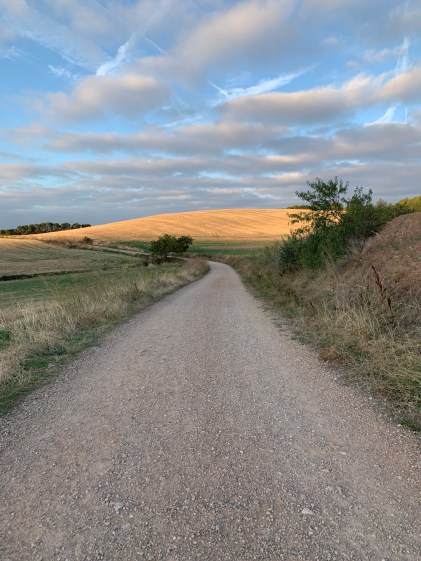
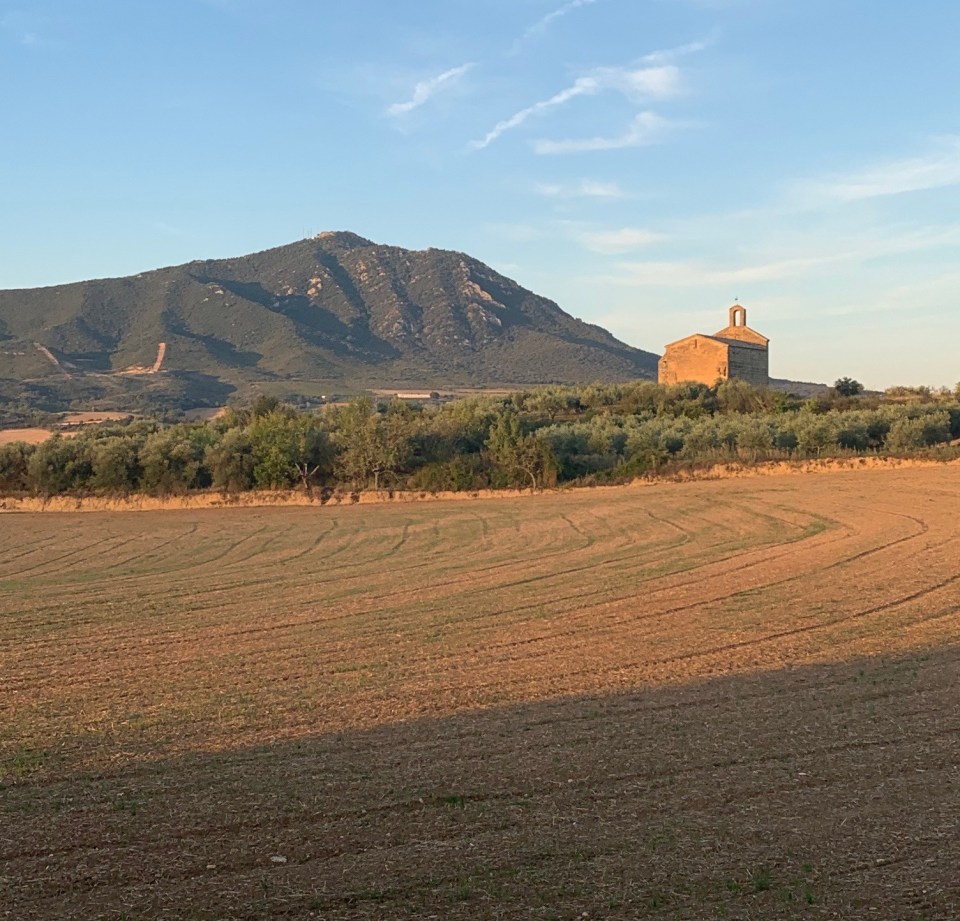
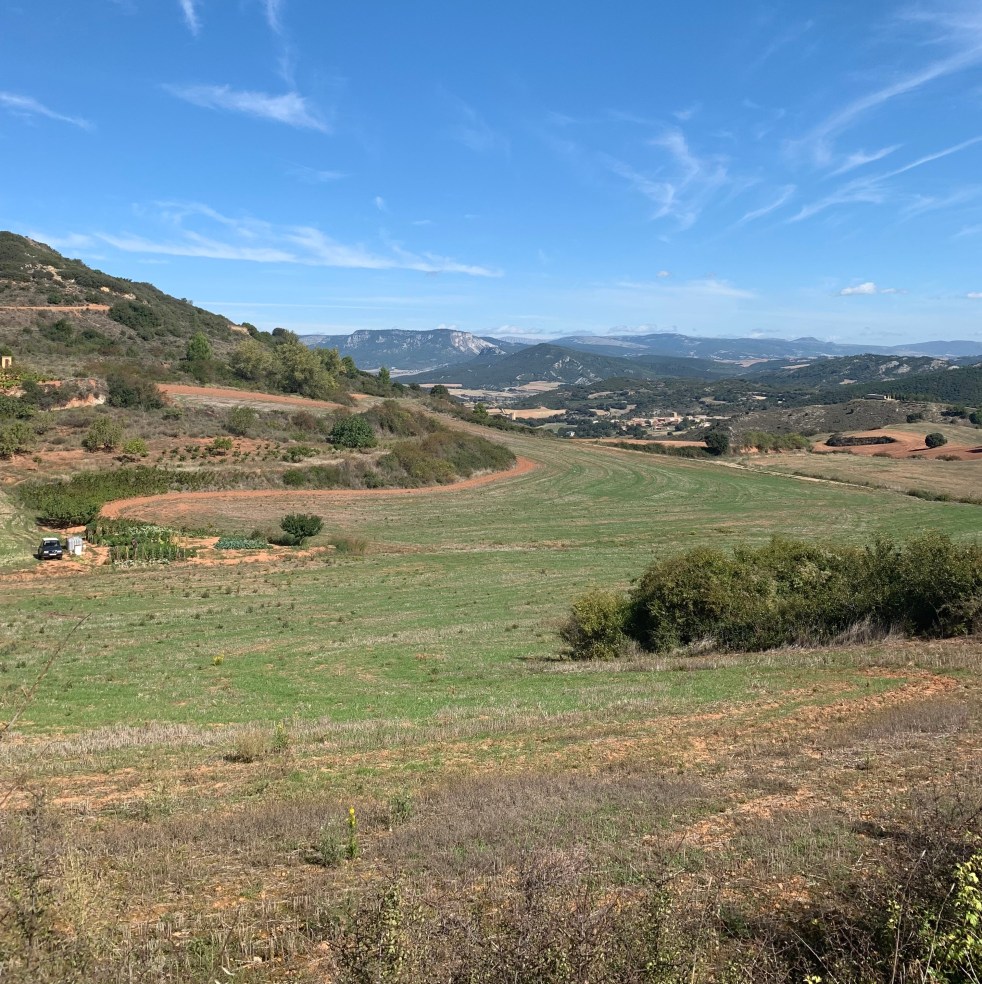
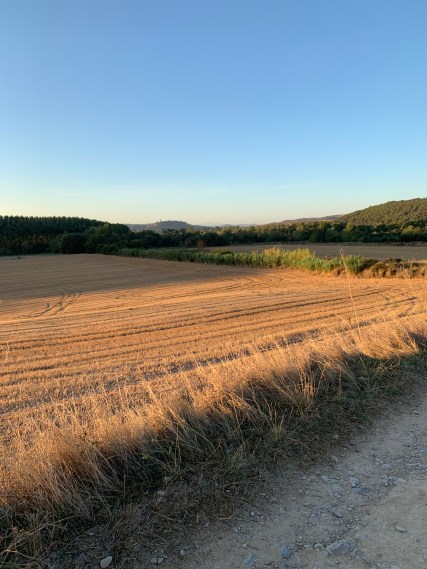
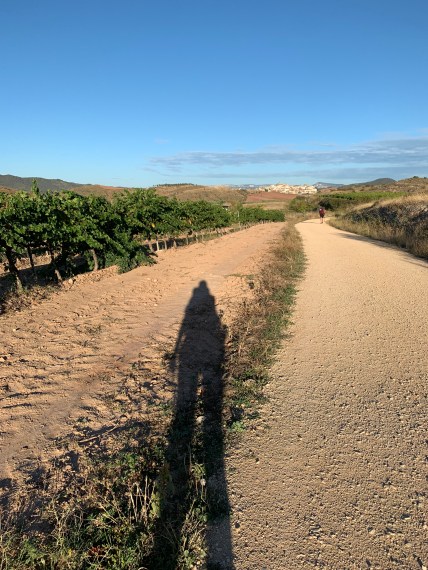
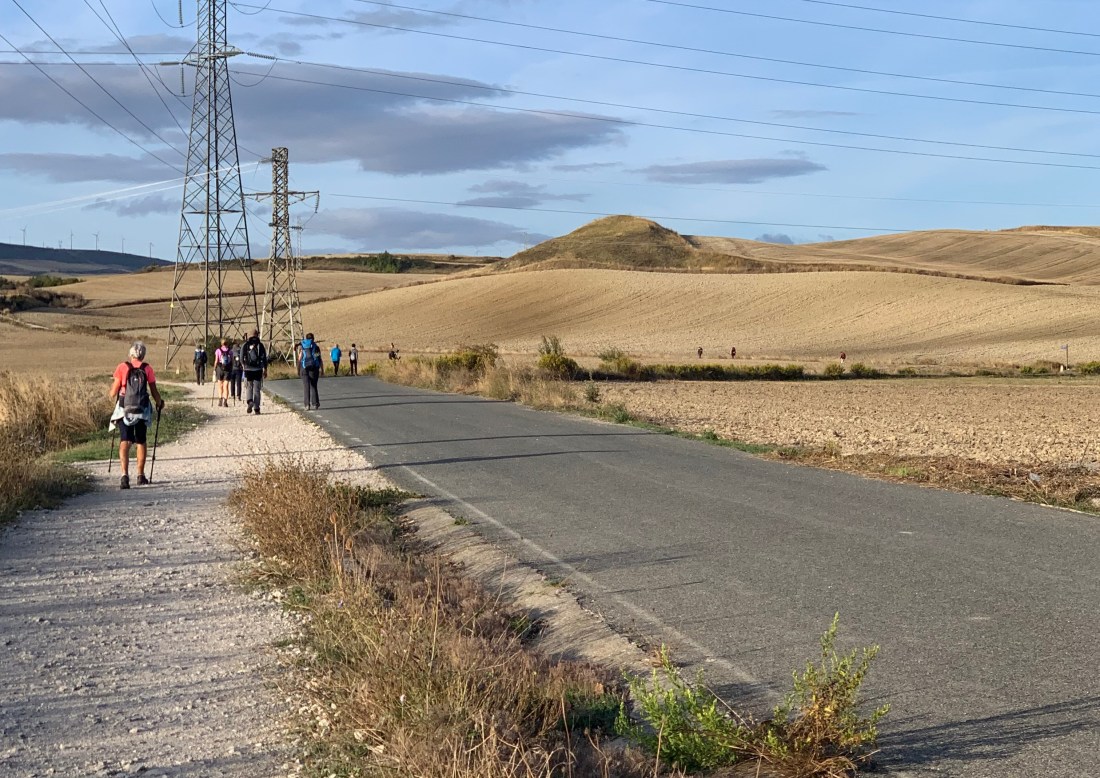
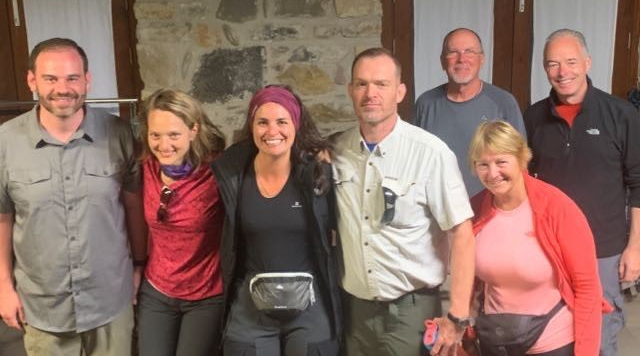
Despite the bizarre feeling of walking with only my little collapsible backpack on and the fact that my feet still hurt a ton even without the extra 25 pounds of weight, I loved our morning walk on this day. We had clear blue skies, variable landscape (fields, hills, valleys, vineyards), and wonderful conversation. It was my first day walking with my core Camino family of Adam, Lou, Bill, Chuck, Kim, and Agnes. We didn’t walk together as one big group, but we always reunited when we arrived in a town to take a coffee break, and I got to rotate my conversations accordingly.

IMG_8592

IMG_8594

I loved this chair under a tree in the middle of nowhere.

IMG_8608

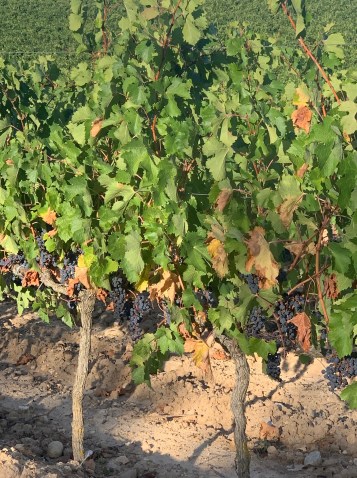
More grapes!

As we neared our final destination, I was using my trekking poles almost as crutches, trying to take pressure off one foot at a time by swinging myself forward using the poles. Wearing my normal pair of sneakers rather than my boots hadn’t made any difference in terms of giving my toes more room, and I was really starting to get concerned that, at best, I was only preventing the blisters from getting worse rather than actually helping them heal. I stopped in a pharmacy in a small town just before Torres del Río and had the undivided attention of the pharmacist for a solid ten minutes of discussion about how to treat my blisters and tendinitis. I left with a fresh syringe (to drain the blisters) and a new supply of Compeed (blister band-aids), individual toe protectors, and a gel form of ibuprofen to rub onto the areas that were more swollen from tendinitis. It occurred to me in this moment that I was experiencing a good metaphor for the need to take care of yourself in everyday life, particularly in the sense of not pushing yourself too far. I’d been living that reality in my maximum-stress job for the past few years and burned out; on the Camino, I probably gave myself the tendinitis as a result of walking too fast and made my blisters worse by being unwilling to do more than ditch my backpack and walk shorter distances. Neither approach is a recipe for short- or long-term success!

Our albergue in Torres del Río was run by a very friendly and generous man from Bolivia. He hooked me up with an ice pack, which helped my tendinitis feel better, and I spent some time sitting in the courtyard next to a little pool. Back inside, people continued to help me treat my blisters. A Hungarian lawyer (my first lawyer on the Camino, in seven days!) sleeping in the bunk next to mine offered some of his own ointment, and Agnes washed my clothes for me so I could stay more immobile. Pilgrims really support each other.

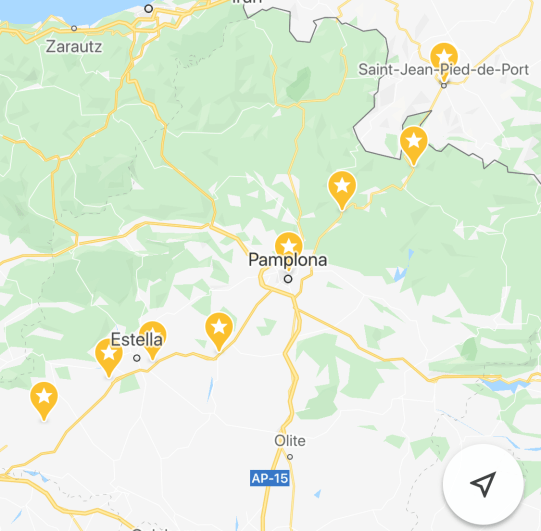
So here’s how far I’ve come now after seven days of walking: 143 kilometers, or 89 miles. In a week I’ll arrive in Burgos, the first major city on the Camino and the end of this first and most physically challenging part of the journey.

IMG_1294

Camino Day 6: Villatuerta to Villamayor de Monjardín

Distance traveled: 12.9 km

I had kept my blistered toes bandaged in breathable gauze overnight to attempt to let them dry out, but they still looked and felt horrible when I woke up the next morning, so I knew I wouldn’t be able to travel too far. I had been keeping in touch with Adam and the rest of the group I’d left in Pamplona, and while I’d gone further than they had that first day, they were likely to catch me up today. My injuries made me feel vulnerable, and I craved a familiar face, so I crossed my fingers and hoped we’d end up in the same place.

IMG_8560

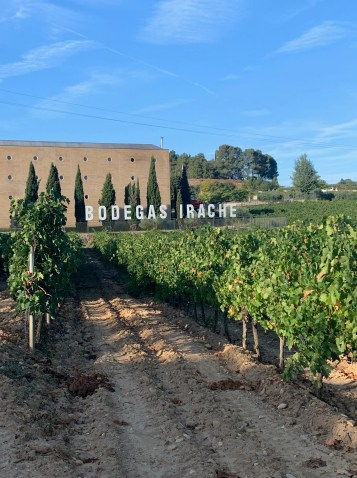
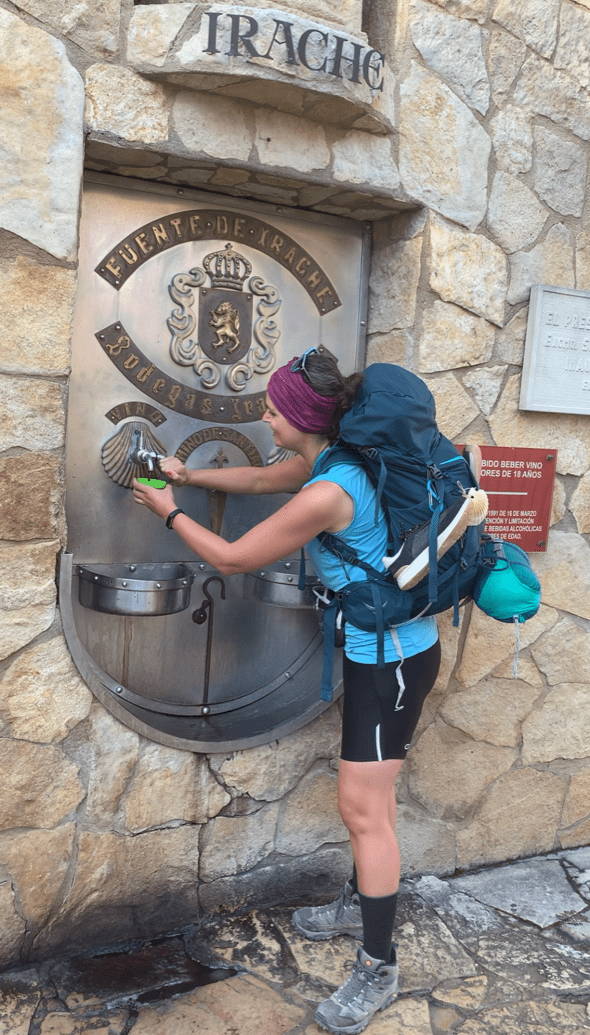
Despite my ruined feet, I was excited for the morning’s walk. It would bring me to something I’d been looking forward to for weeks: the wine fountain! We were rapidly approaching Rioja wine country, and just past the town of Estella (the suggested end point for yesterday’s stage) the path went right through a large winery (Bodegas Irache) that had decided to set up a fountain offering free wine to all pilgrims who pass. When the Camino hopefully reopens later this year (as the coronavirus keeping all of us inside now has also resulted in the closure of all the albergues as well as the cathedral and pilgrim office in Santiago), you can watch pilgrims arrive at the fountain on its webcam.

IMG_8563

IMG_8564

I arrived at the fountain around 10:00 and figured there was no more appropriate time to say “it’s five o’clock somewhere!” I pulled out my little collapsible cup (being wholly unwilling to drink out of the scallop shell I’d attached to my backpack, which is what you’re supposed to do) and waited my turn to approach the fountain.

IMG_8566

The wine was actually very good!

Now, remember that group of American women I’d seen at my albergue the day before? Here they were again! Still way too dressed and made up to be real pilgrims, and taking their sweet time making sure each of them had the perfect videos and photos of themselves at the wine fountain in order to share the experience with everyone on social media. I was in no rush and didn’t mind waiting; I kept myself occupied by judging this group of women (who, it must be noted, did offer to take my picture!). We’ll get back to the wine fountain in a moment, but first, I’ve got to share another big lesson of the Camino and yet another piece of proof that “the Camino provides” what you need, whether or not you know you need it. I never saw these women again – they got into a van nearby that drove them to their next destination – but I met someone a few weeks later who’d also seen them. I had of course described them as I’d seen them: American tourists who at best were missing out on the true meaning of the Camino and at worst were trying to look like real pilgrims when they clearly weren’t. My friend nodded and said “well, there’s more to their story.” As it turns out, the husband of one of the women had recently passed away, and prior to his death, he’d arranged for his widow and her friends to go on this trip so that she’d have something to look forward to and keep her life full of happiness.

Am I a jerk, or what?! I still feel horrible when I think about how badly I misjudged things here. I’m thankful that my judgment never made it back to the women themselves. I have shared this story because many people on the Camino end up learning lessons about judgment, particularly in terms of developing an awareness of how often we tend to judge others, in ways small and large. This isn’t the only example of an ungenerous and ultimately incorrect judgment I made on the Camino; it’s just the worst instance. There are so many ways to judge and compete with people you encounter, on the Camino and in daily life –  and while I got better about stopping myself from doing that on the Camino, I’m still working on carrying that over to my life now.

Back to my walk. The day continued through some more beautiful and varied landscapes.

IMG_8574

IMG_8577

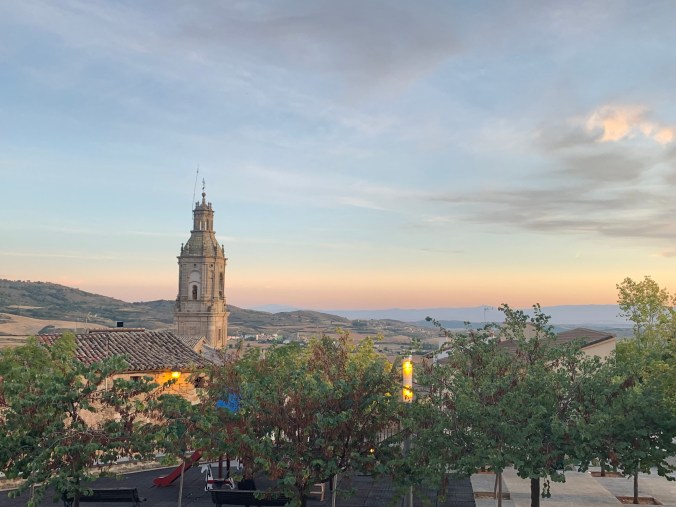
After a nice walk through some woods and then a relatively relaxed walk up a long rise, I arrived in Villamayor de Monjardín, another very small town (though this one had a choice between two albergues). I opted for the one overlooking the central town square, and it turned out to be a delight. The hospitaleros (volunteers who run the albergues) were an American couple who offered each pilgrim a foot bath with epsom salts upon arrival. My early arrival turned out to be very helpful, as a French couple and a single Spanish pilgrim arrived, and I was the only person who could speak to them! I felt like a true pilgrim as I translated all of the arrival information and, later, made sure that the Spanish pilgrim was included in the communal meal conversation. I’ve always been grateful for the opportunities I’ve had to study languages, and I’ve never been more thankful for my ability to communicate with others as during my time on the Camino.

My friends Adam, Lou, and Bill appeared later in the afternoon, and I was so glad to be reunited with them. I met the other new members of our Camino family on this day as well: Chuck and Kim, a couple from British Columbia, and Agnes, a Belgian woman living in Provence. I got to know Chuck and Kim before dinner as we sat with Lou and Bill, soaking our feet and going around in a circle sharing things about ourselves. I met Agnes briefly at dinner (another really good, home-cooked one) and then took a real interest in her at an after-dinner prayer service that some of us chose to attend. She introduced herself as a “Camino addict” – this was I think her third time walking in as many years; she has come to believe that going on Camino is an essential part of her life. While I already knew the Camino would be hugely transformational for me, I wasn’t yet sure if it would be that transformational.

Lou and Chuck would prove very important sources of conversation and contemplation as our journey continued, but today, their biggest contribution was to my physical well-being. Lou turned over his supply of KT tape to help with my tendinitis, and over the next week Chuck would become chief blister advisor to both Kim and me. Here’s how my feet looked at the end of the day:

IMG_8585

You can’t tell, but my right pinky toe in particular was in horrible shape. The bottom side of the toe was just one huge, layered blister. (I hadn’t know blisters could have layers before this, but… they can.) After discussing with the group, I decided I’d try sending my backpack ahead the next day in order to take some pressure off my feet.

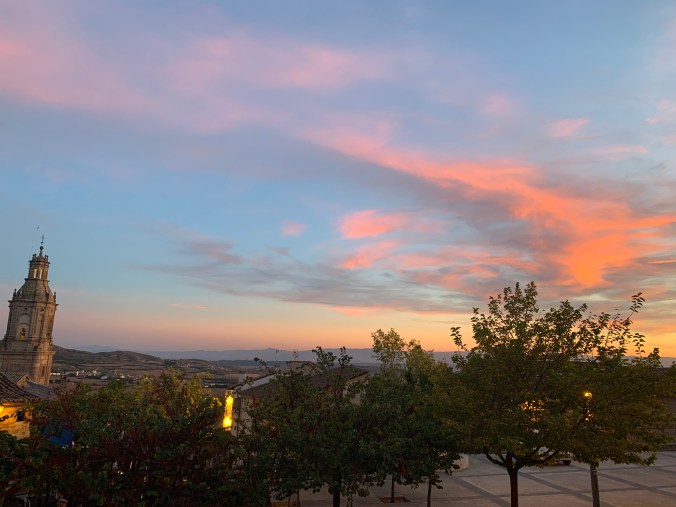
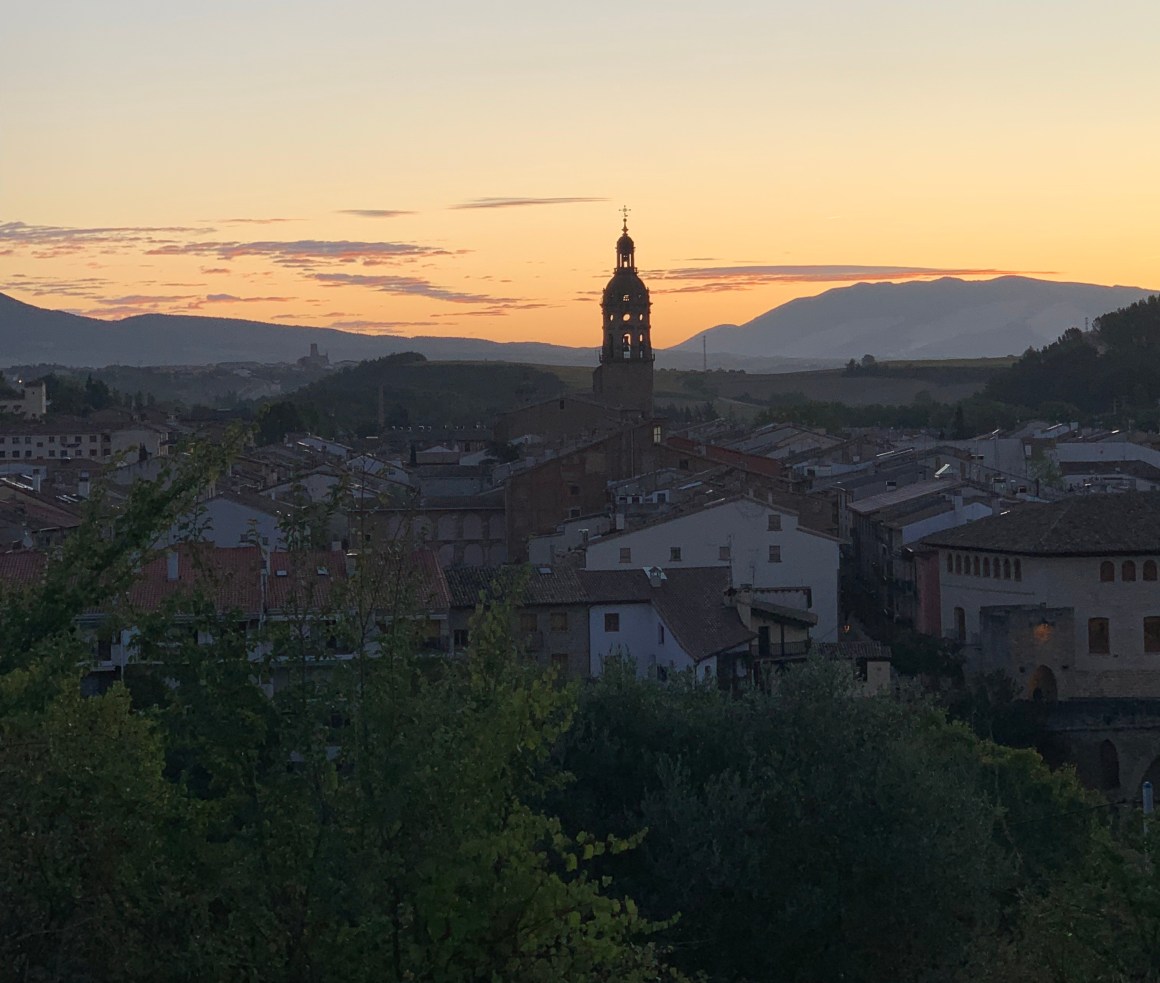
The day ended with a pretty beautiful sunset.

IMG_8583IMG_8584

Camino Day 5: Puente la Reina to Villatuerta

Distance traveled: 18.1 km 

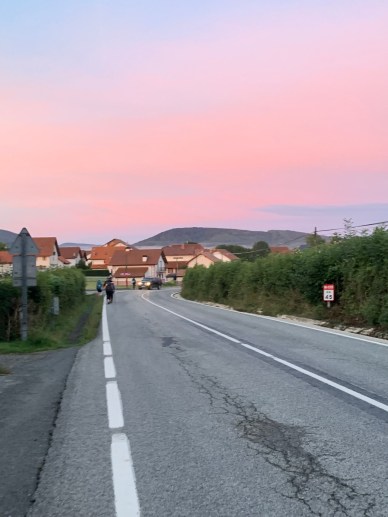
My day began with a glorious view of Puenta la Reina in the pink light of morning as I set off.

IMG_8539

Because I’d stayed with only a handful of pilgrims in the albergue past town, I didn’t initially have too many pilgrims on the road with me. I tried to take it slow – I’d bandaged up my blisters as best I could, but my toes definitely didn’t feel comfortable, and I was also starting to feel tendinitis on the tops of my feet and partway up my shins. Thankfully, it was such a beautiful morning that I found plenty of distraction and comfort in contemplating the landscape before me.

IMG_8540

The path today took me through my first grape vines of the Camino. I found it so remarkable that we could just walk through someone’s land in this way! Most of the vines I would pass in the coming days had yet to be harvested, so they had plenty of grapes still hanging in bunches on the vine. I found myself wishing that my wine studies in Paris had prepared me to identify the particular types of grapes I was seeing!

IMG_8551

Periodically along the Camino, we’d encounter spots where locals or the land owner had left food or set up a resting place for pilgrims, and I encountered a particularly nice one on this morning. There was even a cute puppy hanging around!

IMG_8553

Apparently I didn’t take pictures of the rest of the zen garden… but here’s a good reminder of how far I have to go!

I continued to chat with other pilgrims as I walked. I met a girl from the south of France and enjoyed speaking French with her. One of the things that had surprised me in the first few days of the Camino was that I felt more of a natural affinity with the French pilgrims than with the Americans. I had been living outside the US for six years at the time I started walking, and I’d spent so much time and energy in the past two and a half years in particular attempting to be as French/Parisian as possible that I think I succeeded in mentally distancing myself from my fellow Americans, who had started to become more “othered” in my mind. It’s hard to imagine, but I literally would think “my people!” when I’d see pilgrims speaking French, whereas I registered Americans as foreigners. It felt good to speak French and to identify as a different type of American than most of the others walking. (And there were a LOT of Americans. There’s no question that Americans accounted for the largest group of pilgrims by nationality. Other well-represented countries were France, Spain, Germany, Italy, Brazil, and South Korea.)

I walked a shorter distance on this day due to my blisters. Let me pause for a moment to explain a point of logistics. Perhaps you’re wondering how I decided where to stop each day. The various Camino guide books break down the entire journey into daily “stages” of roughly equal length (with variation according to the distance between towns over particular sections of the country). Often, the recommended stage ends are larger towns with multiple albergues, but you don’t have to follow the recommendations. I had heard that it was a good idea not to stay in the larger towns by default because there is plenty of charm to discover in the smaller ones as well, and just about every town that the Camino passes through has at least one place to stay. So, on this day, I’d heard that the one albergue in Villatuerta, which came before the suggested end point for that day, was really great, and I took that as a sign that I should stop early and give my blistered feet a rest.

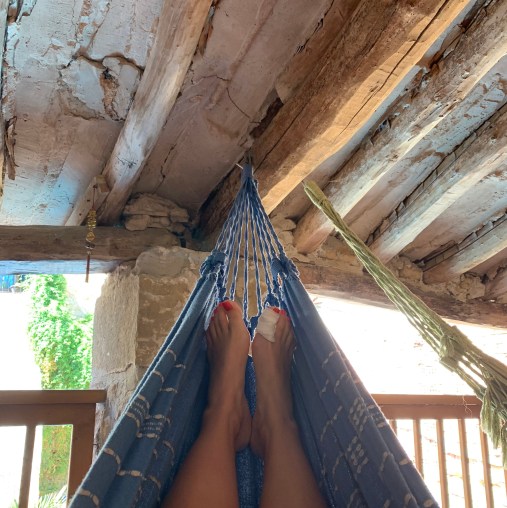
I was the first or second to arrive at La Casa Mágica (the Magic House), a wholly delightful albergue. I received a warm welcome from a teenager working at the desk, signed up for a massage later (massages are easy to find along the Camino!), dropped my stuff in a room with four beds (not bunk beds!) upstairs, and promptly installed myself in a hammock where I could elevate my feet, read, and generally enjoy the afternoon.

IMG_8554

While I was swaying in the hammock, a group of American women arrived to have lunch. They sparked my interest because they clearly weren’t typical pilgrims. All of these women – who were in their 40’s – were wearing athleisure, jewelry, and make-up. (In contrast, I was the typical pilgrim: I was wearing shorts with optional zip-on pants and a tank-top made of a sweat-wicking fabric; I had a bandana in my hair, which I hadn’t put conditioner in for several days; and I wasn’t wearing any make-up at all, let alone the mascara that I could see on these women!) While they enjoyed a boozy lunch, I just kept looking over and thinking… who are these women, and what are they doing here? The Camino isn’t a party! It’s a time for living simply and without all of the trappings of normal life!

I’ll return to these women tomorrow, when I shall encounter them again.

The home-cooked, vegetarian dinner offered by La Casa Mágica is one of its claims to fame, and it didn’t disappoint. It was a lovely communal meal. We all sat at one large table: me, a younger Australian woman who was also alone, two pairs of American women walking together, two Danes, and five people from France. Everyone at the table spoke English except the one French man who was walking by himself, and I tried to make sure he could follow what was going on. The food was delicious, and the conversation included a lot of laughs.

Meals like this were one of the very best features of the Camino – as I mentioned previously, people speak very candidly and openly about their lives, and that comes out just as much when seated with wine as it does while walking during the day. Experiences like this were important and meaningful to me because they were opportunities to practice presenting my future self. Each person I met on the Camino heard the same thing: “I’m originally from Virginia, but I’ve been living in Paris for six years, and I’m about to move to San Francisco. I’m a lawyer, but I’ve quit my job and plan to do something entirely different next.” It was the first time I was living the reality of the huge life decisions I’d made in the preceding months, and constantly meeting people and presenting these things about myself helped to reinforce that I’d made the right choices. I found it particularly interesting to realize my need to present all of this geographic context. Virginia. Paris. San Francisco. Each tells you a lot about me, but none are the whole story; I am Virginian and Parisian and, now, Californian. The simple act of presenting myself helped me to be more in touch with my own identity and to think more about what already was true about me, and what I wanted to be true. This was a principal theme of my thoughts the entire time I walked.

Coming up tomorrow: I reach the famous wine fountain (at 10:00 a.m.), take another shorter day, reunite with some old friends, and make some new ones. Plus: details of my injuries and how I dealt with them!

Camino Day 4: Pamplona to Puente la Reina

Distance traveled: 23.8 kilometers

I hadn’t awoken intending to do this, but I ended up deliberately separating from my group on the way out of Pamplona. I had planned to walk with Alma and William, but I found myself about 30 minutes ahead of them in terms of being ready to leave and just had this gut feeling that it was right for me to go on rather than to wait. I stopped in the cafe where Adam, Jenny, and Lou (you’ll hear more about Lou!) were already having breakfast and told them that I was going on ahead, which they fully supported, and off I went.

Once I got out of the city, there was a long expanse leading to a high-rising cliff with wind turbines, far off in the distance. As it turned out, the path led us straight to those turbines; if I’d known that initially, I would have taken a picture so that you could appreciate the distance. It wasn’t often on the Camino that we’d be able to track our progress visually over so substantial a distance.

IMG_8504

If you look hard, you can see the wind turbines on the left. I’d already walked a substantial distance at this point!

One of the consistently remarkable things about the Camino is the diversity of the landscape. In the course of a day’s walk – and I averaged “only” 13 miles a day – we could go from towns to fields to forests to rocky hills. Even on the Meseta (coming up in about two weeks), where the landscape is more consistent, the place we ended up rarely looked like where we’d started.

IMG_8505

The view from the other direction. Hard to believe I had just been in a city!

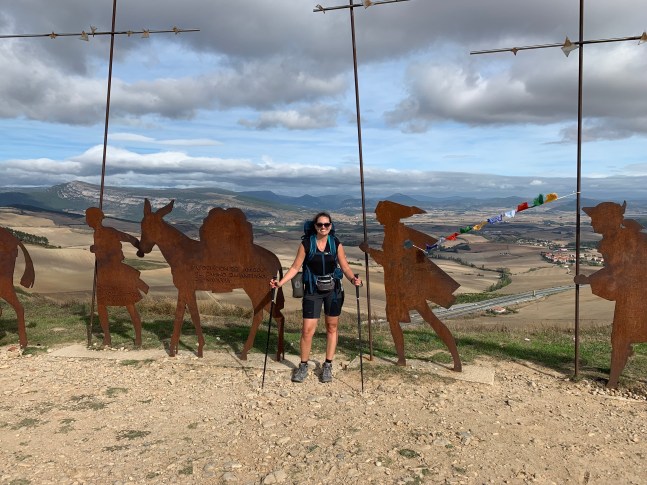
The top of the cliff with the wind turbines is a relatively famous spot on the Camino, and it’s a great photo opportunity. As I said in my Day 1 post, I liked climbs, and this one definitely came with a satisfying view.

IMG_8513

Coming down from the summit was another matter entirely. This, dear reader, is where my feet finally developed the blisters I’d been so proud of avoiding during the preceding three days. The descent was steep and very difficult; parts were more passable (as there had been some effort to create an approximation of stairs), but the majority was rocky, and my toes ended up bearing the brunt of my weight without having sufficient room to move within the boots. Even though I stopped midway down to apply some blister band-aids as I became aware of “hot spots”, the damage was done, and the pain only got worse as the day went on.

I hobbled into Puente la Reina and, curious about a relatively new albergue that supposedly had a pool (I thought soaking my feet might be a good idea), I made my way through the town and, unfortunately, up a pretty good hill on the other side of the river. (It was too late to turn back once I realized how high I had to go!) It was a pretty big place and almost entirely devoid of pilgrims, most of whom had apparently (and wisely) chosen to stay in the actual town. Not wishing to spend the rest of the day in solitude, I showered and, still wearing my shower sandals, made my way back down the hill and into town. I joined my Irish dining companions from Roncesvalles for a glass of vermouth and pondered what to do about my blisters, which clearly needed some attention. I’d come prepared with an entire Ziplock sandwich bag worth of various blister first-aid items, but I figured it was worth a trip to a pharmacy anyway. I stocked up on more blister band-aids, rubbing alcohol, and… a syringe. I’ll get into more detail about blister treatment later…

Alone for the first evening since I’d left Paris, I wandered up and down the main street of town, trying to decide where I’d feel least uncomfortable dining solo. As Adam had told me, though, the Camino provides, and I ran into an American couple named Paul and Siobhan whom I’d met on the first day. We spent a few minutes catching up in the street, and then they invited me to join them for dinner. We had a lovely time, and I was thankful to have dining companions. Unfortunately, I never saw them again after this. Another reality of the Camino is that you truly never know if you’ll see someone again. (Sometimes you’re not that far away – it’s like two parallel lines that never meet. I walked exactly one day behind my friends Lou and Bill for several weeks before, in one long day of walking, I finally caught them up.) It took me a few more days before I realized that if I wanted to be able to stay in touch with someone, I needed to ask for their contact information immediately!

Coming up next: I opt for a shorter day as my blisters start to get the better of me, learn an important lesson about judgment, and have one of the best dinners of the Camino at “the Magic House”.

Camino Day 3: Zubiri to Pamplona

Distance traveled: 21.1 km

Having spent most of the previous day walking alone and not enjoying it, I made sure to leave Zubiri with the group that was becoming my “Camino family”. Here they are below, including my friend Alma from day 1, who somehow got herself from Orisson to Zubiri in only one day! All of these people, except Jenny (the other woman below, who was only walking as far as Pamplona), will appear in many future posts.

IMG_8744

The first members of my “Camino family”!

As would become typical, we set off as a group and then broke into smaller groups or pairs according to people’s pace or just desire for diversity of conversation.

There wasn’t much in the way of towns between Zubiri and Pamplona. We took a mid-morning break, along with everyone else, at a cute cafe with ample outdoor seating. As a longtime fan of tortilla española (a Spanish staple; think of a quiche but firmer and filled with potatoes and onions), I was delighted by its availability at just about every establishment pilgrims might stop at along the way, and I ate it just about every morning.

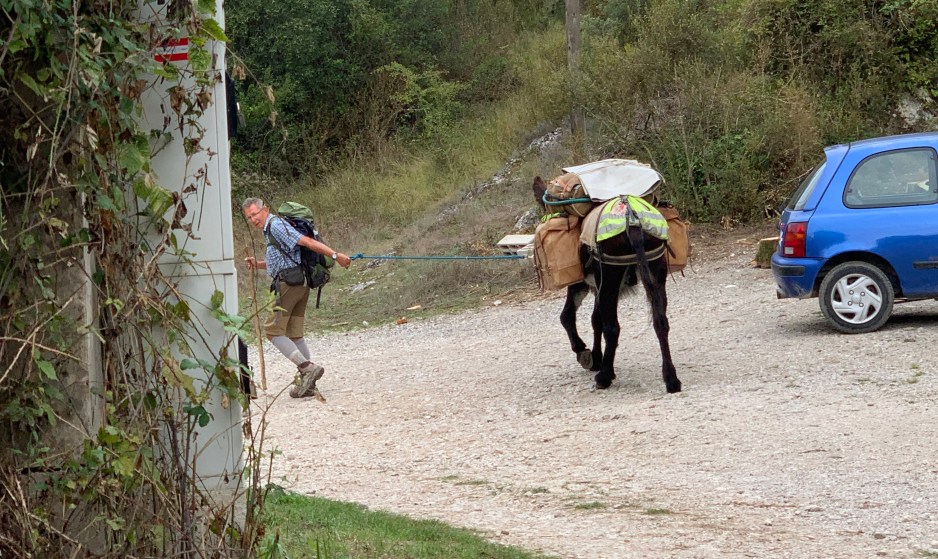
We saw two notable things on the way to Pamplona. First, we passed a REAL pilgrim: a man on his way back from Santiago, walking with a donkey!

IMG_8476

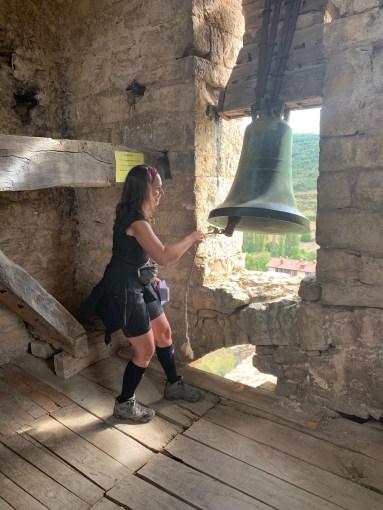
Next, Adam made sure to lead us on a tiny detour off the path in order to see one of the oldest bells in Spain, at the top of a tiny and ancient church. We were allowed to ring it, which of course I did.

IMG_8479

My feet were tired and hurting by the time we finally got to Pamplona. As would often be the case on the Camino, the last hour or so into town was the most difficult, both because of the condition of your body at the end of a day of walking and because you could often see the town well before you actually arrived – and it always took longer to get there than you would have expected!

We wound our way into the center of town and to the largest albergue, housed in what was once a church. I didn’t take a ton of pictures of the albergues, but this one was pretty special.

IMG_8499

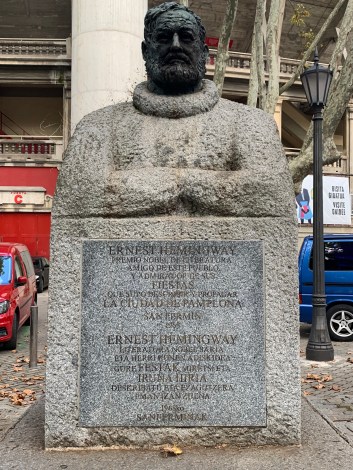
Adam and I went for some tapas and beer on one of the main plazas, and then I went to take a look at the famous bullfighting arena. I was pleased to find a marker for Ernest Hemingway in front of it; I’ve of course read The Sun Also Rises, which takes place in Pamplona, and it was cool to see it in real life!

IMG_8493

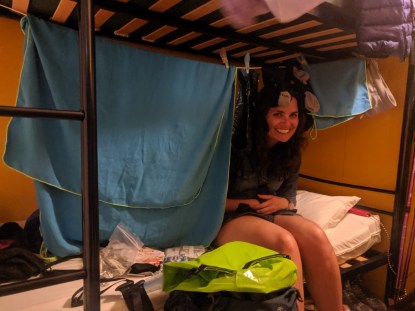
Back at the albergue, having lost a battle with a washing machine, I hung up some of my still-wet clothes above me in my bottom bunk. This would become a trend – if you do the Camino, you should definitely bring enough laundry cord to be able to do the same!

4d0a398c-96e6-4d6d-b42c-336cf1c5111f

Coming up next: I say adiós to my Camino family and venture forth alone. And finally, the blisters arrive…

Camino Day 2: Roncesvalles to Zubiri

Distance traveled: 22.3 kilometers 

I awoke in Roncesvalles to the sound of monks singing. A handful of albergues used music as a wake-up call, and I always loved it. We were up at six, and I hit the road while it was still dark, ahead of a lot of the other pilgrims. (I took the picture below the night before.)

IMG_8453

A pilgrim’s favorite photo opp.

The trail took us through the woods for about a kilometer (my trekking poles did some double duty as cobweb killers) and then eventually fed into the road. By that time, the first of many beautiful sunrises was waiting for me.

IMG_8461

The morning’s walk alternated between cutting through fields (where cows surveyed us with indifference) and walking on the side of the road through small towns. The final lead-in to Zubiri was a pretty difficult and annoying descent; it felt like two hours of going down awkward and uneven stairs. I was thankful for my trekking poles, which had proved invaluable to propel me up the climbs and to steady me as I came down. Although the weight of my backpack didn’t bother me, I wasn’t yet used to the feeling of that bulk on my back, so it helped to have a couple of extra limbs for balance.

Unlike the day before, when I’d started out walking with Alma and then initiated conversations with a lot of the pilgrims I encountered, I spent most of this day alone. I think that was partially because I was ahead of the crowd from Roncesvalles, so there were fewer people around, and partially because I wanted to get a sense of what it felt like to be alone. Many people have asked me what I listened to during all my hours of walking, and the truth is that although I’d put a lot of podcasts and audiobooks on my phone in anticipation of needing entertainment, I realized almost as soon as I started walking from Saint Jean that listening to anything would be counterproductive. Many of us are used to listening to podcasts or music as we move from point A to point B, and I think at least some of that stems from a desire to block out the noise around us; the opposite is true on the Camino. Pilgrims need to bask in the silence; otherwise, we would be less able to appreciate the unique situation of being in the middle of nowhere, usually with a beautiful view and often with sounds we don’t often hear in urban life. One of my favorite things was to catch the faint sound of a bell signaling that a cow or other animal was somewhere nearby. I found the relative silence refreshing, and it allowed my thoughts to wander, which facilitated all the reflections I’d hoped to have while walking.

I didn’t love the solitude of the second day. While I still felt buoyed from the triumph of reaching Roncesvalles the day before, I think the highlight had actually been all of the connections I’d made with people along the trail. I found myself wanting to share my appreciation of what I was seeing or commiserate about the difficulty of the descent into Zubiri.

Adam, my bunkmate from Roncesvalles, had told me where he and his group intended to stay that night, so I made my way there when I arrived in town and was maybe the third pilgrim to check in. I dropped my bag, traded my boots for sandals, and went to stick my feet in the delightfully chilly water of the river flowing through town.

IMG_8472

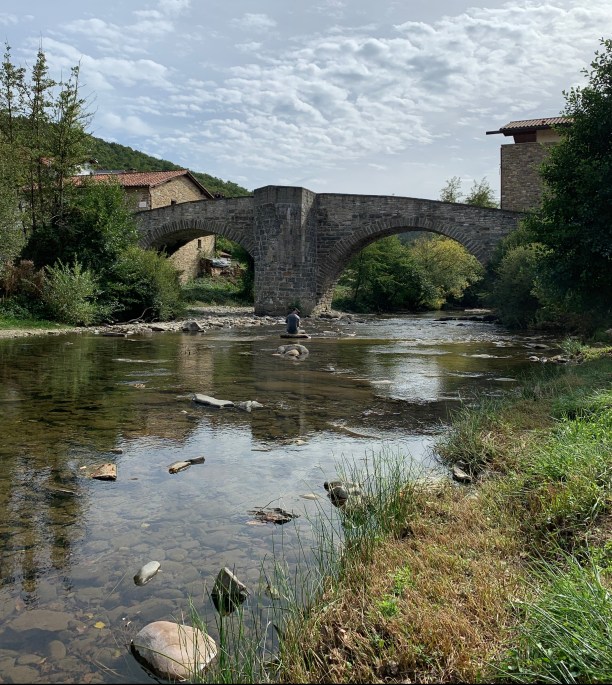
The Camino path leads across this bridge into Zubiri

After that refreshing break, I installed myself at a cafe and ordered a ham and cheese sandwich and a beer. I watched pilgrims arrive in town and spoke with a few seated near me before eventually making my way back to the albergue for the usual routine of showering, washing the day’s clothes, and generally hanging out until it was time for dinner. Adam and the rest of his group arrived over the course of the afternoon, and in the hour before dinner I ended up sitting on a comfortable leather couch with Adam and the house cat, who, much to my delight, leaped on my lap for a Camino cuddle.

That conversation with Adam was one of the big ones of my Camino. Some background: Adam is a life coach from London and had walked the full Camino eight years previously; since then, he’s done certain portions of the Camino numerous times and even spent a while living in one of the towns we’d encounter in about a week. Adam is a veritable font of information about the Camino and the ways it transforms all who walk it, so that’s what we started discussing on this particular occasion. Adam assured me that by the time I returned home, I would be unrecognizable. For some people, this transformation is physical; for others, it’s emotional, mental, or spiritual, and often, it’s a combination of two or more of these.

I told Adam that I was already aware of a significant transformation. Let me preface the following by saying that my writing here about the Camino is going to be like the conversations people have on the Camino: honest, open, raw, and vulnerable. It’s amazing how, even from the first hour of walking, all pilgrims feel comfortable opening up to complete strangers about the intimate details of their lives. People tell each other things on the Camino that their closest friends or family may not know, and with an incredible degree of ease. You’re going to get the same degree of openness and honesty from me here, both because it’s the truth and because I think it’s important to share certain struggles for the sake of letting other people know they aren’t alone. I also want to inspire as many people as possible to do their own Caminos, and I want you to have a complete picture of the ways in which my Camino helped me.

The transformation I’d already seen in myself was my fearlessness in striking up conversations with total strangers. Throughout the previous day and while I’d been sitting at the cafe in Zubiri, I not only greeted people but started really talking to them. I don’t know how often any of us do this in “real life” nowadays, but I can assure you, I am the kind of person who when put in a room full of people I don’t know is only going to start talking to people because that feels less awkward than standing by myself looking around. This isn’t so much because I’m an introvert (although, as I’ll discuss later, the Camino really made me doubt the veracity of that label) as because I carried a lot of social anxiety with me after a pretty unpleasant time in middle school. You can picture this pretty easily: I arrived as a sixth grader at K-8 Catholic school where most of my classmates had known each other since kindergarten, and despite the fact that I’d never had issues making friends before, I was immediately and summarily judged as unworthy of attention. I am thankful that I had the self-confidence, supportive family, and good therapist necessary to help me believe “it’s not me, it’s them”, but those years were really tough, and I never got over that experience of being dubbed unworthy before anyone had even taken the trouble to talk to me. In high school and college, I made a lot of friends, but I also frequently heard that people found me unapproachable, stand-offish or stuck-up, as if I were too self-assured and uninterested in others. I honestly don’t know how true any of that really was, but I took that feedback to heart and spent years making an effort to counteract what I perceived as my natural tendency to be unlikeable. I came to a point of assuming that people would not like me by default, despite all evidence to the contrary, and this made new social situations very stressful for me. I also developed imposter syndrome. I was accepted into Teach For America, got into law school at UVA, and ultimately started working at my law firm; all three of those groups are renowned for how socially adept their people are, but in each case, I believed that I was the exception to the rule, the person who’d somehow slipped through the filters. I was successful and well-liked, but I increasingly attributed that to my having somehow gamed the system or figured out which mask to wear; it was like I didn’t feel I deserved that social success. Appreciate that I was 11 when I started middle school and 34 when I started walking the Camino. That is an awfully long time to have carried the burden of these beliefs.

I had written in a pre-Camino reflection that I hoped to leave some of this social anxiety behind as I walked; it has only been within the past year or so that I’ve started to recognize everything described above and perceive with some degree of separation that this shouldn’t be my reality anymore. But despite having set that intention, I didn’t start my walk with any particular resolve for how to address these things. It’s not like I’d said to myself, “okay, today, let’s try to talk to three new people.” I had no goals in mind and certainly didn’t have any sort of conscious agenda as I walked; I simply encountered people and began talking to them. This is all the more remarkable given that I met people from many different countries and spoke to them in three different languages! (I’ll get to the Camino’s impact on my language ability in another post.) I don’t know what accounts for my total lack of anxiety and pure fearlessness as I spoke to other pilgrims; it was just some form of Camino magic.

Anyway, by the end of the second day of the Camino, I felt my social anxiety had been cured. I had met upwards of 30 people in the past two days, and all of them had appeared to like me. Each person I’d previously met greeted me warmly when we saw each other again. Finally, I had the volume of indisputable evidence I needed to understand that I no longer had anything I needed to fix or hide about myself. I was likable, just as I was, and I was entirely capable of taking the lead in social situations – speaking to others rather than waiting to be spoken to. This was such a powerful paradigm shift for me.

Adam listened to me as I said all of this, nodding his head. “This is pure Camino,” he assured me. “The Camino provides!” I will revisit this phrase – the Camino provides – in future posts. It’s one of the most powerful truths I know, and you will see why.

Coming up next: arrival in one of the few Camino towns you’ve probably heard of – Pamplona, home to the running of the bulls.

Camino Day 1: Saint-Jean-Pied-de-Port to Roncesvalles

Kilometers walked/hiked: 24.7  

Change in elevation: 1230 meters up

I arrived in Saint Jean on Saturday afternoon along with a number of other backpack-wearing, nervous-looking pilgrims. The blue skies suggested good things to come, but I felt no small amount of anxiety about the rain forecast for the next day, when I had cross the Pyrenees on foot. Although I’d been training (by taking two- or three-hour walks around Paris with a mostly full backpack), I had no idea what such a daunting first day would feel like. Would my back hurt? Would I get blisters? Just how exhausted would I be at the end of the day? My naturally anxious brain, always happy to supply me with a stream of worst case scenarios, was in overdrive as I considered all of the known and potentially unknown challenges ahead.

IMG_8392

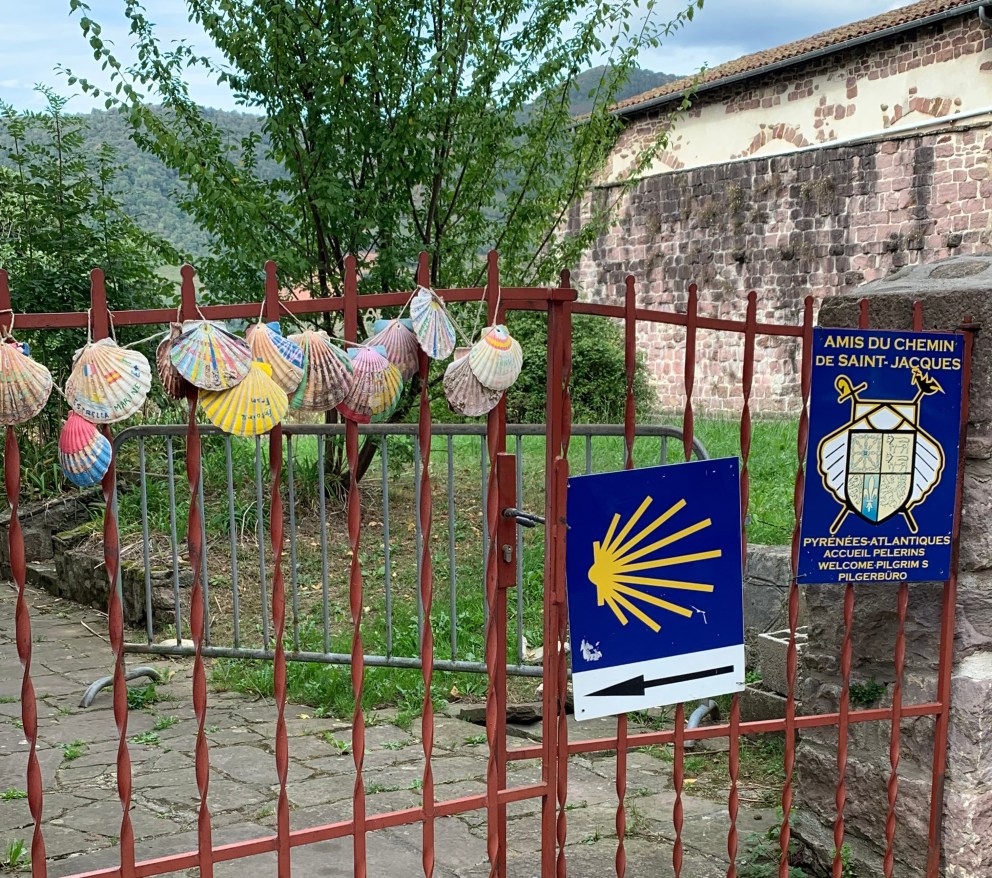
Outside the pilgrim office in Saint-Jean. Pilgrims wear scallop shells on their backpacks and follow these signs, which represent the many routes to Santiago de Compostela (and, not by coincidence, resembles a scallop shell).

I enjoyed dinner that night with two of my roommates in the hostel. One had come from Brazil to bike the whole Camino in about two weeks, and the other had come from London to walk as much as she could before she had to get back to a new job. None of us had done anything like this before.

I woke up the following morning just as the rain was starting to fall. I had known it was coming, but hearing it hit the cobblestones on the street really brought home for the first time that I was about to cross a mountain range on foot and get soaked while doing it.

IMG_8408

A dry moment in front of the hostel, just before we got started. 

Alma and I wished our biking Brazilian friend our first “buen Camino!” and set off on foot through progressively aggressive rain. Our walk transitioned to a climb very quickly, and I had a pleasant and unexpected revelation: I was in great shape for climbs! I had spent the past two and a half years living in fifth- and sixth-floor apartments with no elevator, and without knowing it, I had been training for the Camino each time I climbed those many stairs. While I certainly felt challenged as we ascended, I saw that I could go faster and less breathlessly than many of the other pilgrims we encountered. I didn’t know it then, but climbs were to be one of my favorite elements of the whole Camino journey.

IMG_8258

The change in elevation from Saint Jean (right) to Roncesvalles (left)

Alma and I parted ways at Orisson (still in France) after a break for coffee and, in my case, to dump water out of my supposedly waterproof hiking boots. She was inclined to continue the following day, when the weather looked more promising and she’d be able to enjoy the view that the clouds and fog had currently hidden from us. I continued on for another hour or two in the rain, and it finally stopped sometime near my crossing of the border into Spain.

IMG_8422

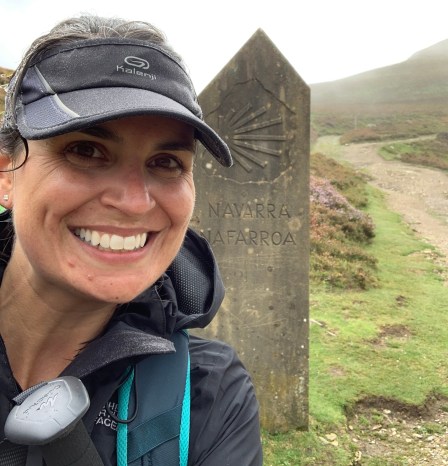
All smile as I stand at the Spanish border

As you can see, the border consisted only of a stone marker next to the path. (I also had the benefit of receiving a message from my French phone carrier to let me know I’d entered Spain, though interestingly, I received that about 30 minutes before reaching this marker.) Not long after, the path diverted from the open into a wooded area, and I and the rest of the new pilgrims experienced the fun of trekking through squelchy mud.

IMG_8424

Don’t let the leaves fool you – this was all mud.

By the time I got through the forest, the clouds had started to part, and I finally got a sense of the views I’d been missing up to that point.

IMG_8435

Looking back towards France

Not long after this, the path finally started to descend again. I spent the last hour accompanying an American woman named Pam who had told her son to go on ahead but seemed in need of a little moral support as we picked our way down the uneven and still wet path leading into Roncesvalles. Staying with her in this moment was the first of many times to come when I’d feel called to help a fellow pilgrim in some way. Many pilgrims discuss the existence of “Camino Angels”, and I believe that these exist in forms both human and divine. All pilgrims walking have opportunities to be a Camino Angel for someone, whether it’s helping someone through a difficult stretch, offering a snack, or sharing first aid items; I also felt, particularly on the more challenging terrain of the first couple of days, that an unseen presence was protecting me while I walked. I said “thank you!” out loud on several occasions when I nearly lost my footing or my balance and somehow righted myself again. I always found that the Camino provided what I needed at any given moment through both kinds of Camino Angels, and I sought to be a Camino Angel for others whenever I could.

IMG_8451

Wet boots attempting to dry outside the albergue in Roncesvalles

When Pam and I finally made it to Roncesvalles, it felt a bit surreal. It takes a while to process the tremendous feat of having crossed the Pyrenees on foot, and you feel the accomplishment of all the other pilgrims too. What a remarkable thing, to have a couple hundred people wearing heavy backpacks cross from one country into another over a mountain range, all in the span of eight hours or less!

The albergue (pilgrim hostel) in Roncesvalles is huge; Roncesvalles is a true hamlet and essentially consists of the albergue, a church, a hotel, and two restaurants. It, like many other towns along the way, exists for and because of the Camino. After receiving a stamp in my pilgrim passport and a bunk assignment, I joined the other pilgrims in taking off my still-wet boots and made my way up to the second floor, where probably about 100 people were to sleep in bunk pods of four.

My other three bunkmates were already there when I arrived. Adam, William, and Bill will figure prominently in many of the forthcoming posts. Of the innumerable serendipitous events of my Camino, being assigned to their pod was probably the most significant.

The rest of my day consisted of taking a shower (in warm water!), washing clothes, having dinner, chatting with the guys as we got our things organized for the morning, jotting a few reflections in my journal, and texting my mother to let her know I’d arrived safely. This was the post-walking routine every day on the Camino.

I’ll close by answering the three questions I posed at the beginning: Did my back hurt? No! Did I get blisters? No, even though I walked in wet socks all that time! Just how exhausted was I? Not as much as expected – I think there was a lot of adrenaline and excitement that carried me through that challenging first day.

I’ll be writing these posts according to the stream of consciousness that arrives as I think back to each day and look at my pictures. I will try to work in information that may be helpful for aspiring pilgrims, but feel free to leave a comment with questions you may have, and I’ll try to address them in future posts!

As we say on the Way: Buen Camino!

The Camino de Santiago: An Introduction

I’m writing this now on March 15, 2020, as the world is starting to shut down in reaction to the spread of the coronavirus. It’s a scary time, in part because of the never-before-in-our-lifetimes restrictions on international travel. I’m one of many people who will be spending 99% of my time for the next several weeks in relative isolation at home, and it’s a somewhat claustrophobia-inducing prospect. So, as a means of mental escape, I’m going to be reliving my pilgrimage on the Camino de Santiago for the next 37 days (one for each day I walked), and I hope that sharing my experience will provide both relief from your own boredom/anxiety and inspiration to do your own pilgrimage at some point in the future.

Santiago de Compostela in Spain joins Rome and Jerusalem as the final destination of the three big Christian pilgrimages. While the significance of Rome and Jerusalem is obvious, you may never have heard of Santiago de Compostela. It is believed that the bones of Saint James (or Santiago, in Spanish) – one of the 12 apostles – are buried in the crypt of the cathedral there and that journeying – on foot, horseback, or, more recently, bicycle – to see them will result in the forgiveness of your sins. Today, pilgrims on the Camino hail from many countries and religious traditions, and many would no longer identify religion as the primary motivation for their journey, but religion and particularly Catholicism still figure prominently in the experience.

I earned a degree in Hispanic Studies from the College of William & Mary, and the Camino first came onto my radar sometime during that period thanks to a member of the faculty who is one of the foremost experts on the Camino – George Greenia. I didn’t know much about it at the time, but as someone who’d already identified as an aspiring European and traveler, I knew it was something I’d want to do one day. I was also raised Catholic and liked the idea of undertaking a more novel expression and exploration of my faith.

Fast-forwarding more than a decade, in August of 2018 I found myself confronting irrepressible evidence that I needed to quit my job as an attorney working legitimately unhealthy hours in a big law firm. As I started mentally preparing myself to be comfortable with the idea of quitting before I’d found something else to do, the Camino popped back into my mind. I knew I might never have a better opportunity, at least while still young and fit, to make the five-week journey. Little by little, I released my fear of quitting and instead embraced the lack of a professional next step as a unique chance to undertake something that would, at the very least, help me to process my experiences of the past several years and prepare myself for whatever would come next. I finally left my job at the end of June of 2019, and I left Paris (my home for the past two and a half years) for Saint-Jean-Pied-de-Port on Saturday, September 21, 2019.

The traditional Camino experience involves carrying all of your necessary possessions in a backpack, making your way on foot from town to town, and spending the night in a pilgrim hostel (albergue). There are many routes to Santiago; the most famous, and the one I took, is the Camino Francés, which begins in Saint-Jean-Pied-de-Port in France and continues across northern Spain, inland from the coast. (Other routes include the Camino del Norte, which goes along the northern coast of Spain, and the Camino Portugués, which leads north to Santiago from Lisbon. You can even start much further afield; France has its own routes from the east and the north, and I met people who walked from as far as the Netherlands.)

I followed this tradition, for the most part; I walked with a 36-liter backpack, wore the same three outfits for six weeks, and gradually learned how to block out the symphony of snoring that accompanies nights spent in dorm rooms. Officially, I walked alone, though as you will see, my experience was rarely solitary. I averaged 15 miles (24 kilometers) per day and covered 560 miles (894 kilometers) total over 37 days of walking.

It’s one of the best things I’ve ever done.

I hope to show you why in the days to come!


Catch-Up: Istanbul, 2015

I somehow never got around to writing about my trip to Istanbul despite the fact that it was AMAZING and wholly deserving of detailed praise! I’m saddened by the string of terrorist attacks in Turkey, so I want to capture my good memories to keep the positivity alive.

Istanbul was the fourth and final city on the trip my friend Mary and I took in August 2015. We flew to Istanbul from Casablanca after spending more than a week in Morocco, which as related in that post was a really mixed experience that by the end made us very ready to leave. Istanbul was the total opposite: we loved everything about it, and for the first 24 hours we kept saying “upgrade!!!” to ourselves as we walked around.

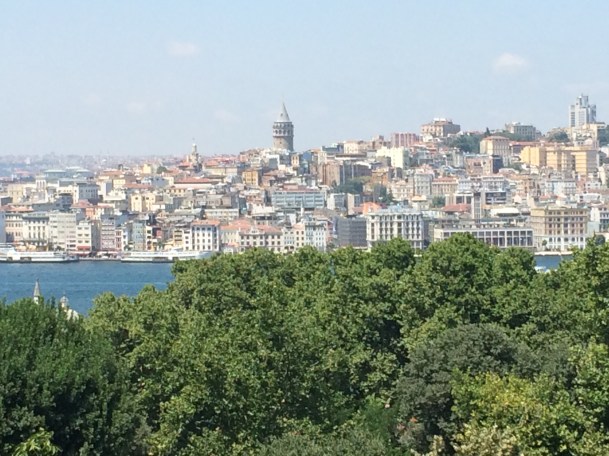
Istanbul has three parts, all separated by water. We stayed in the newer part of the city near Galata tower, in an Airbnb apartment with access to a rooftop with this view:

img_6732

Nearer across the water you can see the Hagia Sophia on the far right and Topkapi palace to the left; the land mass further away on the left is Asia!

We never tired of this view, which was also gorgeous at night with the moon rising over the Bosphorus. I also loved listening to the call to prayer from up here.

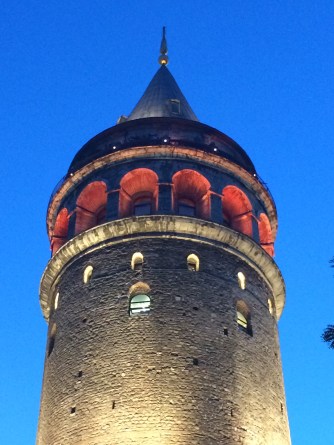
Here’s Galata tower, just a block or two further up the hill:

img_6741

Aside from our gorgeous view over the Bosphorus, we found plenty to praise and further points of cultural curiosity in Istanbul. The food, as you’ll see, never disappointed us. (And indeed, even before this trip, I had a proclivity for Turkish food, so I was thrilled to have the chance to eat some that was extra authentic.) I always love cities with rich histories, and Istanbul certainly qualifies. For me it had always seemed like this mysterious, exotic destination – the seat of the mighty Ottoman Empire, home to the sultans and their famous harems, and before them to Alexander the Great! I think the Turks, like the French, take great pride in their history of having power over huge portions of the globe, and I think that explains things like the effort and expense they have put into maintaining the city. Its most famous tourist sites are truly stunning, and I’ve never been in a large city so clean. I was quite impressed.

We also felt instantly more safe and comfortable than we had in Morocco. I’m not sure what exactly accounts for that. As much as I’d love to declare us such seasoned travelers that our increased comfort had nothing to do with the fact that Istanbul felt distinctly more European, I think that certainly contributed to it. We felt like out of place foreigners the entire time we were in Morocco, but in Istanbul, we felt like tourists in any other European city. It was easier to navigate through Istanbul, to be sure – there’s one tram line that takes you pretty much everywhere you’d want to go, which was a huge improvement from the maze of the medinas and the chaos of trying to find a taxi in Rabat and Casablanca. And we were better able to blend in – although we saw plenty of women wearing hijabs, plenty more weren’t wearing them, and in general we didn’t feel nearly as much pressure to dress conservatively. (Whereas in Morocco we’d worn only maxi dresses and kept our arms fully covered, in Istanbul we switched to knee-length dresses in the evenings for dinner.) I suppose you could say that Istanbul just required less effort, which was a relief (especially after feeling that our effort in Morocco often didn’t make things any better for us).

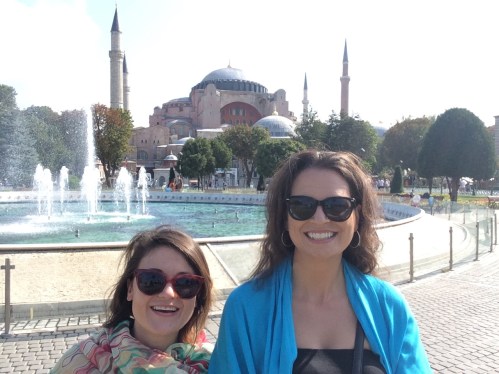
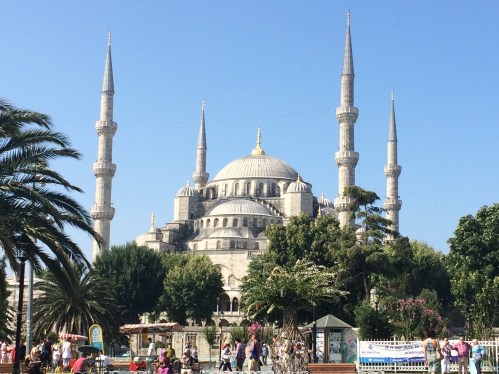
Anyway, our first full day in Istanbul was the day of hitting most of the big tourist sites: the Hagia Sophia, the Blue Mosque, Topkapi Palace, and the cistern, all across the bay from us and easily reached via the tram. It was a beautiful day, and we took lots of pictures while standing between the Hagia Sophia and Blue Mosque, which face each other and are separated by a plaza/park.

img_6765

in front of the Hagia Sophia

img_6766

the Blue Mosque

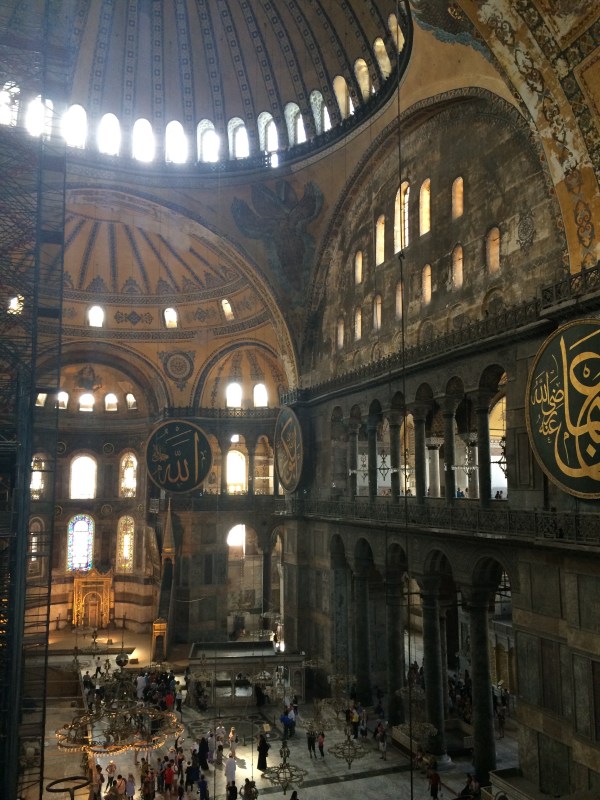
We started in the Hagia Sophia as we figured that would have the longest line. I’ll let you research the fascinating history of this religious space and instead let you marvel at its interior.

img_6773

The Hagia Sophia, like Notre Dame in Paris, is one of those places where you never stop being aware of the fact that you’re in an awe-inspiring, very old space for spiritual activity. Despite the many people moving around inside, there was still a pervasive sense of calm and quiet. We spent probably about an hour inside, relying on Rick Steve’s tour to work our way around and take in all of the detail.

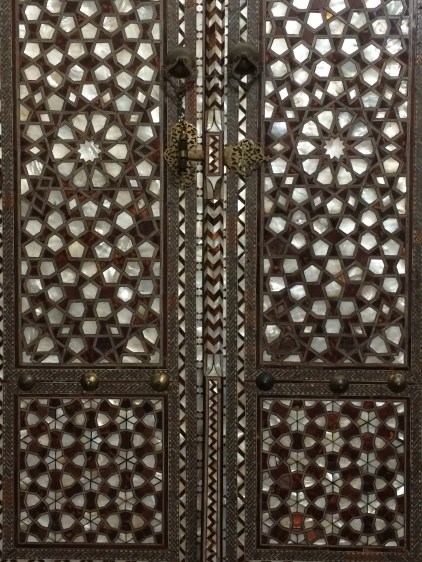
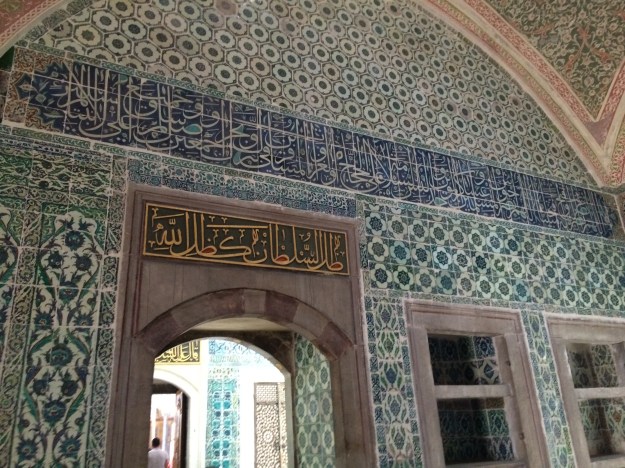
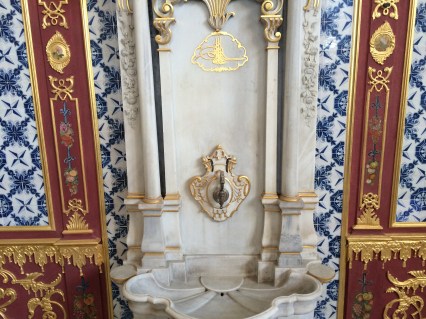
From the Hagia Sophia we moved on to Topkapi Palace, the former home of the sultans. I was pretty excited to see this too, particularly its famous harem. It’s a sprawling complex – we invested in some audioguides to help us navigate our way around. We started in the harem, which didn’t quite conjure the visions I was expecting but was nonetheless full of impressive architecture and interior decoration:

img_6799

The tile art…

img_6807

the most beautiful closet door!

img_6808

THE TILES!

img_6813

just your typical sink.

img_6829

View from Topkapi Palace to our side of the city

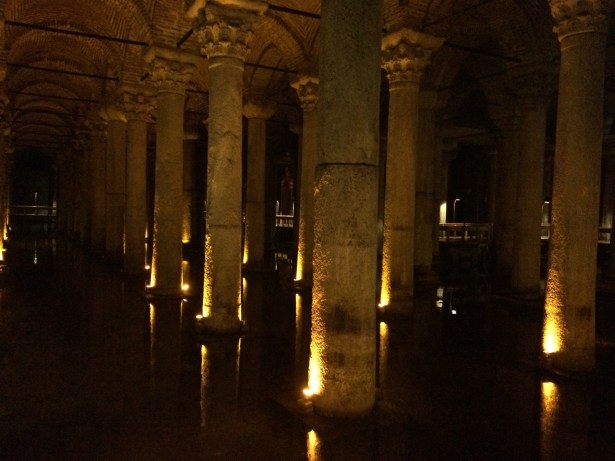
After the palace, we needed to beat the mid-afternoon heat, so we backtracked and went to the underground cistern, which turned out to be my favorite place of the day. The underground cistern is essentially a massive pool of water hidden under the street, quite close to the Hagia Sophia. It dates back about 1400 years, and you can tell; the place is even more of a time capsule than the Hagia Sophia.

img_6784

the Underground Cistern

Visitors make their way around on a series of platforms above the water, which is only a few feet deep but hosts plenty of large fish, who must have a very peaceful life down there. This would be the ideal place to come in the middle of a stressful day – you feel completely removed from the outside world! I would also love to go to one of the concerts that regularly take place down there; the sound must be incredible.

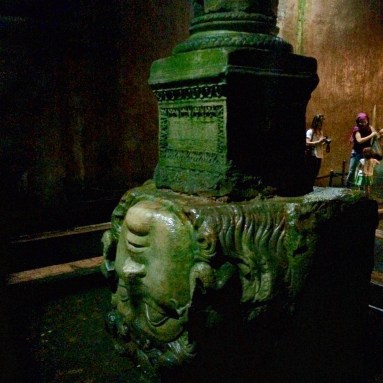
The underground cistern is also famous for its two giant Medusa heads, whose presence (and orientation) is unexplained. One is upside-down, and the other is sideways. It’s thought that they are leftovers from some previous structure and just happened to be the right size to hold the columns that rest on them…

img_6862

the upside-down Medusa head

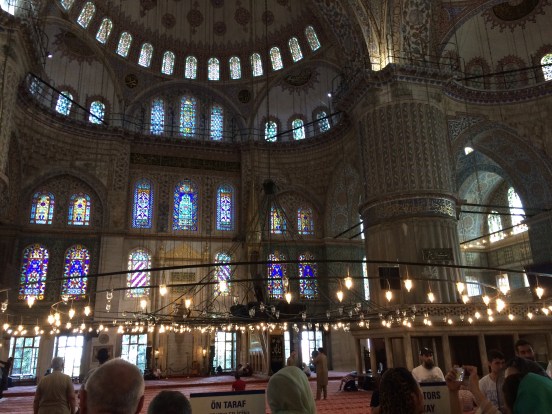
Our last stop on the tourist trail that day was the Blue Mosque, which as you can tell from the picture above is massive. We learned that they take the dress code very seriously; to my chagrin, I was handed a supplemental covering to wrap around my waist because my maxi dress had slits up to the knees that allowed some leg to be visible when I walked. (At least I was better than many of the other tourists who showed up in shorts!) Here’s the inside of the Blue Mosque:

img_6849

I feel a little disoriented even now looking at the picture of that chandelier (if that’s even the right word for something so wide) – it’s only a foot or two higher than standing height!

I have fewer pictures from our other activities around Istanbul. The Grand Bazaar and the Spice Market, for instance, are both busy enough that walking around with a camera isn’t the most practical. Both are quite an experience. The Grand Bazaar is huge; there are probably at least 15 very, very long rows of stalls inside the building, and saying “I’ll come back here after I’ve looked around more” didn’t end up being the easiest strategy! We were a bit disappointed to see that many of the clothing stalls were selling designer knock-offs – not because we were so opposed to knock-offs but more because they detracted from the authentic, historical feel of the place! I was, however, quite satisfied with my purchase of knee boots featuring a cool blue/green/gold tapestry-like stitching on the outside. I bargained HARD; the transaction took about 15 minutes. (As I think I’ve mentioned before, I am horrible at bargaining. It makes me really uncomfortable, particularly in situations where I’m fully capable of paying the first price given. In this case, the boots were still not a steal even after I got the price cut in half, so I was a lot more motivated to negotiate.) The vendor, in gratitude for my business, a) asked me to get a beer with him later and b) led us halfway across the bazaar to the stall of a friend of his, who proceeded to offer us tea and join in the pleas to get us to go out with them. (I don’t even remember what wares we were supposedly viewing at the second place!) We did not end up taking them up on the offer of the beer, but it was a very amusing exchange nonetheless.

Another activity (which strangely I appear to have no pictures from) was taking a cruise on the Bosphorus. I learned two important lessons from that experience: 1) everyone should aspire to have a mansion on the Bosphorus, and 2) giant wafer cookies (about eight inches across) are THE snack to eat on a boat in Istanbul. The cruise took about two hours; we traveled beyond the limits of Istanbul up the Bosphorus and passed countless charming mansions right on the coast (some looked more like houses in Venice, where you could essentially open a door and step into the water).

We saw plenty of the Asian side of the greater Istanbul area from the boat, but we didn’t actually set foot on Asia until our last day, when we went to Asia for lunch. (That statement makes me smile just as much now as it did then! Just a cheeky trip to Asia for lunch…) The Asian side has a slightly different feel, though I’m not sure how to describe it – perhaps that’s it actually; the Asian side is just a bit more nondescript, as opposed to the European side which is so steeped in the visible history. We heard that more and more Istanbul residents are moving to the Asian side, so it will be interesting to follow how that part of the city evolves in the coming years. It couldn’t be easier to get there despite the fact that it looks kind of far away across the water: there’s an underwater train that runs from a station on the European side near the palace to a point on the Asian side across the Bosphorus, and it takes less than 10 minutes.

Finally, before I get to all of the food we ate, I have to talk about the whirling dervishes. I’m sure that you, like me, have certainly heard of “whirling dervishes” but would be hard pressed to explain what they are or even link them to Turkey. The dervishes fascinated me every bit as much as all of the other aspects of Islam that we encountered in Morocco and in Istanbul. I will again refer you to Google to learn more, but essentially, dervishes are sort of like monks, and they practice whirling (twirling) as a means of getting closer to God. There is one place in Istanbul where, once a week, you can watch the whirling dervishes perform a full ceremony. It is truly one of the coolest things I’ve ever seen. There are different stages; they aren’t whirling the entire time, but they do it for waaaaay past the point at which I would have fallen down from dizziness.

What I most wanted to understand, and unfortunately still haven’t been able to find out, is the significance of the positioning of their various parts of the body. Their heads, for example, are kept tilted at an angle; you’ll notice if you look hard at the picture above that they all have their left and right hands oriented in a different way as well. They plant one foot and rotate around that foot (using the other foot to spin themselves around). The whirling is just slow enough (I imagine) to moderate the dizziness but is still pretty fast.

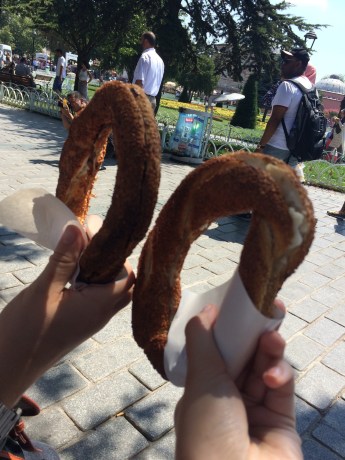
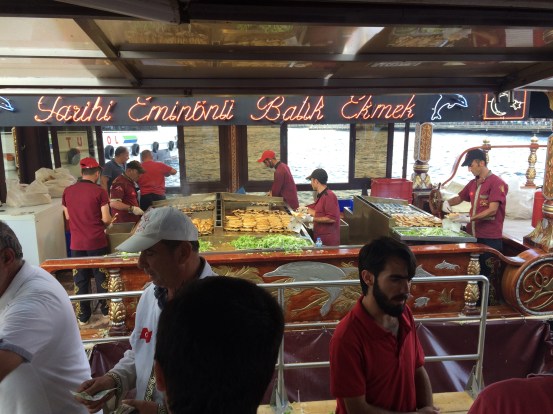
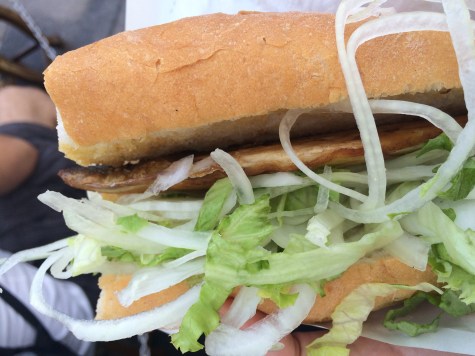
Finally, the food. We ate so well in Istanbul, both casually and formally. For snacks, we had simits (essentially a Turkish take on the pretzel), strange ice cream with a consistency closer to taffy (such that the vendors liked to play tricks on the buyers, with lots of upside-down flips of the cone), freshly fried fish sandwiches cooked on a boat, kebab wraps from a place visited by Anthony Bourdain, and even a special Turkish hamburger whose bun is covered in a tomato sauce. Here are a few of those:

img_6795

Simits (plain and with cheese)

img_6868

It doesn’t get much fresher than fish friend on a boat.

img_6869

our fried fish sandwich

img_6923

spicy kebab wraps

By far our most memorable meal in Istanbul (which is saying something) was our brunch. Anyone going to Istanbul should prioritize having a proper Turkish brunch. It was a thing of beauty. Observe our table:

img_6888

the best brunch of my life.

Brunch included: spinach pita sandwiches, a delicious and spicy egg, tomato, and sausage dish, sliced veggies, olives, several types of Turkish cheese, homemade spreads and jams (including a homemade hazelnut spread), bread, juice, and, of course, Turkish coffee. We at this at a table set up literally on the street in a residential area not too far from our own neighborhood, and it was clearly the place to be on a late Sunday morning; taxis regularly dropped people off next to us.

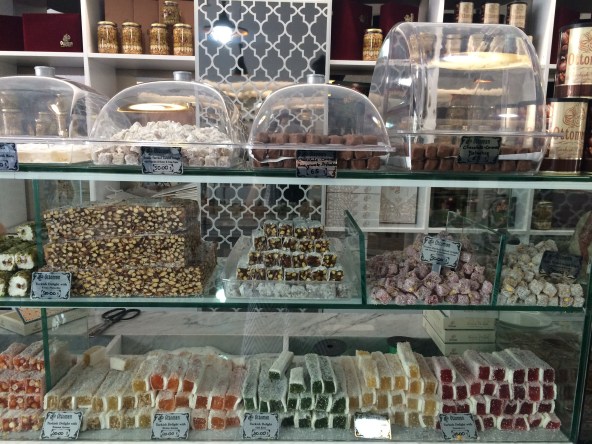
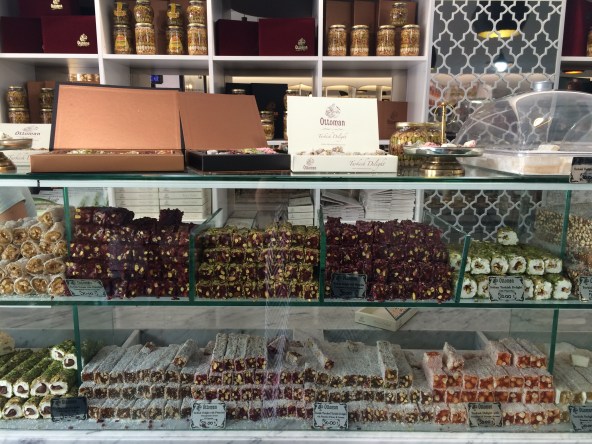
You might be wondering what authentic Turkish Delight is like. I can’t claim to have eaten a lot of Turkish Delight in my life, but I can say that nothing I’ve had before or since this trip has been anything close to what we ate. Here is the Turkish Delight shop near our apartment where I filled a big box to bring to my colleagues.

img_6943

img_6944

Turkish Delight comes in a huge array of flavors, and all of them are delicious!

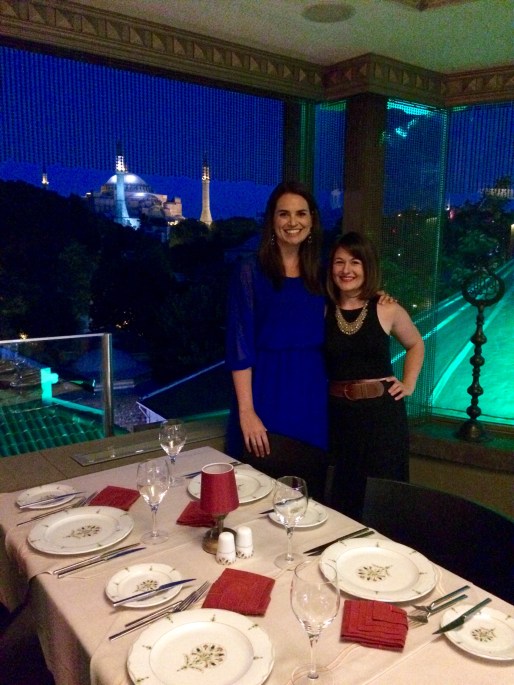
Mary and I decided to end our trip by staying in a five star hotel on our last night; we crossed the river and stayed closer to the main tourist sites. We ended up having our last dinner in the rooftop restaurant of our hotel, and while the meal itself was wonderful, the view was the best part.

img_6968

Me and Mary, with the Hagia Sophia in the background

In summary: Istanbul was a beautiful city, one in which I could easily imagine living. It’s right up there with Paris and Rio in terms of cities where I have felt a real connection, as if it’s possible I lived there in a past life. I’ve been watching a Turkish television show on Netflix recently, and it has only increased my desire to learn more about Turkish culture and see more of the rest of the country, as I recognize that Istanbul is but one city in a very large country. I hope that the security situation settles down so that everyone can soon feel comfortable going there again, and I look forward to visiting Istanbul again sometime in the future.

Solo Trips from 2016: Bilbao and Lyon

Last week I discussed my experience as a solo (and female) traveler with one of my high school teachers, and I realized that I had failed to recount those experiences here. One of the side effects of living in Europe and the comparative ease of international travel in this region is that weekend trips to other countries feel much the same as weekend trips to other states within the US; as a result, it’s easy for me to forget that they qualify as the type of travel on which this blog focuses!

I posted previously about my first solo trip, to Barcelona just after my 30th birthday in 2015. That trip was a great success and gave me the confidence necessary to embark on further solo trips, at least to places within Europe where I can speak the language and feel the minimum level of comfort necessary for such an undertaking.

Bilbao

I booked the trip to Bilbao in March. After such a great time in Argentina for New Year’s, I was aching for another chance to speak Spanish, and I remembered that the New York Times had recently done one of its “36 Hours” features on Bilbao. I booked on a Monday and left on Friday night.

According to what I’ve read, Bilbao’s reputation is in the process of transitioning from that of an unpleasant industrial city to that of the more modern and chic variety. I had a hard time believing that anyone could have previously disliked Bilbao: I found it charming. It is a relatively small city whose center can be easily traversed on foot in 35 minutes or so. I stayed right in the middle of everything, in a hotel about a 15-minute walk southeast of the Guggenheim.

I arrived late on Friday night and didn’t pressure myself to accomplish anything in particular upon my arrival, especially since it was raining. Nonetheless, feeling that it would not be acceptable to simply go to sleep, I grabbed an umbrella and set off on a reconnaissance mission of sorts. I had a list of pintxos and cocktail bars that I wanted to scope out for the following day, and I walked a big loop to see a few of them and generally get a feel for the geography. Bilbao’s center is organized in a simple grid, so it was easy to find my way around without relying heavily on my phone.

I wasn’t hungry and hadn’t yet summoned enough courage to enter a bar alone, so after my little walking tour I went back to the hotel and took pleasure in watching Spanish Netflix. (The UK Netflix library is awful – those of you in the US should not take for granted the far superior titles available to you!) One of the beautiful things about speaking a foreign language is that you can do something like watch a movie in that language and feel like you’re accomplishing something intellectual. I happened upon a Spanish television show telling the story of Queen Isabella (in my the same style as “The Tudors”) and quickly became engrossed, not only because the story was interesting but also because the dialogue took place entirely in the Spanish that was spoken at that time. I could only watch with Spanish subtitles, which were actually very helpful. I am a big language nerd and was fascinated by the linguistic differences!

In a similar vein, one of the nice things about traveling alone is that you do only what you want to do. Had someone else been with me, I likely wouldn’t have felt comfortable staying in my room and watching Netflix even though, as explained above, for me that was an entirely enjoyable and useful activity. (Sure, it can feel a little sad or weird to be in a hotel room by yourself and without a friend nearby, but sometimes that’s just life!) I think one of the lessons of solo travel is becoming more comfortable in your own skin; somehow being alone in a foreign place feels different from being alone in your home city.

Saturday was a busy day for me; I had a long list of things to see, many of which would involve eating. I had prepared a Google Map of the city with all of my destinations saved, so it was easy to navigate efficiently. I had relied entirely on TripAdvisor, and I think almost everything I ate or drank came from one of the places for which I’d read a recommendation.

One of the lessons I learned, to go back to the idea of feeling comfortable when traveling alone, is that there’s no harm in trying to transplant a bit of your usual routine or something familiar into the new place. For instance, I happened upon Sephora, the French cosmetics store I came to know intimately while living in Paris. We don’t have Sephoras in the UK, so I was justified in going in, but my time in Sephora served the dual purpose of helping me take a break from feeling the foreign-ness of where I was and what I was doing. It was something familiar, except that the product labels were in Spanish! Watching Netflix qualifies as the same type of activity – it wasn’t just like being at home because I had access to an entirely new library of films and shows, but it also wasn’t something that further highlighted the fact that I was in a strange place alone.

My favorite part of Saturday was going to the Corte Inglés, Spain’s principal department store. My hotel was a five minute walk away, and I logged over an hour inside. I delighted in the kitchenwares section, where I found a pan designed specifically for making tortilla española (and in this case, for people like me who have not yet mastered the art of flipping the tortilla halfway through). I also bought two glass champagne coupes (now the vessel of choice for many artisan cocktails), which I mention because a) I’d tried to find ones of exactly the right shape and height all over London, including in antiques shops and b) they cost a mere 3 euros a piece – go figure! I spent probably an additional 40 minutes in just the books department; whenever I am in a bookstore in a Spanish or French-speaking country, I feel so tempted to buy a bunch of books; they appeal to two sides of my nerdy nature: I am a girl who loves to read, and I am a girl who loves foreign languages. Combine the two and… I have to exercise real restraint, especially since my track record of actually reading books purchased in such circumstances is not the best. I managed to withstand the temptation and instead spent the equivalent amount of money on chocolate. 🙂

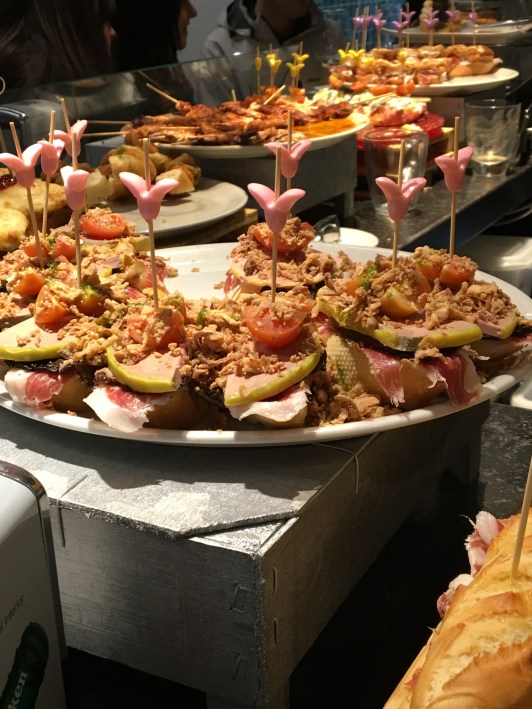
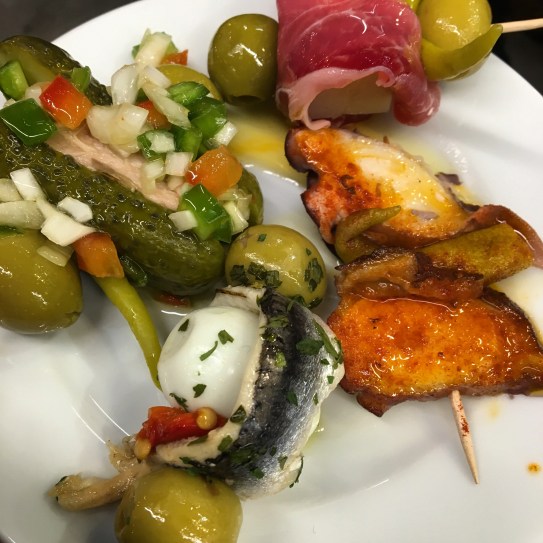
The highlight of the trip was of course the food. Bilbao is part of the Basque region (more on that later) and is famous for its pintxos (tapas), which are even more ubiquitous there than in the rest of the country. Practically every block had at least one pinxtos bar, where throughout the day and night a colorful medley of pintxos were laid out on the bar, ready to be grabbed and eaten along with a cheap (but delicious) glass of wine.
img_5967

My introduction to this experience was the covered market across the river, which like the famous market in Barcelona was a mixture of produce, meat, fish, and cheese stands as well as pintxos establishments. The place was packed on Saturday afternoon, and the only thing harder than finding a place on which to put my food was picking that food in the first place. I got a bit of everything and even took advantage of some free wine tasting. The market was the perfect place to come alone because there were so many people around, and the atmosphere was totally distinct from that of a regular bar or restaurant.
img_5965

My culinary experiences later in the day were just as satisfying from a taste perspective but more difficult from a solo traveler perspective. The clientele at the pintxos bars I visited later seemed generally disinclined to engage with me as someone there alone; everyone seemed to be there in large groups or in a couple, so no one was looking for someone else to talk to. (I wonder now how many times I might have failed to notice someone alone in a similar situation.) I was more surprised that the men behind the bar weren’t inclined to chat with me – it’s been my general experience (recognizing that my experience being in similar situations is limited) that men serving drinks are not unwilling to chat with women, and it was obvious that I spoke Spanish, so I was disappointed that no one struck up a conversation with me. The only time in the span of about three hours that I did talk to someone was when standing next to an older couple. I don’t remember how we started talking (something must have triggered them saying something to me), but I spoke with them for about 10 minutes and was grateful for the interaction. I don’t think eating alone is as hard as I had previously thought, but in this case it was made more difficult by the fact that I was always standing at a bar – I wasn’t seated at a table where I could get out a book and tune out what was going on around me.

I did manage to have an extended conversation later in the evening with the owner and chief bartender of a cocktail bar that was surprisingly devoid of patrons, even at 11 p.m. I had walked past the night before and found it similarly empty, but I had read a lot about it and really wanted to try one of their drinks, so this time I was undeterred by the emptiness. The owner asked me what I wanted to have and (this is the mark of all good bartenders) readily invented something for me based on my response. I had finished the whole drink by the time anyone else entered the bar! I still don’t know how a bar was empty on a Saturday night.

I did feel a bit discouraged and lonely after the evening, but I was proud of myself for sticking it out. After all, I could have just eaten a bunch of pintxos in just one bar and then given up and gone back to the hotel at 8 pm; instead, I stayed out for five hours and went to five or six different places, which is worth celebrating even if I didn’t do much talking!

The next day I was more social because I had arranged to go on a date in the hours before my late afternoon flight! I started the day at the Guggenheim museum, which really is a very cool piece of architecture, and there is a lot of thought-provoking art inside (even if I’m still not the most appreciative of modern art). As a side note, going through museums is the best part of traveling alone – you can go at exactly the pace you want, not spending a moment more or less than you want to spend on any particular piece. Anyway, Iñigo came and picked me up at the Guggenheim around 1:00, and that was the last time I spent alone on that trip.

There is a new trend of “Tinder Tourism” – using Tinder as a means of meeting people while traveling. (For anyone who may not know, Tinder is a dating app that uses your location and shows you a seemingly unlimited array of candidates – you can usually see a few pictures, and you find out their names, ages, and any other small amount of information they want to include on their profile.) Mary and I have previously tried using Tinder together (creating one account with pictures of the both of us and indicating that we’re two friends traveling together) without success, but this was my first time using it successfully as a traveler. I changed my profile to have a message in Spanish explaining that I was an American living in London who was visiting Bilbao for the weekend and interested in sharing pintxos with a local. I love using Tinder outside of London because a) the men always seem to be more attractive (in every way) and b) the men are always more responsive. I got messages from a handful of guys but “hit it off” best with Iñigo. I should appease the worriers out there by saying that of course I approached this with some caution, but really, meeting up with a total stranger in a foreign city isn’t radically different from meeting up with a total stranger in the city where you live!

Iñigo turned out to be a very nice guy; we spoke Spanish the whole time, of course, and he told me more about what it’s like to live in the Basque region. As in Barcelona (where Catalan is the official language), all of the street signs in Bilbao are in both Spanish and Basque; according to Iñigo, everyone grows up speaking both interchangeably; both are taught in school. (This is pretty impressive because Basque is a totally different language, unlike Catalan, which isn’t all that different from Spanish.) We didn’t discuss the grittier political issues like the movement for Basque independence from Spain, but we kept our general conversation going pretty easily. (First dates are wonderfully low key when you go into them knowing that they are also, in all likelihood, the only date you’ll ever go on with that person!) Iñigo took me across the river to the old town (part of which I’d explored the day before) and to a crowded pintxo bar just off a big square. It was clearly the place to be on Sunday afternoon; people seemed to be there with their entire family, and everyone from the age of six months to 85 was enjoying the array of food and drinks. We grabbed a bunch of pintxos, including one that was not immediately identifiable to me, and we had a funny couple of minutes as Iñigo tried to convince me I didn’t want to know what it was – it turned out to be blood sausage, which I quickly explained was no big deal and something I was quite fond of eating! After spending a while there, we wandered around for a bit and eventually decided to spend the remaining time I had drinking beer at a place down the street from my hotel. It was a really nice way to spend my last few hours in Bilbao; travel is always enhanced by the interactions you have with locals, and what better way to interact with a local than to go on a date with one?!

In summary: overall I had a very nice time in Bilbao. It was a stress-free and refreshing weekend away that, despite not being quite as socially engaging as my trip to Barcelona, was nonetheless quite enjoyable (the food was so good…) and helped me feel a different type of confidence and self-reliance about traveling alone. I was fortunate to go on a lot of great trips in 2016, but my trips to Bilbao and Lyon are ones that pop into my head especially frequently – perhaps because I shared them with no one but myself.

Lyon

I went to Lyon at the end of the summer, over the UK equivalent of Labor Day weekend. I knew it was likely my last time to get away for a while, and I decided it was high time that I forced myself to go somewhere other than Paris in France. Of course, I still allowed myself some time in Paris – I arrived in Paris on Friday and took the train to Lyon on Sunday morning.

Thanks to my friend Colleen who had studied abroad in Lyon during undergrad, I arrived in the city with some more personalized recommendations, and as I’d done for Bilbao, I plotted everything onto a Google Map. I checked into my Airbnb apartment in the center of town and then did a small loop around the neighborhood before sitting down for lunch. Lyon forced me to get comfortable eating alone – I ate two lunches and two dinners in restaurants, so I really had to face the fact that there was no one sitting across from me. For this first lunch, I was sitting outside, so the passersby provided some distraction.

After lunch, I walked about 40 minutes over to the History Center of the Resistance and Deportation, which is a museum dedicated to France during World War II. Everything is in French, so there was plenty of opportunity for me to practice my reading! I knew very little about occupied France and the Vichy government and even less about the treatment of Jews during the occupation, so this was very educational for me. I ended my visit with a 40-minute mini-documentary about the trial of Klaus Barbie, one of the Nazi officers in France who was ultimately convicted in France of crimes against humanity. Since international criminal law is my passion, I really enjoyed getting to watch the footage of the trial, and the statements from the witness helped to contextualize everything I’d just seen in the exhibits.

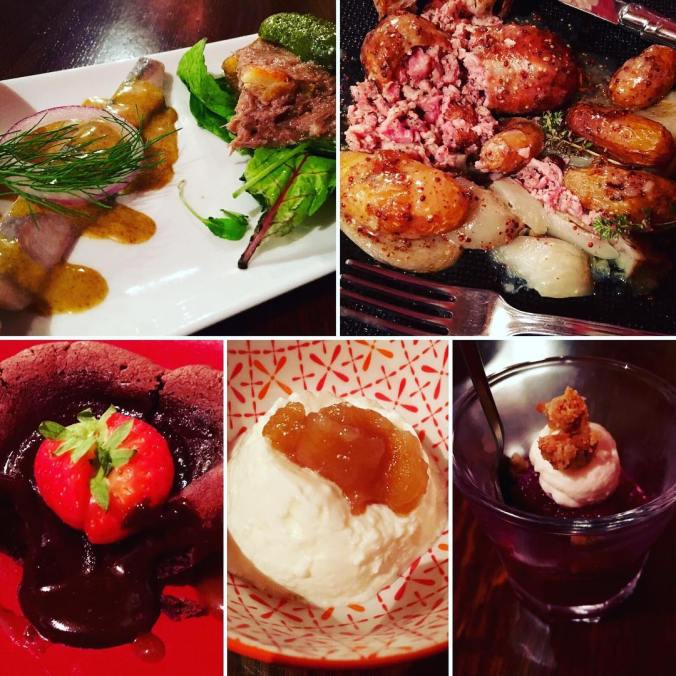
I spent the remainder of the afternoon walking around even more and covered a lot of ground. I eventually made my way to the Le Bouchon des Filles, which was my dinner destination. Lyon is famous for its food (even in a country already famous for its food), and bouchons are its claim to fame. They specialize in what might be categorized as “country” fare, made with simple ingredients that often include parts of the animal that many might prefer not to have identified. I had heard from multiple sources that Le Bouchon des Filles was one of the best, so I made sure I was there when they opened in order to get a table. What a spread and what a value: I paid a total of 26 euros for a starter of smoked flounder and chilled beef tenderloin, a beetroot amouse-bouche, a main of andouillette (sausage featuring that meat you don’t want identified), and a dessert of fromage blanc with pear compote and a gooey chocolate cake with salted caramel. It was INCREDIBLE. And although I felt a bit awkward eating in the restaurant alone (it’s definitely harder inside), I was in good company; another woman came in by herself a few minutes after me and was seated near me. (I was tempted to ask her to join me but couldn’t quite work up the nerve – partially because I couldn’t tell if she was French or something else.)
14063624_1613236568975014_2028644138_n1

On Monday, I visited the Musée des Beaux-Arts, which was huge and had plenty of items to help me pass the time – I didn’t see everything. When I was ready for lunch, I returned to a place I’d passed the day before that looked great and specialized in tartines. It had been very crowded on Sunday and was no different on Monday, but I had nothing else to do and was willing to wait. I had a heartwarming conversation with a waiter:

Waiter: Can I help you, mademoiselle?

Me: Do you have a table available for one person? I’m alone.

Waiter: You are not alone, mademoiselle! I am here with you, and I will take care of you!

And sure enough, the kind older man had me seated at a table (sadly, not in his own section) less than five minutes later. (A linguistic note: in French, the word “seule” means both “alone” and “lonely” – at least in Spanish, where those two words are “sola” and “sóla”, you have the accent to differentiate! This is not the first conversation I’ve had where I haven’t been entirely confident that my use of the word “seule” was taken as “alone” rather than “lonely”.)
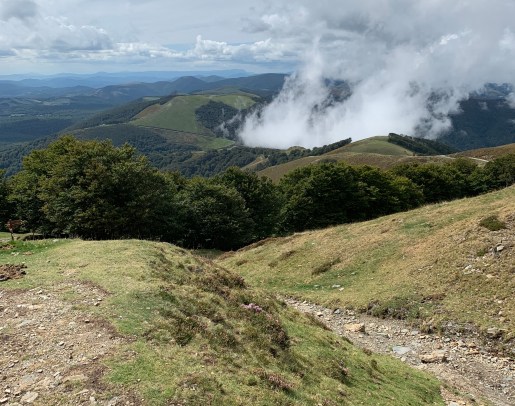
At any rate, I had a delicious tartine featuring three different kinds of cheese. It was a grilled cheese sandwich the likes of which I could never dream of in the US…
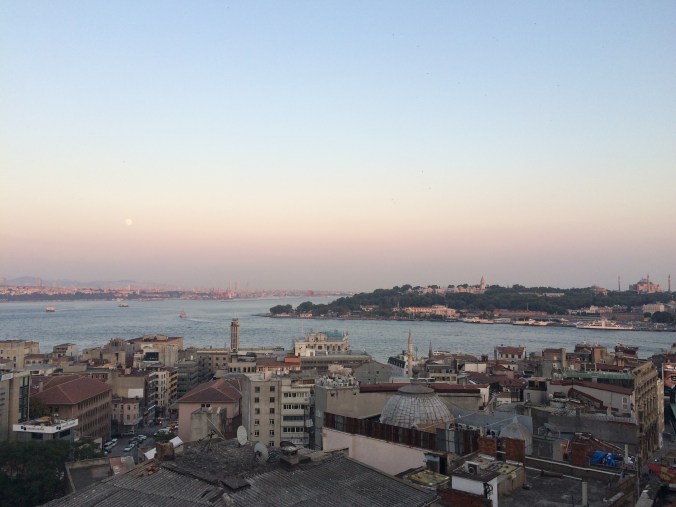
My last meal in Lyon was my most anticipated as I’d managed to get a restaurant at a relatively famous restaurant: Le Sud, one of four restaurants in a chain (each named after a direction – there is also Le Nord, L’Ouest, and L’Est) owned by a famous chef. Fortunately for me, I was able to sit outside, and I ended up not touching the Kindle on which I’d expected to rely. I had a prime view of not only the passersby (and we were just off a huge square, so there were plenty) but also a gorgeous sunset taking place behind a church. The meal itself was lovely; my favorite course was the dessert, for which I allowed myself the indulgence of waffles with a variety of homemade sauces and compotes.

I had more reason to feel isolated in Lyon than in Bilbao. Because I was there on Sunday and Monday, none of the bars I would otherwise have visited were open, so my only nighttime activities were eating dinner and walking around; there wasn’t really an opportunity to meet other people. I did dabble in Tinder again but didn’t get as far as I had in Bilbao. So essentially, I spent about 48 hours not only by myself but also without really talking to anyone except waiters. But that was okay too; as I discussed earlier, one of the tricks of solo travel is to just incorporate something from your usual routine. I usually FaceTime with Mary on Sundays, so that’s what I did on Sunday night there after I returned from my dinner at Le Bouchon des Filles. I also watched a little Netflix (again, the French library is superior!) and did give in to my urge to buy a French book, so I had that to read as well. And despite all of the quiet, I look back on that trip often and fondly.

~~~~

2017 is going to be a big year for me (I am about to move back to Paris!), and I’m not sure what sort of travel it will hold – but I am glad that I pushed myself in 2016 to go on these two trips. Both have made me better prepared for future solo travel, and while I think my preference will always be to travel with someone else, I’m no longer afraid to go by myself and can appreciate certain ways in which it can actually be quite nice to travel solo. I hope others reading this will feel similarly comfortable and will have the courage to go it alone! Travel is too important and too enjoyable to avoid simply because of a lack of partner.