Distance traveled: 13.5 kilometers
I knew we had about 13 kilometers to walk in order to get to Burgos; 13 kilometers is less than half a usual day, so I expected it to feel like an easy morning stroll. Although the walk was totally flat, I found that my anticipation of arriving in Burgos made it feel like a very long walk, and the landscape didn’t help things. The walk into Burgos is, in my opinion, the second worst part of the Camino. There are two routes you can take, and I had been zealously advised as early as day 2, “take the river route!!!!” I was very glad to have Adam and Lou with me to steer us correctly, because I never would have noticed the turn-off for the river route. Regardless of the route, the majority of the walk isn’t very picturesque; we walked around the perimeter of the airport for what seemed like 45 minutes, then through some industrial outskirts. We arrived at the river only when we’d arrived at the city itself, and then, as with many other destinations thus far, it took us quite a while longer to actually get to where we were going. I found myself getting grumpier by the moment. Finally, we made it to the city center, and we stopped for a snack and a coffee before continuing on.
At this point I was with Adam, Lou, Chuck, and Kim. Our friend Bill had gone ahead of us two days before and had arrived in Burgos the day before. Lou wanted to catch up to Bill and ended up walking another full day’s walk this same day in order to reach him; Adam, Chuck, and Kim were planning to take a day off in Burgos. Since I planned to continue on the next day, the five of us said good-bye. It was a surreal moment, after having spent so much time together!
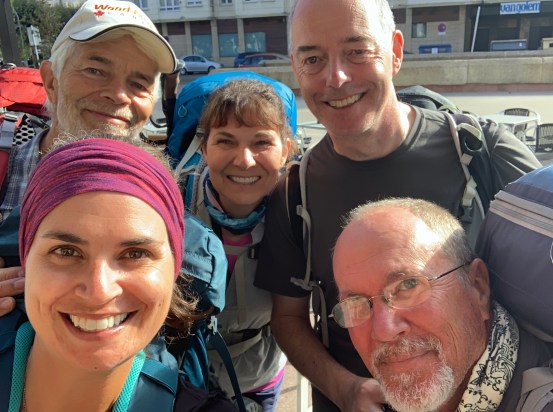
By this point, we had already created a WhatsApp group, so I knew I’d continue to be in touch with everyone even if we didn’t necessarily find each other again soon on the trail. It felt sad to be going our separate ways, but I also felt it was time for me to spread my wings a bit.
I checked into my hotel, where I was upgraded to a nicer room, and left again pretty quickly in order to tackle some errands. Burgos was the first big city we’d encountered, so there was a lot I wanted to get done. I started by finding a laundromat and taking everything except what I was wearing for a proper wash and dry. After that, I went straight to the Sephora that coincidentally happened to be on the same block as my hotel, and I treated myself to face, hand, and foot masks as well as a bath bomb. (My hotel room had a bathtub, and I took two baths during the 19 hours I was there!) Finally, I went in search of a new pair of walking shoes. I found a small outdoor store and, somewhat riskily, bought the first pair of shoes that the sales woman presented to me. Technically, the shoes are trail running shoes; that essentially means they look like regular running shoes with an extra complex tread. I was wary of the trial by fire involved in wearing a brand new pair of shoes for a full day of hiking, but I didn’t want to do the whole rest of the Camino in my Tevas!
Next, I decided I was overdue for a drink, so I headed off in the direction of the cathedral and ducked into a bar off the main plaza, where I got a vermouth and some tapas. Vermouth is one of the best things about northern Spain, and I drank it often on the Camino. (You’re probably thinking about the clear vermouth that’s used in martinis; as you can see from my picture below, I’m talking about red vermouth, which you drink straight, usually with a couple of olives and/or some orange peel, as here. It’s delightful.)
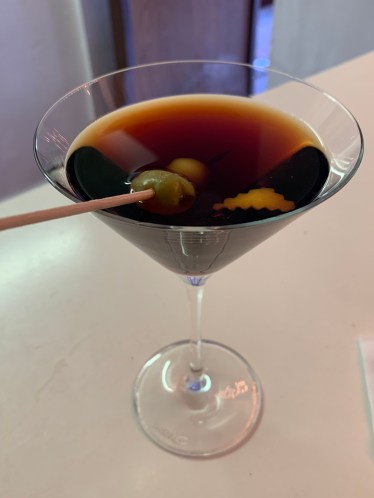

“Happiness is finding two olives in your vermouth when you’re hungry.”
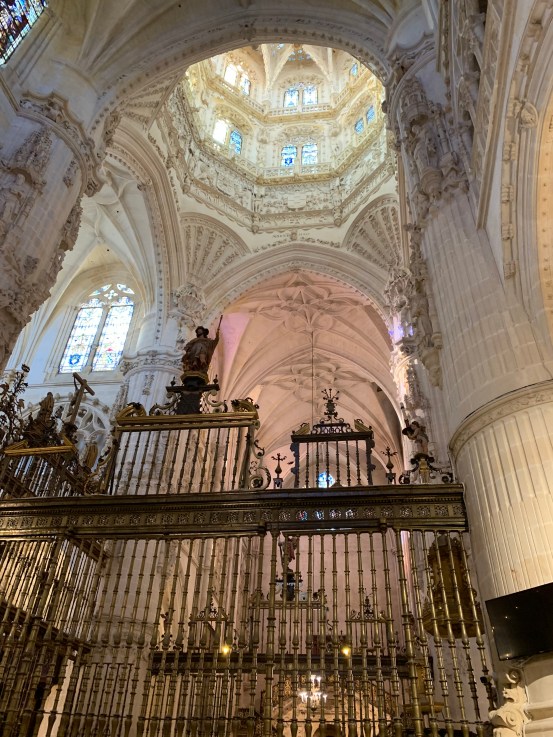
Now, Burgos is very famous for its grand cathedral, and the Camino path (still marked within the city) leads you straight to it. I have to confess that I wasn’t willing to spend my precious free afternoon exploring the cathedral, so I only went inside as far as the ticket check point. It was really beautiful, and I do regret not doing the full tour, but I’ve rationalized it as giving me a reason to do the Camino again. I’m sure Google can supply you with plenty of pictures!
I spent the rest of the day in my spacious hotel room, happy to be by myself in a quiet space. I watched a Pedro Almodóvar film on my phone, ate food I’d picked up in a supermarket, took my bath, and applied all of my masks. It was a real treat.
So, 14 days into the Camino, I’ve now traveled 292 kilometers (181 miles), 35% of the way. Here’s where I am (and the heart is Santiago):

I felt so many things: proud of having made it this far, humbled by the Camino’s challenge to my body, grateful for the friends I’d made and experiences I’d had so far, nervous about the new obstacles awaiting me on the Meseta, and excited to keep going. Two weeks seemed like both a very short and a very long time to have been walking. My life in Paris seemed geographically and temporally very far removed from my present situation. My job, which I’d left a bit over three months before, seemed even more distant. I felt like a different person that the one who’d set out from Saint Jean, yet I also felt more truly myself than I had in a long time.
The stretch of the Camino from Saint Jean to Burgos is the “hell” part of the journey. It’s the most physically grueling, not necessarily because it’s the most difficult terrain (there are two more notably challenging climbs and descents coming up) but because your body is adjusting the whole experience. However, it’s this difficulty that brings people together. The sense of community among pilgrims was, to me, markedly stronger during these first two weeks. Everyone was in it together and in need of support. I can’t convey adequately here just how powerful and special that is; you just have to experience it for yourself. In the separate guide to the Camino that I’ve written, I address your options if you don’t have time to do the entire journey in one go, and I recommend that if you can only do one section of the Camino, you should start with this one. Yes, it’s harder, but your interactions with other pilgrims will make it more meaningful. Also, the food is better in the first third of the Camino than anywhere else until you get to Santiago!
The next portion of the Camino is the Meseta. The vast majority of pilgrims really dislike the Meseta; only my friend Lou had positive things to say about it. The reason for this disapprobation stems principally from the fact that the Meseta is, well, boring. The landscape is largely flat and open, so it can be a bit monotonous. I was warned that many pilgrims find the lack of visual distraction difficult to bear because of its impact on their thoughts. Without more to keep your eyes busy, your mind is naturally going to find new ways to keep itself occupied, and many people find that this isolation with their thoughts leads to some discomforting reflections and realizations. In particular, I’d heard that people often end up ruminating on their regrets.
I wasn’t sure how any of this would impact me, but I felt ready to face it. Now that I’d survived blisters and tendinitis, I felt relatively unstoppable. I had gotten into the swing of the pilgrimage and looked forward to leaning in to what it would bring me next.
 Travel With Wergs